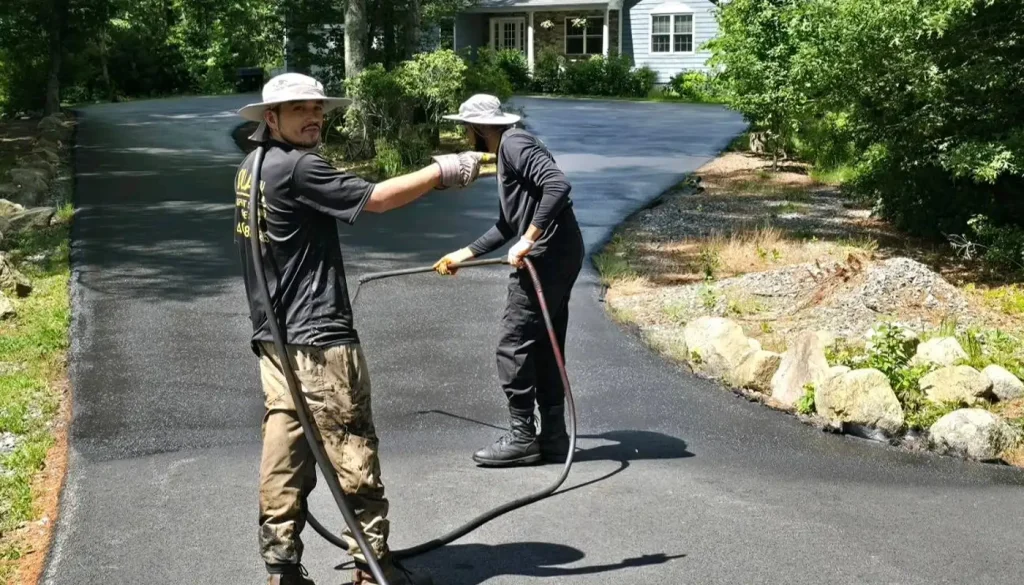
Stripping vs. Striping: What’s the Real Difference?
When you hear the words stripping or striping, it’s easy to think they might mean the same thing, or at least be closely related. However, these two terms describe very different actions. They often sound similar, but their meanings are poles apart, especially in property and pavement maintenance.
Here’s the quick answer:
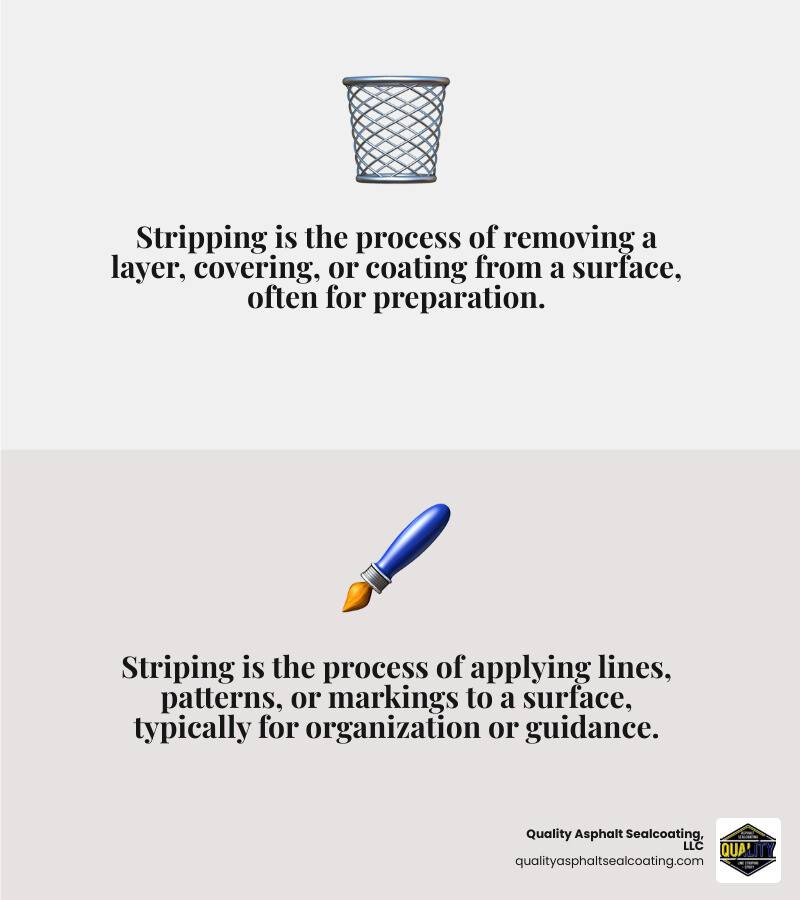
- Stripping means removing a layer or coating from a surface.
- Striping means applying lines or patterns to a surface.
For property owners, understanding this key difference is vital. It ensures you request the correct service, avoid costly mistakes, and keep your asphalt surfaces safe and well-maintained. Getting it right impacts everything from your parking lot’s appearance to its long-term durability.
What is ‘Stripping’? The Act of Removing a Layer
Imagine you’re preparing for a fresh start. Whether it’s a piece of furniture, an old wall, or even an entire pavement, sometimes you need to get rid of what’s there before you can build something new. That’s where stripping comes in. At its core, stripping is the process of removing a covering, coating, or layer from a surface. It’s an action of taking away, clearing, or preparing by making bare.
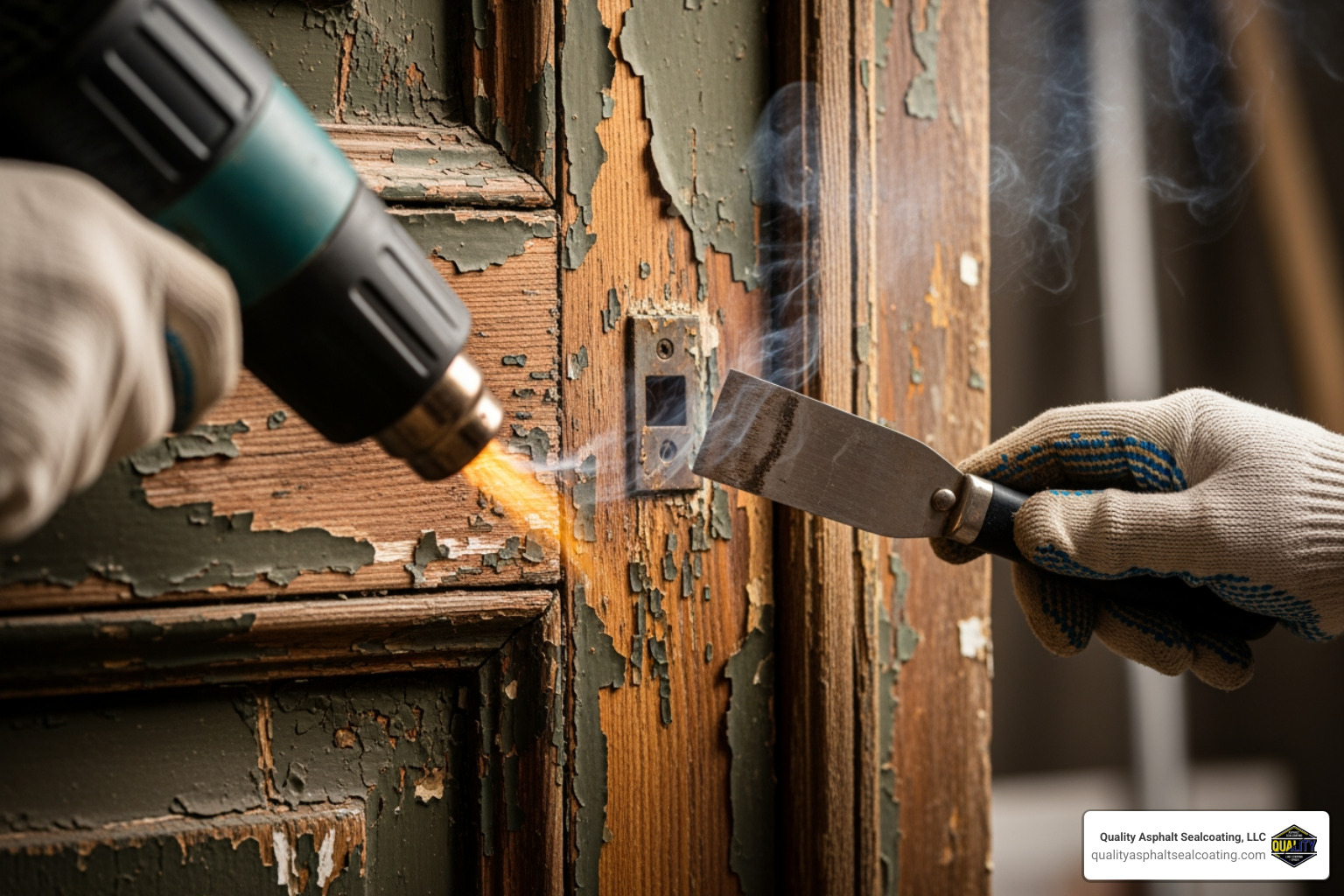
This removal can be physical, chemical, or even metaphorical. Think of it as hitting the “reset” button on a surface, getting it ready for the next phase. This often involves preparation and surface clearing, aiming to leave a clean, underlying material ready for treatment or renewal.
Common Meanings and Contexts
The term stripping is incredibly versatile and appears across a wide array of industries and everyday situations, always carrying the connotation of removal:
- Construction and Home Renovation: This is perhaps one of the most common contexts. When we talk about stripping in this field, we mean removing old paint, wallpaper, varnish, flooring, or even damaged siding and roofing materials. It’s a crucial first step for many renovation projects, ensuring a smooth and lasting finish for new applications. For example, rather than simply painting over old, peeling walls, many homeowners opt for stripping them entirely clean before replastering or repainting.
- Automotive Work: Mechanics and car enthusiasts are familiar with stripping a car. This could involve stripping car interiors, engine parts for cleaning or repair, old decals, or corroded components during restoration. It’s essential for getting down to the bare metal or core components.
- Electrical Work: Proper wire stripping is fundamental for making safe and effective electrical connections. Electricians carefully remove the insulation or cable sheathing to expose the conductive wires.
- Metalworking and Manufacturing: In industrial settings, stripping is used to remove plating, rust, powder coatings, heat treatments, or industrial films from metal surfaces. This prepares the material for further processing or for a new protective layer.
- Digital and Software Fields: Even in the digital world, stripping has a place. It can refer to removing metadata, formatting, excess file elements, or unnecessary code from a digital file to streamline it or protect privacy.
- Legal and Administrative Usage: Here, the term takes on a more abstract meaning. Someone might be metaphorically stripped of authority, a project of its funding, or a company of its license as a form of punishment or consequence. Similarly, “asset-stripping” refers to buying a company and selling off its valuable assets.
- Pavement Maintenance (The Bad Kind): In our field, Quality Asphalt Sealcoating, LLC, stripping can refer to a serious pavement issue. Asphalt stripping is a form of pavement failure where the asphalt binder separates from the aggregate. This isn’t something you want; it’s a structural problem that can cause major issues for the entire pavement layer by reflecting cracks to the surface or causing large areas to break quickly. It’s essentially the pavement “removing” its own integrity.
To dig deeper into the multifaceted meanings of this word, you can check out The American Heritage Dictionary entry: stripping.
Examples of ‘Stripping’ in a Sentence
To make it perfectly clear, here are some sentences demonstrating the correct use of stripping:
- “The crew spent all day stripping the old varnish from the wooden deck chairs, preparing them for a fresh coat of sealant.”
- “Rather than just painting over it, we recommend stripping the wallpaper completely for a truly smooth finish.”
- “During the engine rebuild, the mechanic was careful when stripping the components, ensuring everything was clean before reassembly.”
- “The city council considered stripping the contractor of their license due to repeated safety violations on the job site.”
- “After a long day, she enjoyed stripping the bed of its linens, ready for fresh sheets.”
- “Unfortunately, our parking lot showed signs of asphalt stripping, where the aggregate was separating from the binder, requiring immediate attention.”
What is ‘Striping’? The Act of Adding Lines
Now, let’s turn our attention to striping. While stripping is about taking away, striping is all about adding. When we talk about striping, we’re referring to the act or process of applying lines, patterns, or markings onto a surface. It’s about creating order, guiding movement, enhancing safety, or simply adding a decorative element.

Think of the crisp, clear lines that guide you in a parking lot or on a road. That’s striping at work! It’s a precise application that defines spaces, directs traffic, and communicates important information without a single word.
Common Meanings and Contexts
Striping is a crucial element in many environments, particularly where organization and safety are paramount:
- Road Construction and Maintenance: This is a primary field for striping. State highway departments regularly engage in striping to mark traffic lanes, centerlines, turn arrows, symbols, and crosswalks. These markings are vital for traffic management and driver safety.
- Parking Lot Maintenance: For businesses and property managers in Rhode Island, professional parking lot striping is indispensable. It defines parking spaces, accessible spots (crucial for ADA compliance), directional arrows, and fire lanes. A well-striped parking lot not only looks professional but also significantly improves safety and traffic flow. This is a core service we provide at Quality Asphalt Sealcoating, LLC, ensuring your lot is clear, safe, and compliant. You can learn more about our services, including Commercial Parking Lot Sealcoating.
- Airport Runways: The intricate network of lines and symbols on airport runways and taxiways is a critical application of striping, guiding aircraft safely during take-off, landing, and ground movement.
- Sports Fields: Without striping, organized sports would be chaos! From football yard lines to baseball foul lines, soccer pitch boundaries, and track lanes, striping defines the playing area and is essential for fair play.
- Graphic Design and Textiles: Striping can also be an aesthetic element. In graphic design, stripe patterns are used for website backgrounds, branding, and logos. In textiles and apparel, striping refers to creating line patterns through dyeing, printing, or weaving, resulting in classic designs like pinstripes or rugby stripes.
The first known use of ‘striping’ as a term for marking with stripes dates back to 1677, highlighting its long history in defining visual order. For a detailed linguistic definition, refer to the Definition of STRIPING.
Examples of ‘Striping’ in a Sentence
Here are some clear examples of how to use striping correctly in sentences:
- “Our team specializes in precision striping for commercial parking lots, ensuring optimal traffic flow and safety for your customers in Rhode Island.”
- “The city workers were busy with road striping, refreshing the faded lines on the busy intersection to guide drivers more clearly.”
- “The zebra’s distinctive black and white striping is a natural camouflage in its habitat.”
- “Before the big game, the grounds crew carefully applied the new striping to the soccer field, making sure every line was perfectly straight.”
- “Thermoplastic striping was chosen for the highway project due to its superior longevity, strength, and nighttime reflectivity, making it a wise investment for high-traffic areas.”
- “For a well-maintained property, professional parking lot striping is a low-cost investment that yields a high return in terms of safety and curb appeal.”
- “You can find more information about our professional striping services, including Line Striping & Pothole Repair, on our website.”
The Core Differences: Stripping or Striping
So, we’ve established that stripping is about taking away, and striping is about adding. But let’s dig a little deeper into the fundamental differences, especially when it comes to their grammar, spelling, and pronunciation. These nuances are often where the confusion truly lies.
| Feature | Stripping | Striping |
|---|---|---|
| Action | Removing a layer, coating, or object | Adding lines, patterns, or markings |
| Root Word | Strip (verb: to remove) | Stripe (verb: to mark with lines) |
| Spelling Rule | Double ‘p’ before -ing (short ‘i’ sound) | Single ‘p’ before -ing (long ‘i’ sound) |
| Pronunciation | Short ‘i’ sound (like “trip”): /ˈstrɪp.ɪŋ/ | Long ‘i’ sound (like “type”): /ˈstraɪ.pɪŋ/ |
| Primary Goal | Preparation, cleaning, making bare | Organization, safety, guidance, aesthetics |
This table clearly illustrates the distinct paths these two words take, even though they sound so similar.
The Grammar and Spelling Rule Explained
The difference in spelling between “stripping” (with two ‘p’s) and “striping” (with one ‘p’) is a classic example of English phonics at play, specifically the rules of consonant doubling when adding suffixes like “-ing” or “-ed.”
The root verb for stripping is “strip.” The ‘i’ in “strip” has a short vowel sound, like the ‘i’ in “sit” or “trip.” When you add a vowel suffix (like -ing or -ed) to a single-syllable verb that ends with a single consonant preceded by a single short vowel, you double the final consonant. Hence: strip -> stripping, stripped. The first known use of ‘strip’ (as a verb meaning to remove covering) was also in 1677, aligning with ‘striping’ in terms of historical usage, which can add to the confusion!
On the other hand, the root verb for striping is “stripe.” The ‘i’ in “stripe” has a long vowel sound, like the ‘i’ in “light” or “type.” This long ‘i’ sound is typically indicated by the silent ‘e’ at the end of the word. When you add a vowel suffix to a verb ending in a silent ‘e’, you usually drop the ‘e’ but do not double the consonant. Hence: stripe -> striping, striped.
To hear the difference, consider the pronunciation:
- Stripping: Pronounced with a short ‘i’ sound, like “stryp-ing” (IPA: /ˈstrɪp.ɪŋ/).
- Striping: Pronounced with a long ‘i’ sound, like “stry-ping” (IPA: /ˈstraɪ.pɪŋ/).
This grammatical rule is a fantastic way to tell these two words apart just by looking at them. For more on this, you can check out How to Use Striped/striping vs stripped/stripping Correctly.
As for their grammatical functions, both stripping and striping can serve multiple roles:
- Present Participle: They can be part of a continuous verb tense (e.g., “We are stripping the paint,” “They were striping the parking lot”).
- Gerund: They can function as nouns (e.g., “Stripping old paint is hard work,” “The quality of the striping was excellent”).
- Adjective: They can describe a noun (e.g., “a stripping solvent,” “a striping machine”).
A Simple Memory Trick to Avoid Confusion
We understand that remembering these rules on the fly can be tricky, especially when you’re busy managing a property or a project. So, here’s a simple memory trick we like to use to keep stripping or striping straight:
The ‘P’ Pattern Trick:
- One P for Pattern (Striping): Think of striping as adding a pattern of lines. The word “striping” has only one ‘p’, just like a single, clean line that defines a pattern.
- Two P’s for Pulling Off (Stripping): Think of stripping as pulling off or removing something. The word “stripping” has two ‘p’s, suggesting more effort, like you’re really pulling something away.
Another way to remember it is: Removing something (stripping) takes more effort and typically involves more “stuff” being taken away, so it gets more letters (two ‘p’s). Adding lines (striping) is often a cleaner, more precise application, so it has fewer letters (one ‘p’).
If you’re ever in doubt, just ask yourself: Am I adding something, or am I removing something? If you’re adding lines, it’s striping. If you’re removing a layer, it’s stripping.
The Real-World Impact of Confusing the Terms
While a simple spelling or pronunciation error might seem minor, confusing stripping or striping in professional contexts can lead to significant problems. From miscommunication in construction to safety hazards in pavement maintenance, the implications can be far-reaching and costly.
Common misconceptions arise because the words sound so similar, but their actions are diametrically opposed. Imagine the chaos if a contractor misunderstood a request to “stripe the highway” as an instruction to “strip the highway”—they might start preparing to remove asphalt instead of applying new lines! This isn’t just a hypothetical; in a real transportation project in Arizona, a misread instruction delayed a highway opening because the crew began preparing for material removal instead of line application. Similarly, a homeowner asking a painter to “stripe the wall” when they meant “strip the old wallpaper” could lead to delays as the painter plans a decorative accent rather than prep work. Or a graphic designer being told to “strip the logo” when the client wanted “striping” (adding clean linear accents) could lead to multiple wasted revision cycles.
The Critical Distinction in Pavement Maintenance
For us at Quality Asphalt Sealcoating, LLC, and for any property owner in Rhode Island, this distinction is particularly critical when it comes to pavement maintenance.
- Asphalt Stripping (Pavement Failure): This is a problem, not a service. Asphalt stripping refers to a severe form of pavement deterioration where the asphalt binder loses its adhesion to the aggregate (the stones and sand within the asphalt mix). This separation is often caused by water penetrating the pavement, leading to a loss of structural integrity. It’s like the pavement is coming apart from the inside out. This kind of stripping can cause major problems for the entire pavement layer, leading to cracking, potholes, and a significantly shortened lifespan for your asphalt. It requires professional assessment and often extensive repair to eliminate the moisture penetration and restore the pavement’s strength.
- Line Striping (Pavement Marking): This is a vital service that improves safety, organization, and aesthetics. Line striping involves applying durable, visible markings to asphalt surfaces to define parking spaces, traffic lanes, pedestrian walkways, and accessible routes. It’s a proactive measure that prevents accidents, improves traffic flow, and ensures compliance with regulations like the Americans with Disabilities Act (ADA).
Requesting the wrong service due to confusing these terms could have disastrous consequences. If you ask for “stripping” when you need “striping,” you might find a crew preparing to remove parts of your asphalt instead of painting crisp new lines! Conversely, if you ignore signs of asphalt stripping because you think it’s just a cosmetic issue, you could be facing much more expensive repairs down the line. Our Services cover both the prevention of pavement deterioration and the application of high-quality line striping.
Why Precise Language Matters for Your Property
Using precise language isn’t just about sounding smart; it’s about practical results and protecting your investment.
- Ensuring Clear Instructions: When you communicate with a service provider, clear and unambiguous instructions are paramount. Using the correct term for stripping or striping ensures that the work performed aligns exactly with your expectations and needs.
- Avoiding Costly Mistakes: Misunderstandings can lead to rework, wasted materials, and unexpected expenses. A simple linguistic error could translate into significant financial setbacks and project delays.
- Professional Communication: Clarity in communication fosters trust and efficiency. When we understand exactly what you need, we can provide the most accurate quotes and deliver the highest quality service.
- Project Efficiency: Precise language streamlines project planning and execution, minimizing confusion and maximizing productivity. This means your project gets completed on time and within budget.
Understanding the subtle yet crucial difference between stripping and striping empowers you as a property owner. It helps you make informed decisions, communicate effectively with professionals, and ensure your property receives the exact care it needs. For more insights on the value of clear markings, read our article, Re-Striping Your Parking Lot: More Than Just Paint.
Frequently Asked Questions about Stripping or Striping
We often encounter questions about these two tricky terms. Here are some of the most common ones we hear, along with our expert answers.
What is the fundamental difference between stripping and striping?
The fundamental difference is in the action they describe. Stripping refers to the process of removing a layer, coating, or covering from a surface to make it bare or clean. Think of taking something away. Striping, on the other hand, is the process of applying lines, patterns, or markings to a surface, often for organization, guidance, or aesthetic purposes. Think of adding something on.
Is asphalt stripping a good thing?
Absolutely not! Asphalt stripping is definitely not a good thing. In the context of pavement, asphalt stripping is a significant form of pavement failure. It occurs when the asphalt binder (the glue) separates from the aggregate (the stones and sand) within the pavement mix, usually due to water damage. This leads to a loss of structural integrity, causing cracks, potholes, and overall deterioration of the pavement. It’s a problem that needs to be addressed quickly to prevent further damage and costly repairs. It’s completely different from line striping, which is a beneficial service for marking your pavement.
How much does parking lot striping cost?
The cost of parking lot striping can vary depending on several factors, such as the size and complexity of the lot, the type of paint or material used, and the existing condition of the pavement. Generally, basic paint striping can cost approximately $0.05 to $0.20 per linear foot, while more durable options like thermoplastic striping might range from $0.50 to $1.50 per linear foot.
While these costs represent an investment, professional parking lot striping is considered a low-cost maintenance item with a very high return. It significantly improves safety by guiding traffic and pedestrians, improves efficiency by clearly defining spaces, boosts your property’s curb appeal, and ensures ADA compliance. Thermoplastic striping, for example, is chosen over normal paint for its superior longevity, strength, and nighttime reflectivity, making it a valuable option for high-traffic areas. Parking lot striping costs approximately $300 to $500 per lot, depending on the size and complexity, but this is a general estimate and can vary. Investing in quality striping ultimately saves money by preventing accidents and creating a more professional appearance for your business.
Conclusion: Getting Your Lines Straight for a Perfect Finish
We’ve journeyed through the intricacies of stripping or striping, uncovering their distinct meanings, grammatical rules, and real-world implications. It’s clear that while these two words may sound alike, their actions are fundamentally different: stripping is about removing, making bare, and preparing, while striping is about adding lines, organizing, and guiding.
Understanding this crucial distinction is more than just a grammar lesson; it’s a practical necessity, especially for property owners. Misinterpreting these terms can lead to frustrating miscommunications, project delays, unexpected costs, and even safety hazards, particularly in vital areas like pavement maintenance. By remembering our simple ‘P’ Pattern Trick—one ‘p’ for striping (adding a pattern), two ‘p’s for stripping (pulling off a layer)—you can confidently use the correct term every time.
At Quality Asphalt Sealcoating, LLC, we pride ourselves on clear communication and precision in our work. We understand the difference, and we ensure your project gets the exact care it needs. For professional and accurate Line Striping & Pothole Repair Services in Rhode Island, trust the experts to get it right the first time. Let us help you get your lines straight for a perfect finish that improves the safety, functionality, and appearance of your asphalt surfaces.