Why Line Striping Matters for Safety and Property Value
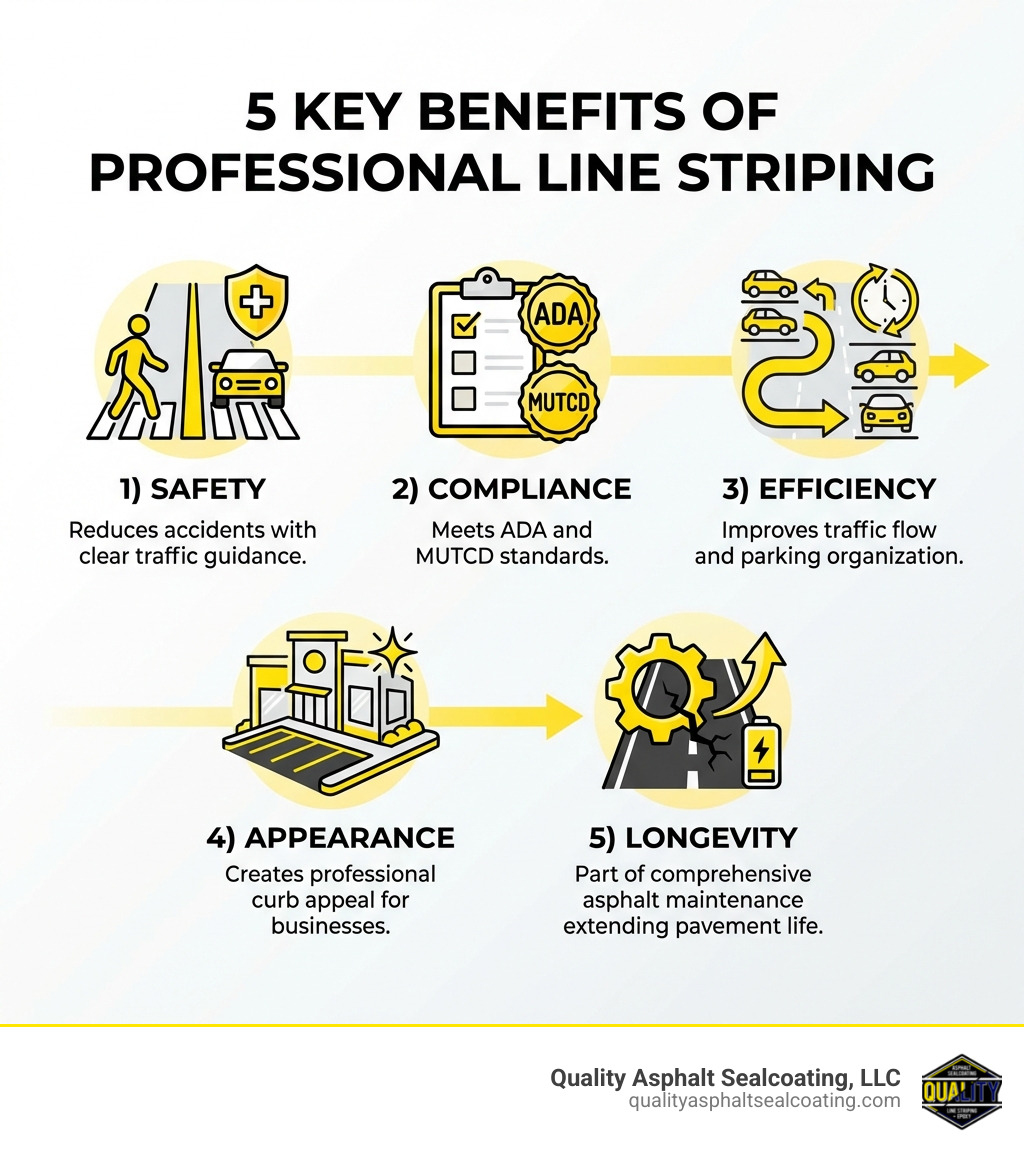
Line striping is the practice of painting lines and markings on asphalt or concrete surfaces to guide traffic, designate parking spaces, and ensure safety. Whether you’re managing a commercial parking lot or maintaining a residential driveway, professional line striping provides:
- Improved safety – Clear markings reduce accidents by guiding drivers and pedestrians
- Regulatory compliance – Meet ADA requirements and local traffic standards
- Improved traffic flow – Organized layouts reduce congestion and confusion
- Professional appearance – Crisp, clean lines signal a well-maintained property
- Extended pavement life – Part of a comprehensive maintenance program
The workplace hustle and bustle in commercial, industrial and institutional operations creates a significant amount of traffic from both vehicles and pedestrians. Without clear markings, the liability for a company in case of an accident on an unmarked floor or lot can be tremendous.
Professional striping isn’t just about aesthetics. Lines on parking lots and roadways serve critical functions: they let people and machinery know where to go and where not to go, they designate where vehicles belong, and they guide you to safety in the event of an emergency.
Most importantly, well-maintained line striping keeps people safe. According to county pavement marking programs, properly applied markings with reflective beads provide visibility during evening hours and inclement weather, dramatically improving safety outcomes.
Whether you’re restriping a faded parking lot, creating new traffic lanes, or ensuring your property meets current accessibility standards, understanding the professional line striping process helps you make informed decisions about this essential maintenance task.
Understanding Pavement Markings: The Language of the Road
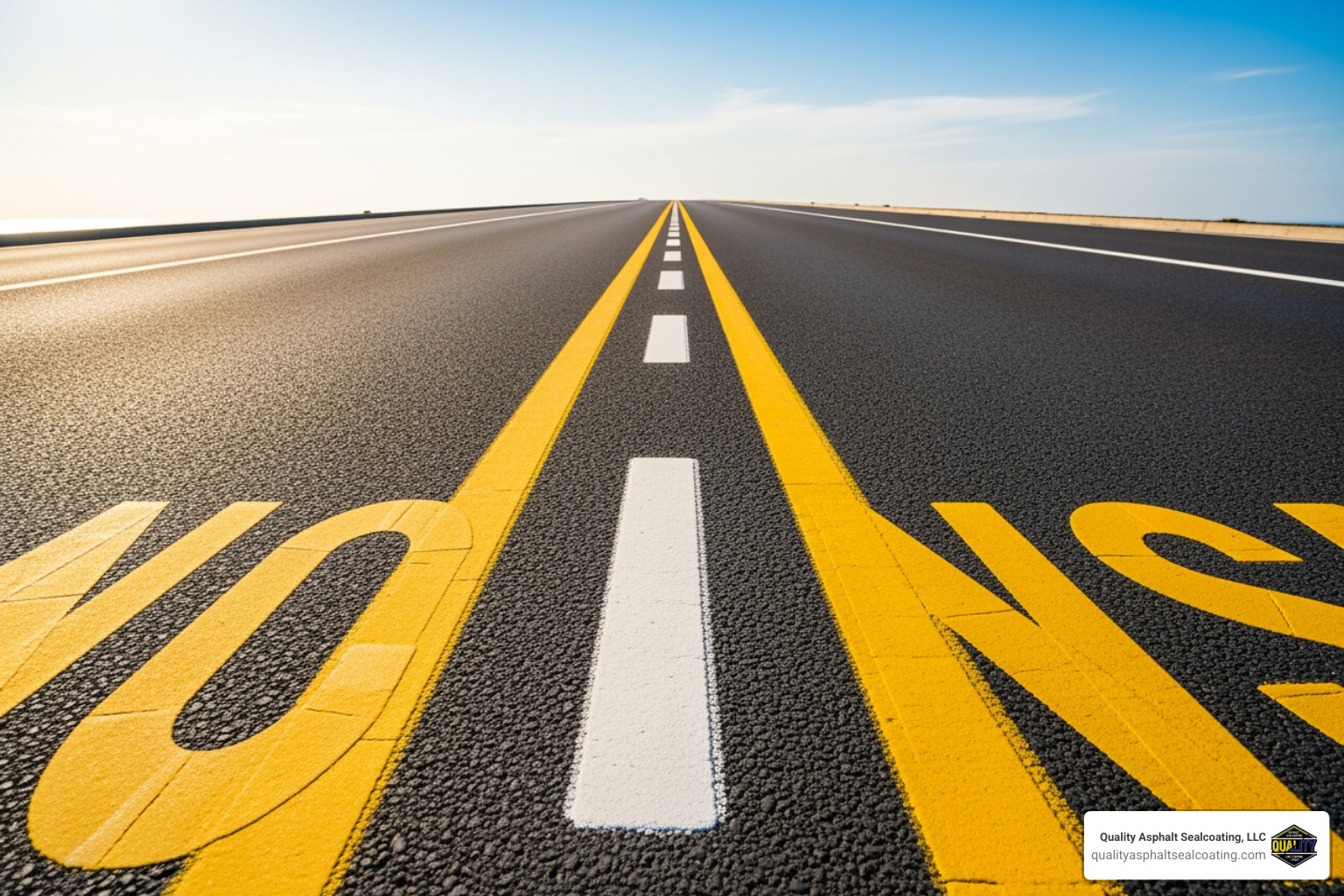
Pavement striping is more than just painting lines; it’s about creating a visual language that directs, informs, and protects. From busy commercial parking lots to quiet residential streets here in Rhode Island, these markings are essential for maintaining order and preventing accidents. The purpose of pavement striping is fundamental: to guide drivers and pedestrians safely, delineate parking spaces, and enforce traffic regulations.
We use various types of pavement markings, each with a specific purpose:
- Centerlines: These separate traffic flowing in opposite directions. They can be solid (no passing) or dashed (passing permitted).
- Edge Lines: Found at the outer limits of the travel lane, edge lines define the road’s shoulder or the edge of the pavement. They are particularly vital on roads prone to flooding, significantly improving driver safety during inclement weather.
- Crosswalks: Clearly marking pedestrian crossing areas, these are crucial for pedestrian safety.
- Stop Bars: These lines indicate where vehicles must stop at intersections or before crosswalks.
- Parking Stalls: Perhaps the most familiar, these lines delineate individual parking spaces, maximizing lot capacity and preventing chaotic parking.
The colors of these lines also carry universal meanings:
- Yellow Lines: These are primarily used for medians, passing zones, and to separate traffic flowing in opposite directions.
- White Lines: These indicate traffic moving in the same direction, delineate shoulders, mark the edge of the pavement, define channelizing islands where traffic passes on both sides, and outline stop bars, bicycle lanes, and crosswalks.
- Blue Lines: While less common for general traffic flow, blue lines are universally recognized for marking handicapped parking spaces and access aisles, ensuring ADA compliance.
The importance of clear and well-maintained pavement markings cannot be overstated. They are considered traffic control devices, guiding and regulating traffic flow. This safety line painting directly contributes to risk reduction and compliance with accessibility standards, ensuring our communities are safer for everyone.
Traffic Calming Measures through Striping
Beyond basic guidance, line striping can also be an effective traffic calming measure, especially on residential streets. While many local neighborhood streets exist without any traffic striping, the strategic placement of centerlines, edge lines, and lane lines can influence driver behavior. For instance, reducing travel lane widths through striping can make drivers feel more restricted, encouraging them to lower their speeds.
Sometimes, a better treatment may be to provide edge lines with no centerline. This indicates to drivers that they must share the two-way space with all traffic, often leading to more cautious driving. Conversely, some citizens perceive that pavement markings detract from the attractiveness of their neighborhood and encourage speeding, highlighting the need for careful planning and community input when implementing such measures. However, when applied correctly, line striping offers a relatively easy and low-cost method to manage traffic and improve safety.
Want to learn more about how we can improve your property’s safety and functionality? Check out More info about our services.
The Role of MUTCD in Ensuring Uniformity
The rules and guidelines for pavement markings aren’t arbitrary; they are governed by comprehensive standards to ensure consistency and safety across all roadways. The Manual on Uniform Traffic Control Devices (MUTCD), a federal document, sets these specifications. While it’s a federal standard, states like Rhode Island adopt and often supplement these guidelines to fit local needs.
The MUTCD ensures uniformity in traffic control devices, including pavement markings, which are crucial for driver predictability and safety. It outlines specific criteria for when certain markings should be used, often based on factors like Average Daily Traffic (ADT) and roadway width.
For example, MUTCD specifications detail when centerlines are mandatory or recommended:
- Urban Arterials and Collectors: Centerline markings should be placed on paved urban arterial and collectors that have a a traveled width of 20 feet or more and an ADT of 6,000 vehicles per day or greater.
- Multi-lane Streets: Centerline markings are also required on all paved two-way streets or highways having three or more traffic lanes.
- Rural Arterials and Collectors: For rural roads, centerlines are recommended on those with a traveled width of 20 feet or more and an ADT of 4,000 vehicles per day or greater, or a travel width of 18 feet or more and an ADT of 3,000 vehicles per day or greater.
Conversely, centerlines are generally discouraged on low volume residential streets, especially if the portion of roadway on which a center line is proposed carries below 600 vehicles per day. This is often due to the perception that such markings can encourage speeding or detract from neighborhood aesthetics.
Adhering to MUTCD specifications is not just about compliance; it’s about employing best practices that have been proven to improve safety and efficiency on our roads. For detailed information, you can always refer to the Official MUTCD guidelines.
A Guide to Line Striping Materials and Methods

When it comes to professional line striping, the choice of materials is as important as the application itself. We use high-quality paints designed for durability and visibility, ensuring that your markings stand the test of time and Rhode Island’s diverse weather conditions. Understanding the different types of pavement striping paint helps us select the best solution for your specific project.
Different Types of Pavement Striping Paint
- Water-Based Latex Paint: This type of paint is a popular choice for many applications, including parking lots, crosswalks, airports, and even football fields. It’s known for being environmentally friendly, quick-drying, and offering good adhesion to various surfaces. Water-based traffic marking paint is ideal for striping parking lines, numbers, and handicapped stencils. You can find examples like Water-Based Traffic Zone, Football Field Paint.
- Oil-Based Alkyd Paint: Widely used for both restriping projects and new layouts, oil-based alkyd paint offers excellent durability and is often more cost-effective than latex-based options. It provides a robust finish that can withstand moderate traffic and environmental exposure.
- Epoxy-Based Paints: For maximum durability and longevity, epoxy-based paints are a superior choice. They are more durable than oil-based paints, making them ideal for high-traffic areas or industrial settings where markings need to endure constant wear and tear.
Here’s a quick comparison of these paint types:
| Paint Type | Durability | Cost | Application Considerations |
|---|---|---|---|
| Water-Based Latex | Good | Moderate | Environmentally friendly, fast-drying, good for general purpose, often used for fields. |
| Oil-Based Alkyd | Very Good | Moderate | Durable, widely used for roads and parking lots, good balance of cost and performance. |
| Epoxy-Based | Excellent | Higher | Most durable, ideal for heavy traffic and industrial settings, longer cure time. |
Raised Pavement Markers (RPMs)
To further improve visibility, especially during inclement weather or at night, we often incorporate Raised Pavement Markers (RPMs). These small, reflective devices are affixed to the pavement surface to supplement conventional markings. They provide tactile and auditory feedback to drivers when driven over, and their retro-reflective properties make lines significantly more visible in low-light conditions.
In regions like ours, where snow is a factor, Snow-Plowable Raised Pavement Markers (SRPMs) are often used. These markers feature metal rails that protect them from snowplow blades and are typically recessed into the pavement, ensuring they remain effective even after repeated plowing. SRPMs are particularly valuable in high accident locations or areas where geometric conditions require improved traffic marking systems.
Choosing the Right Materials for Your Line Striping Project
Selecting the appropriate materials for your line striping project involves considering the surface type, expected traffic volume, environmental conditions, and desired longevity. Our expertise ensures we choose the best combination for your specific needs.
Reflective Glass Beads
For improved nighttime visibility, reflective glass beads are a game-changer. These tiny beads are embedded into the wet paint during application. They work by reflecting light from vehicle headlights back to the driver, making the lines appear much brighter in the dark. This retro-reflectivity is crucial for safety on roads and in parking lots, especially in Rhode Island’s darker winter months.
The MUTCD mandates specific requirements for these beads, ensuring they meet certain reflectivity standards (e.g., Type 1 Gradation A). We apply them at a precise rate, typically six to eight pounds per gallon of paint, to ensure optimal performance. Specialized equipment like Reflective Bead Dispensers ensures even and efficient distribution.
Industrial and Warehouse Striping
In industrial or commercial facilities, durable warehouse striping is paramount. These environments experience significant traffic from vehicles like forklifts and heavy machinery, as well as pedestrians. Lines on factory floors serve multiple purposes: they guide traffic, designate storage zones, mark safety areas, and improve operational efficiency. The benefits of durable warehouse striping include:
- Improved Safety: Clearly separates pedestrian walkways from forklift lanes, identifies hazard zones, and marks emergency exit paths, contributing to significant risk reduction.
- Improved Organization: Defines storage areas, work cells, and traffic flow, leading to a more efficient and less chaotic environment.
- Compliance: Helps facilities meet OSHA standards and other regulatory requirements for workplace safety.
Choosing the right floor striping paint for industrial facilities means selecting materials that can withstand constant abrasion, spills, and frequent cleaning. High-performance, heavy-duty coatings are often necessary to ensure the lines remain vibrant and intact for extended periods.
The 5S Floor Marking System
For optimal organization and safety in industrial settings, many facilities adopt the 5S floor marking system, where different colors have distinct meanings:
- Yellow: Used for aisle-ways, traffic lanes, and work cells.
- White: Typically marks equipment and fixtures.
- Blue, Green, or Black: Designates materials and components.
- Orange: For materials or products held for inspection.
- Red: Indicates defects, scrap, rework, and “red tag” areas.
- Red and White: Used for areas that must be kept clear for safety or compliance (e.g., electrical panels, fire extinguishers).
- Black and White: For areas to be kept clear for operational purposes.
- Black and Yellow: Signals areas with physical or health hazards.
Striping on Different Types of Surfaces
While our primary focus is on asphalt and concrete surfaces, the principles of line striping apply to various mediums. Asphalt and concrete require specific paint formulations and surface preparation techniques to ensure proper adhesion and longevity. For instance, paint and thermoplastic work best on porous, rougher surfaces where they have something to “grab onto.”
Other surfaces, like wood for decorative purposes or athletic fields for sports, also use striping principles, albeit with different materials and application methods. For example, some DIY enthusiasts learn Tips for striping on wood for home projects, and specialized water-based paints are used for fields. While we specialize in pavement, it’s fascinating to see how the art of the line extends to so many areas!
The Professional Process: A Step-by-Step Guide to Flawless Line Striping
Achieving crisp, consistent, and durable line striping is a meticulous process that begins long before the paint touches the pavement. Our 23+ years of experience have taught us that thorough preparation and precise execution are key to delivering results that last.
Surface Preparation: The Foundation of Quality Striping
The most critical step in any line striping project is surface preparation. Neglecting this stage can lead to premature paint deterioration, poor adhesion, and an unsightly finish.
- Cleaning Debris: We begin by thoroughly cleaning the surface. This involves sweeping away dirt, vegetation, and loose debris. For caked-on grime, especially in areas prone to standing water, we might use a wire brush.
- Power Washing: For a deeper clean, power washing can be effective, removing embedded dirt and grime. However, we always factor in significant drying time, as the surface must be completely dry before paint application.
- Crack Filling: This is arguably the most important maintenance step for prolonging asphalt life. Cracks allow water to penetrate the pavement, leading to freeze-thaw damage, which is particularly relevant in Rhode Island. Filling these cracks prevents further deterioration and provides a smoother surface for striping.
- Sealcoating: Often, line striping is performed after sealcoating. A fresh layer of sealcoat provides a uniform, clean, and ideal surface for paint adhesion, extending the life and vibrancy of the new lines. Our comprehensive approach to asphalt maintenance often includes both sealcoating and striping. This ensures your parking lot looks its best and is protected for years to come. For more on this, check out Re-Striping Your Parking Lot: More Than Just Paint.
Weather Considerations: Timing is Everything
Weather plays a significant role in the application and durability of pavement striping. We carefully monitor conditions to ensure optimal results.
- Ideal Temperature Range: The best weather conditions for applying pavement markings are when temperatures are between 40 and 95 degrees Fahrenheit. Applying paint outside this range can affect its drying time, adhesion, and overall longevity.
- Humidity Impact: Low humidity is ideal, as high humidity can prolong drying times.
- Dry Surface: The surface must be completely dry before application. Any moisture can prevent proper paint adhesion, leading to premature peeling or fading.
- No Rain in Forecast: We always ensure there’s no rain in the forecast for at least 24 hours post-application to allow the paint to cure properly.
Generally, the best time of year for sealcoating and subsequent line striping in Rhode Island is between April and November, when temperatures are consistently within the ideal range.
Traffic Control: Safety During Application
During line striping operations, maintaining traffic flow and ensuring safety for both our crew and the public is paramount. We implement strict traffic control measures:
- Cones, Barrels, and Barricades: These are used to delineate work zones, guide traffic away from fresh paint, and warn drivers of ongoing work.
- Flashing Arrow Units: On multi-lane roads, flashing arrow units are mandatory to direct traffic safely around our operations.
- Chase Vehicles: A dedicated “chase truck” with appropriate warning lights and signs follows our striping machine to keep traffic out of the fresh paint, preventing tracking and ensuring a clean finish.
These measures are crucial, as freshly applied paint needs time to dry and cure. It typically takes 24-48 hours (depending on humidity) before vehicles can safely drive on newly sealed asphalt, and two to three weeks for the sealer to fully cure.
Essential Equipment for Professional Line Striping
Professional line striping relies on specialized equipment to ensure straight, even, and consistent lines. Our investment in top-tier machinery is a testament to our commitment to quality.
Professional Striping Machines
These machines are the workhorses of our trade. They range from walk-behind models for smaller jobs to ride-on vehicles for large parking lots and roadways. Professional striping machines are designed for precision and efficiency, allowing us to cover significant linear feet quickly and accurately.
Key features we look for in a line striping machine include:
- Pump Pressure: A robust pump ensures consistent paint flow and a crisp line. For instance, professional-grade machines like the Titan Tool PowrLiner 4500 can operate at up to 3300 psi, delivering a uniform spray.
- Engine Size: A powerful engine maintains consistent pressure and speed, preventing fluctuations that can lead to uneven lines.
- Wheel Configuration: Machines with locking front wheels are essential for achieving perfectly straight lines, especially over long distances. Adjustable wheel bases allow for versatility on various surfaces and terrains.
Accuracy-Enhancing Tools
To further improve the accuracy and quality of our work, we use advanced tools:
- Laser Guides: These ingenious devices project a light beam that outlines the exact location of the new line. Laser Guides dramatically improve accuracy, ensuring perfect results every time by eliminating guesswork and human error.
- Spray Shields: Attached to the striping machine, Spray Shields protect the paint from wind and overspray, ensuring an uninterrupted stream and preventing paint from landing where it shouldn’t. They are critical for achieving clean, sharp edges, especially in windy conditions.
This combination of professional-grade machines and accuracy-enhancing tools allows us to deliver superior line striping results, every single time.
Maintaining Your Lines for Longevity and Safety
The lifespan of your line striping isn’t just about the initial application; it’s also heavily influenced by ongoing asphalt maintenance and environmental factors. We understand that durable markings are a long-term investment in safety and property value.
Durability Factors
Several elements contribute to how long your pavement markings will last:
- Traffic Volume: High-traffic areas, like commercial parking lots, experience more wear and tear, necessitating more frequent repainting than residential driveways.
- Snow Removal and Sanding: Rhode Island winters bring snow, and aggressive snowplowing and the use of sand and salt can significantly abrade pavement markings. Leaving sand and salt on asphalt is like using sandpaper on paint – it wears down the lines faster.
- Pavement Age and Condition: Newer pavement surfaces tend to absorb more paint, which can lead to better initial adhesion. Older, degraded surfaces may not hold paint as well.
- Road Curves: Areas with frequent turning and braking can experience faster wear on lines.
- Paint Formulation: As discussed earlier, the type of paint (latex, oil-based, epoxy) directly impacts durability.
Repainting Frequency
Given these factors, the frequency of repainting varies:
- Parking Lots: Stripes on parking lots typically need to be repainted approximately every 2-5 years. Commercial lots, with their higher traffic volume, will wear faster.
- Roadways: Public roadways often require more frequent attention, with striping sometimes needed yearly, or even twice a year in high-wear areas.
Regular inspection is key to determining when repainting is necessary. Faded or chipped lines compromise safety and the professional appearance of your property.
Sealcoating Benefits and Post-Sealcoat Care
Sealcoating plays a crucial role in extending the life of both your asphalt and its markings. A fresh sealcoat provides a pristine surface for new line striping, enhancing its vibrancy and adhesion.
- Ideal Sealcoating Season: Just like striping, sealcoating is best done when temperatures are between 40-95 degrees Fahrenheit, typically from April to November in Rhode Island.
- Post-Sealcoat Care: After we’ve applied a fresh sealcoat, proper care is essential to protect both the coating and any new lines.
- Keep the asphalt free of abrasive materials like sand and salt.
- Remove fertilizers and mulch immediately, as they can stain or damage the coating.
- Absorb oil and gas spills with a cloth; avoid using harsh degreasers or power washing, as these can strip the sealer.
- Allow adequate curing time: it’s best to wait 24-48 hours before driving on newly sealed asphalt, and the sealer takes 2-3 weeks to fully cure. Tire prints or scuffing on new sealer are normal and will typically wear in within 1-2 weeks.
By following these maintenance practices, you can significantly extend the life and effectiveness of your line striping and overall asphalt surface. Check out View our recent work to see how we transform properties with our expertise.
Frequently Asked Questions about Line Striping
How often do parking lot lines need to be repainted?
Parking lot lines typically need to be repainted approximately every 2-4 years, though this can vary significantly based on several factors. High traffic volume, harsh weather conditions (like Rhode Island’s snow and ice, which necessitate plowing and salting), and the type of paint used all impact longevity. Faded lines are not just an aesthetic issue; they are a safety hazard, leading to confusion and potential accidents. Regular inspection of your parking lot is essential to determine when the lines have lost their clarity and retro-reflectivity, signaling that it’s time for a refresh.
What are the best weather conditions for applying pavement markings?
The best weather conditions for applying pavement markings involve a combination of specific factors to ensure optimal adhesion and durability. Ideally, the air and surface temperatures should be between 40 and 95 degrees Fahrenheit. Low humidity is also crucial, as high moisture in the air can significantly extend drying times and negatively impact the paint’s cure. Most importantly, the pavement surface must be completely dry, and there should be no rain in the forecast for at least 24 hours after application. Applying paint in less-than-ideal conditions can lead to poor adhesion, premature fading, and a much shorter lifespan for your line striping.
What do the different colors mean in a warehouse 5S floor marking system?
The 5S floor marking system is a visual management tool used in industrial and commercial facilities to improve safety, organization, and efficiency. Each color serves a distinct purpose:
- Yellow: Denotes aisle-ways, traffic lanes, and work cells.
- Red: Indicates areas for defects, scrap, rework, and “red tag” items.
- White: Typically marks equipment and fixtures.
- Blue/Green/Black: Used for identifying materials and components.
- Orange: Designates materials or products held for inspection.
- Red and White: For areas that must be kept clear for safety or compliance purposes (e.g., around fire extinguishers or electrical panels).
- Black and White: Used for areas that must be kept clear for operational reasons.
- Black and Yellow: Signals areas with physical or health hazards.
Conclusion: Achieve a Professional Finish with the Right Approach
Line striping is an essential aspect of property management, contributing significantly to safety, organization, and curb appeal. As we’ve explored, achieving a professional finish involves a comprehensive approach that prioritizes meticulous surface preparation, the selection of quality materials, the use of proper application techniques, and consistent maintenance.
From understanding the language of pavement markings and adhering to MUTCD specifications to choosing the right paint for industrial durability or ensuring visibility with reflective beads, every step plays a vital role. The right equipment, like precision striping machines with laser guides and spray shields, empowers us to deliver flawless results, while careful weather consideration and traffic control ensure a safe and successful application.
Well-maintained line striping is a clear indicator of a well-managed property, reducing risks, improving traffic flow, and extending the life of your asphalt. For expert results in Rhode Island, trust the 23+ years of experience from Quality Asphalt Sealcoating, LLC. We’re here to help you achieve a professional, durable finish that stands the test of time.
Contact us for professional line striping and pothole repair services today!