Why Parking Lot Re-Striping Matters More Than You Think
Parking lot re-striping is more than a cosmetic upgrade—it’s a critical investment in the safety, compliance, and value of your property. If you’ve noticed faded lines, improper parking, or confusion in your lot, it’s time to act.
Quick Answer: What You Need to Know About Parking Lot Re-Striping
- Frequency: Repaint every 18-36 months, or annually for high-traffic areas
- Cost: Typically $0.25-$1.00 per linear foot ($350-$1,600 for most lots)
- Timeline: Most projects take a few hours to one day; paint is traffic-ready in about 2 hours
- Key Benefits: Improved safety, ADA compliance, improved curb appeal, maximized parking capacity
- When to Re-stripe: After sealcoating, when lines are barely visible, or when accidents increase
Imagine a parking lot with faded lines where cars park at odd angles and pedestrians lack clear crosswalks. It’s chaotic and a liability waiting to happen. Now, picture the opposite: crisp lines, marked handicap spaces, and directional arrows guiding traffic. The difference is striking. Clear parking lot striping creates order, safety, and professionalism.
But re-striping is more than just painting over old lines. It’s a detailed process involving surface preparation, durable materials, regulatory compliance, and expert application. Done right, it protects you from lawsuits, maximizes your parking spaces, and makes a powerful first impression.
Industry standards suggest repainting every 2-4 years, but many lots go far longer, creating safety hazards and potential code violations. Faded markings can lead to preventable accidents, customer complaints, and even fines for non-compliant fire lanes.
This guide covers why re-striping matters, when to schedule it, how the process works, what it costs, and how to choose the right contractor. You’ll learn how to keep your parking lot safe, compliant, and looking its best.
The “Why”: Key Benefits of Professional Parking Lot Re-striping
This section covers the crucial reasons why maintaining your parking lot’s stripes is a vital investment for any property owner, going far beyond simple aesthetics.
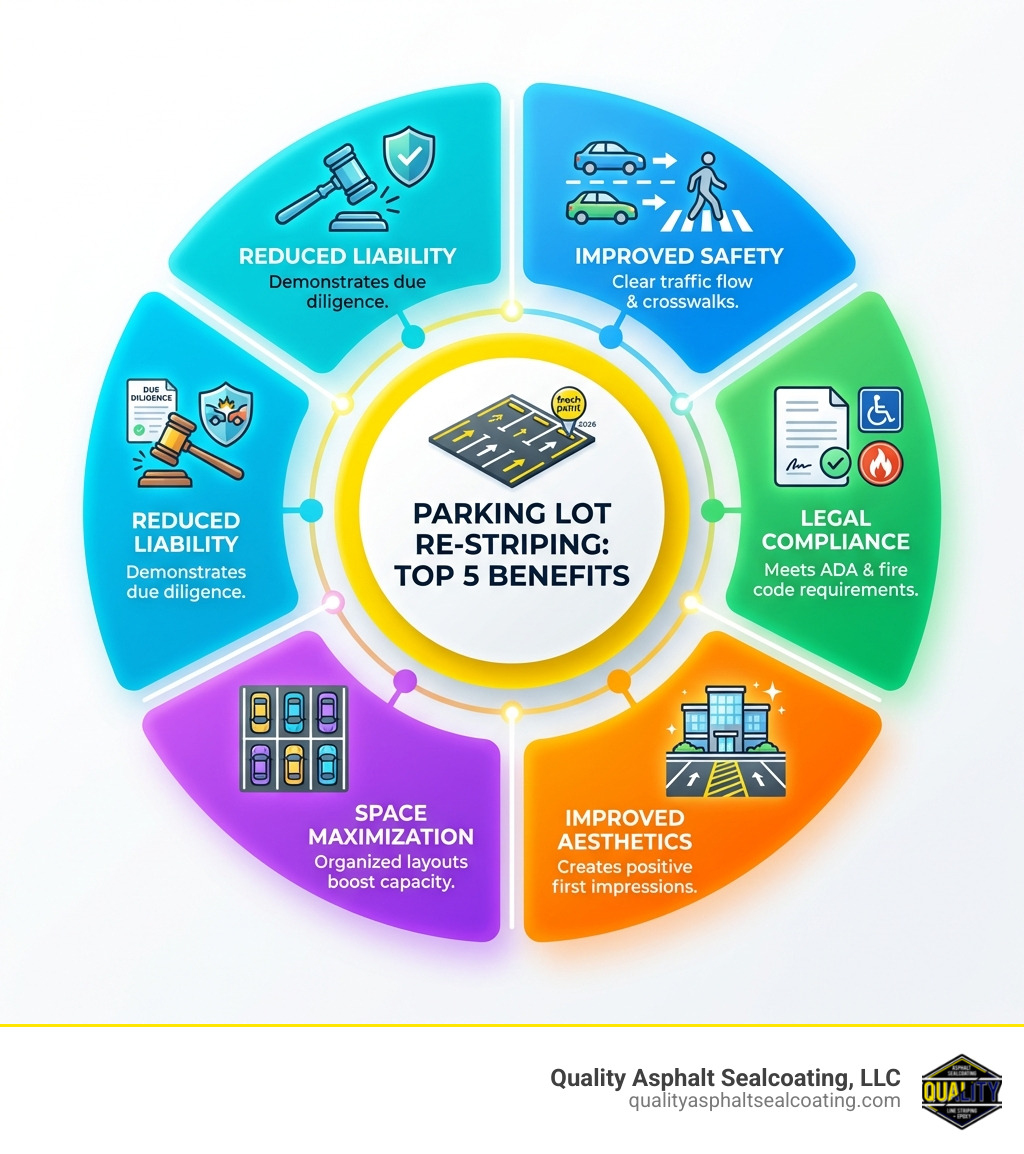
Enhancing Safety and Reducing Liability
The primary benefit of clear parking lot striping is improved safety. Faded lines create a confusing environment that can lead to preventable accidents, such as fender benders or pedestrians walking in unsafe areas because crosswalks aren’t marked.
When we perform parking lot re-striping, we restore clear traffic flow, pedestrian crosswalks, and directional arrows. This guides drivers and pedestrians safely, minimizing confusion and reducing the risk of collisions.
For property owners, this translates to reduced liability. By ensuring your lot is clearly marked, you demonstrate due diligence in maintaining a secure environment. In the event of an accident, well-maintained markings can be crucial in preventing lawsuits and proving you took reasonable steps to ensure safety.
Ensuring Regulatory Compliance
Proper parking lot re-striping is essential for adhering to local, state, and federal regulations, as failure to comply can result in significant fines.
Key regulations we always consider include:
- Fire Lane Access: Fire codes require designated fire lanes to be clearly marked and unobstructed. In Rhode Island, we ensure our striping meets all local and state requirements. Failing to mark a fire lane can lead to substantial daily fines and, more importantly, delayed emergency response. You can learn more about fire codes at the NFPA website.
- ADA Requirements: The Americans with Disabilities Act (ADA) has strict guidelines for accessible parking. When a lot is re-striped, it must comply with current ADA Standards. This includes the number of accessible spaces (one per 25 conventional spaces), their dimensions (at least 8 feet wide), and clearly marked access aisles (5 feet wide). One of every six accessible spots must be van-accessible, often requiring a wider aisle. These spaces must also be on the most direct route to the entrance. You can find comprehensive information on these requirements on the ADA website.
Staying compliant is a legal and moral obligation. We can help you steer these requirements. Find more about how we can assist with your property’s needs on our Services page.
Boosting Curb Appeal and Customer Satisfaction
Your parking lot is often the first point of contact for your business. A freshly striped lot makes a positive first impression, signaling that the property is well-cared for. This professional image boosts curb appeal and makes your property more welcoming. Conversely, a faded, disorganized lot can look neglected and deter customers.
Beyond aesthetics, a well-striped lot improves the customer experience by reducing frustration and making parking easier. This can translate into repeat business and positive reviews. For residential properties, it improves tenant satisfaction and can contribute to higher occupancy rates.
Maximizing Space and Efficiency
Faded lines lead to inefficient use of your parking space. When drivers can’t see where to park, they often park haphazardly, taking up more than one space or creating bottlenecks. This prevents you from utilizing your lot to its full capacity.
Professional parking lot re-striping ensures organized parking and maximizes your stall count. We can help optimize your layout, ensuring each space is clearly defined and traffic flows smoothly.
Consider the dimensions:
- Standard parking spaces are typically 9 feet wide by 18 feet long.
- Aisle ways need a minimum of 22 feet for straight stalls or 16 feet for angled stalls.
- ADA accessible spaces must be at least 8 feet wide, with 5 feet of clearance on each side.
By maintaining precise markings, we prevent incorrect parking and disorganization. Re-striping is an opportunity to re-evaluate your layout to fit more vehicles while adhering to all regulations.
The “When”: Signs It’s Time to Re-Stripe Your Lot
Knowing the right time to re-stripe is key to cost-effective maintenance. This section details the visual cues and timelines to follow.
Telltale Signs of Fading Lines

The most obvious indicator that your parking lot needs attention is the visual deterioration of the lines. Here are the signs we look for:
- Poor Visibility: Lines are barely visible in daylight and become nearly invisible at night or in bad weather, compromising safety.
- Chipped or Peeling Paint: Flaking, cracked, or peeling paint looks unsightly and indicates the paint’s protective qualities are gone.
- Water Pooling on Lines: Water that pools on lines after rain can accelerate their deterioration.
- Customer Complaints: Customers or tenants express frustration about parking confusion, difficulty finding spaces, or near-misses.
- Improper Parking: Drivers park haphazardly due to faded lines, causing a disorganized lot and wasted space.
- Non-Compliance: An inspection reveals your lot no longer meets ADA or fire code requirements due to faded markings.
How Often Should You Re-Stripe?
The frequency of parking lot re-striping depends on several factors, but general guidelines exist:
- General Guideline: Most properties need re-striping every 18 to 36 months. Experts recommend repainting every 2-4 years, depending on traffic and weather.
- High-Traffic Lots: For busy commercial properties like retail centers, annual re-striping is often recommended as they wear out faster.
- After Sealcoating: Re-striping is a must after Commercial Parking Lot Sealcoating. Once the sealant cures (about 24 hours), new lines must be painted. Coordinating both services ensures better adhesion and longevity.
- As Needed: If lines become difficult to see or you notice any of the signs above, it’s time to schedule re-striping.
Factors That Accelerate Fading
Several factors contribute to the premature fading of parking lot striping:
- High Traffic Volume: Constant friction from tires grinds away paint, especially in drive lanes, stop bars, and loading zones.
- UV Sun Exposure: Intense UV rays break down paint pigments and binders, causing colors to fade. This is a factor during Rhode Island summers.
- Harsh Weather: Rain, snow, ice, and freeze-thaw cycles cause paint to peel and abrade.
- Snowplow Scraping: Snowplows, essential in Rhode Island, can scrape away paint, requiring more frequent re-striping.
- Chemical Spills: Oil, gasoline, antifreeze, and de-icing salts are corrosive and cause paint to degrade and peel.
- Poor Initial Surface Preparation: If the asphalt wasn’t properly cleaned before striping, the paint won’t adhere correctly, leading to early failure.
The “How”: The Complete Parking Lot Re-striping Process
A professional re-striping job involves more than just a can of paint. Here’s a step-by-step look at how the experts achieve a durable, high-quality finish.
Step 1: Surface Preparation and Old Line Removal
Proper surface preparation is crucial and differentiates a professional parking lot re-striping job from a temporary touch-up. Applying paint to a dirty or failing surface leads to poor adhesion and premature failure.
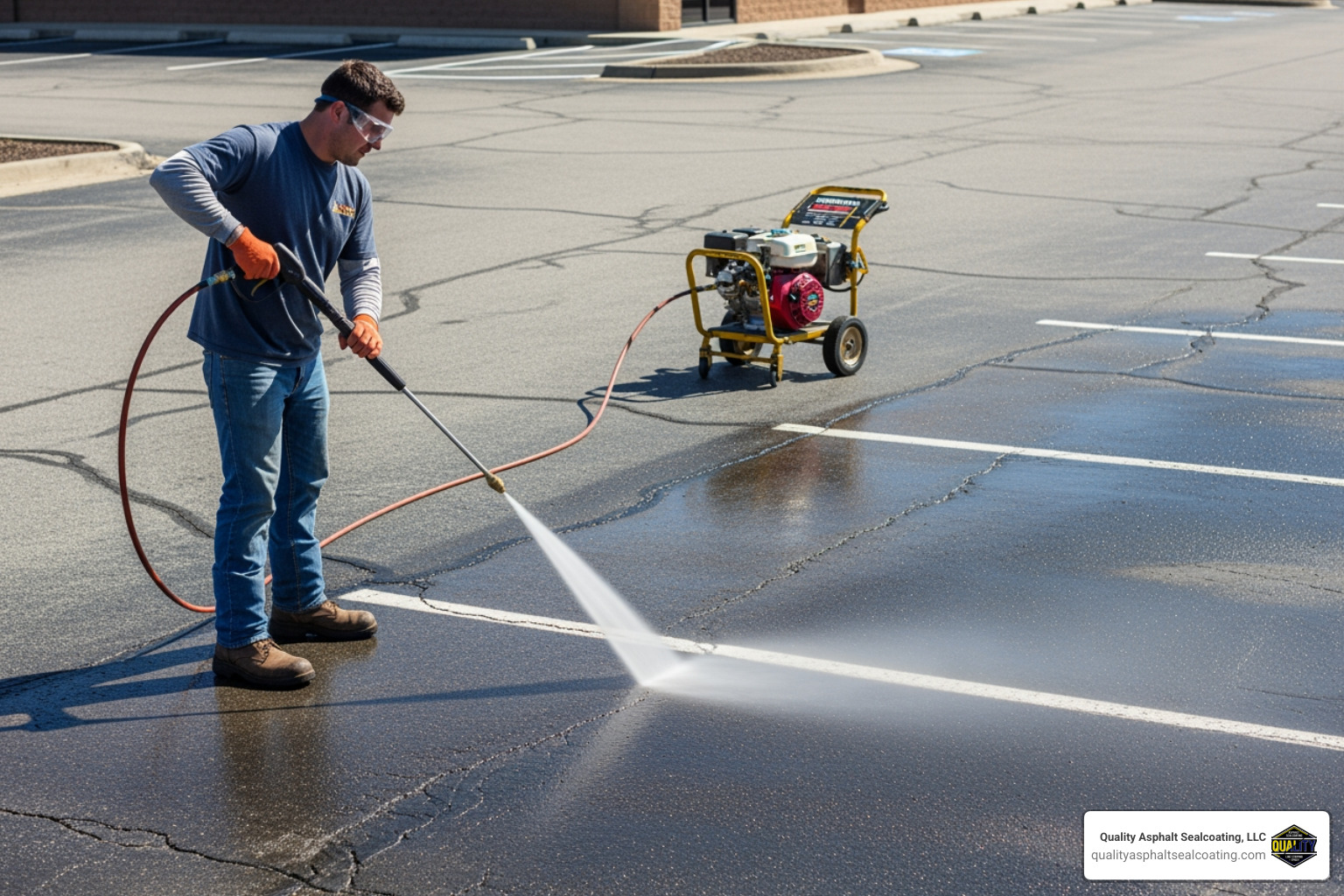
- Debris Removal: We clear the area of all debris like dust, dirt, and leaves using blowers, sweepers, or power washers to ensure a clean surface for paint adhesion.
- Pothole and Crack Repair: We repair cracks and potholes first. Painting over damaged asphalt is ineffective, as the paint will fail as the pavement deteriorates. Our Line Striping & Pothole Repair Services create a smooth, stable base.
- Cleaning the Surface: The pavement is thoroughly cleaned, often with power washing, to remove embedded dirt and oil stains. The surface must be completely dry before painting can begin.
Line Removal Methods: In many cases, removing old, faded lines is critical to avoid a messy, inconsistent finish. Common methods include:
- Grinding: Uses specialized equipment with rotating abrasive heads to physically grind away old paint. It’s effective but can be aggressive on the asphalt.
- Water Blasting: High-pressure water jets blast away old paint. This is an eco-friendly option that causes less damage to the pavement than grinding.
- Sand Blasting: Uses abrasive media like sand propelled at high speed. It’s effective but creates dust and requires careful containment.
- Chemical Removal: Chemical strippers dissolve old paint but require careful handling and proper disposal.
Our experts will assess your lot to determine the best approach.
Step 2: Choosing the Right Materials for the Job
Selecting the correct paint is crucial for durability and longevity. We consider traffic, climate, and budget to recommend the best options for your Rhode Island property.
Here’s a comparison of common paint types:
| Paint Type | Durability | Cost | Drying Time | Environmental Friendliness |
|---|---|---|---|---|
| Water-Based | Good, but less durable than oil-based/thermoplastic | Most affordable | Quick (30 mins touch, 2 hrs traffic) | More eco-friendly, low VOC |
| Oil-Based | Very Good, especially in cold climates | Moderate | Moderate (can be affected by humidity) | Higher VOC, less eco-friendly |
| Thermoplastic | Excellent (most durable) | Most expensive (initial) | Very fast (solidifies as it cools) | Low VOC, long-lasting |
- Water-Based Paint: A popular, affordable, and eco-friendly choice that dries quickly.
- Oil-Based Paint: Offers good durability, particularly in colder climates like Rhode Island’s.
- Thermoplastic: The most durable and long-lasting option, though more expensive upfront. It’s ideal for high-traffic areas.
In addition, we often incorporate reflective glass beads in the stripes. Added to wet paint, these beads improve night visibility, a key safety feature for high-traffic lots.
We also use high-quality stencils for all necessary symbols, including handicap logos, directional arrows, numbers, letters, and safety markings.
Step 3: Layout, Measurement, and Application
With the surface prepared and materials selected, the next phase is precise layout and professional application.
Layout and Measurement: Before painting, we carefully measure and plan the layout. This includes:
- Stall Dimensions: We adhere to standard dimensions (typically 9’x18′) and can incorporate compact spaces (7.5′-8.5′ wide).
- Aisle Width: We ensure appropriate aisle widths for traffic flow (e.g., a minimum of 22′ for straight stalls).
- ADA Dimensions: We precisely measure accessible spaces and aisles to comply with ADA guidelines.
- Chalk Lines: We use chalk lines for accuracy, ensuring straight, consistent markings.
- Optimizing Space: We can optimize your layout to maximize parking efficiency while maintaining compliance and safety.
Professional Application: We use professional line striping machines for clean, sharp, and consistent lines. Lines are typically at least 4 inches wide, and we often apply two coats for vibrancy and proper adhesion. During application, we use cones and tape to control traffic and cordon off freshly painted areas for safety.
The “How Much & How Long”: Costs and Timelines
Budgeting and planning for downtime are critical. This section breaks down the typical costs and duration of a re-striping project.
Understanding the Costs of Parking Lot Re-striping
The cost of parking lot re-striping varies based on lot size, layout complexity, paint type, and the amount of prep work required.
- Cost per Linear Foot: The average cost is typically $0.25 to $1.00 per linear foot.
- Lot Size Estimates:
- A 50-space lot can cost between $350-$800.
- A 100-space lot can range from $700-$1,600.
- Factors Affecting Cost:
- Prep Work: Extensive cleaning, power washing, or asphalt repairs will add to the overall cost.
- Line Removal: If old lines need to be removed, this can significantly increase the cost.
- Paint Type: Durable paints like thermoplastic are more expensive than standard water-based paints.
- Number of Stencils: Additional markings like arrows, letters, or handicapped logos will incur extra costs.
- Layout Complexity: A complex design is more expensive than a simple rectangular layout.
- Geographic Location: Costs vary by region; as a Rhode Island business, we provide competitive local pricing.
Re-striping is typically 20-50% less expensive than a brand-new paint job if the pavement is in good condition.
Project Duration and Drying Times
Understanding the timeline for parking lot re-striping helps you plan for minimal disruption.
- Average Project Time: An average-sized lot can take a few hours to a full day. Larger lots might span multiple days. We work efficiently to minimize inconvenience.
- Paint Drying Time: Paint is usually dry to the touch in 30 minutes, but we recommend waiting at least 2 hours before allowing traffic on the lines to prevent smudging.
- Weather Impact on Drying: Weather plays a significant role. Warm, dry weather is best, while cool or humid conditions can extend drying times. We schedule projects during optimal conditions, typically between late spring and early fall in Rhode Island.
- Sealcoating Timeline: If your lot was recently sealcoated, we must wait for the sealant to fully dry (about 24 hours) before applying new paint.
To minimize disruption, we can schedule work during off-peak hours or in phases to maintain accessibility.
Choosing the Right Contractor and Final Thoughts
Selecting a qualified professional is the most important step to ensure a lasting, compliant, and attractive result for your property.
What to Look for in a Re-striping Contractor
Choosing the right contractor for your parking lot re-striping project is crucial. As a family-owned Rhode Island business, we understand the importance of trust. Here’s what to look for:
- Local Experience (Rhode Island): A local contractor understands Rhode Island’s climate and regulations. Our 23+ years of local experience means we know what works best here.
- Years in Business: Longevity in the industry often suggests reliability and expertise.
- Use of Quality Materials: A reputable contractor uses high-grade traffic paint designed to withstand local weather and traffic.
- Proof of Insurance: Always ensure the contractor is fully licensed and insured to protect you from liability.
- Detailed, Transparent Quotes: A trustworthy contractor provides a clear, itemized quote. Avoid vague or unusually low bids.
- Portfolio of Recent Work: Ask to see examples of past projects. Seeing their Recent Work can give you confidence in their capabilities.
- Knowledge of Regulations: Ensure they are up-to-date with ADA and fire code compliance requirements.
Your Next Steps for a Perfect Parking Lot
Parking lot re-striping is a strategic investment in the safety, compliance, and value of your property. By maintaining clear markings, you improve curb appeal, improve customer satisfaction, maximize parking efficiency, and reduce liability risks.
Don’t let faded lines lead to chaos, accidents, or costly fines. We’ve seen the difference a professionally re-striped parking lot makes for businesses across Rhode Island.
For over 23 years, Quality Asphalt Sealcoating, LLC has provided expert asphalt maintenance for Rhode Island businesses. We pride ourselves on using top-quality materials and delivering lasting results. To ensure your property is safe, compliant, and looks its best, explore our professional Line Striping & Pothole Repair Services. We’re ready to help you make a lasting positive impression.