Why Clear Direction is Non-Negotiable: The Purpose of Directional Arrows
Parking lot directional arrows are the unsung heroes of any well-organized property, providing silent, constant guidance for every driver.
Here’s a quick overview of what they are:
- Markings or signs on pavement or posts.
- Their main job is to guide traffic flow.
- They clearly show drivers where to turn, go straight, or stop.
- They help prevent confusion and accidents.
Without clear signals, a parking lot can feel like a maze, leading to driver frustration, delays, and accidents. Directional arrows solve this by speaking an unspoken language, telling drivers exactly where to go. Clear arrows mean better safety and efficiency, and they create a great first impression for visitors.
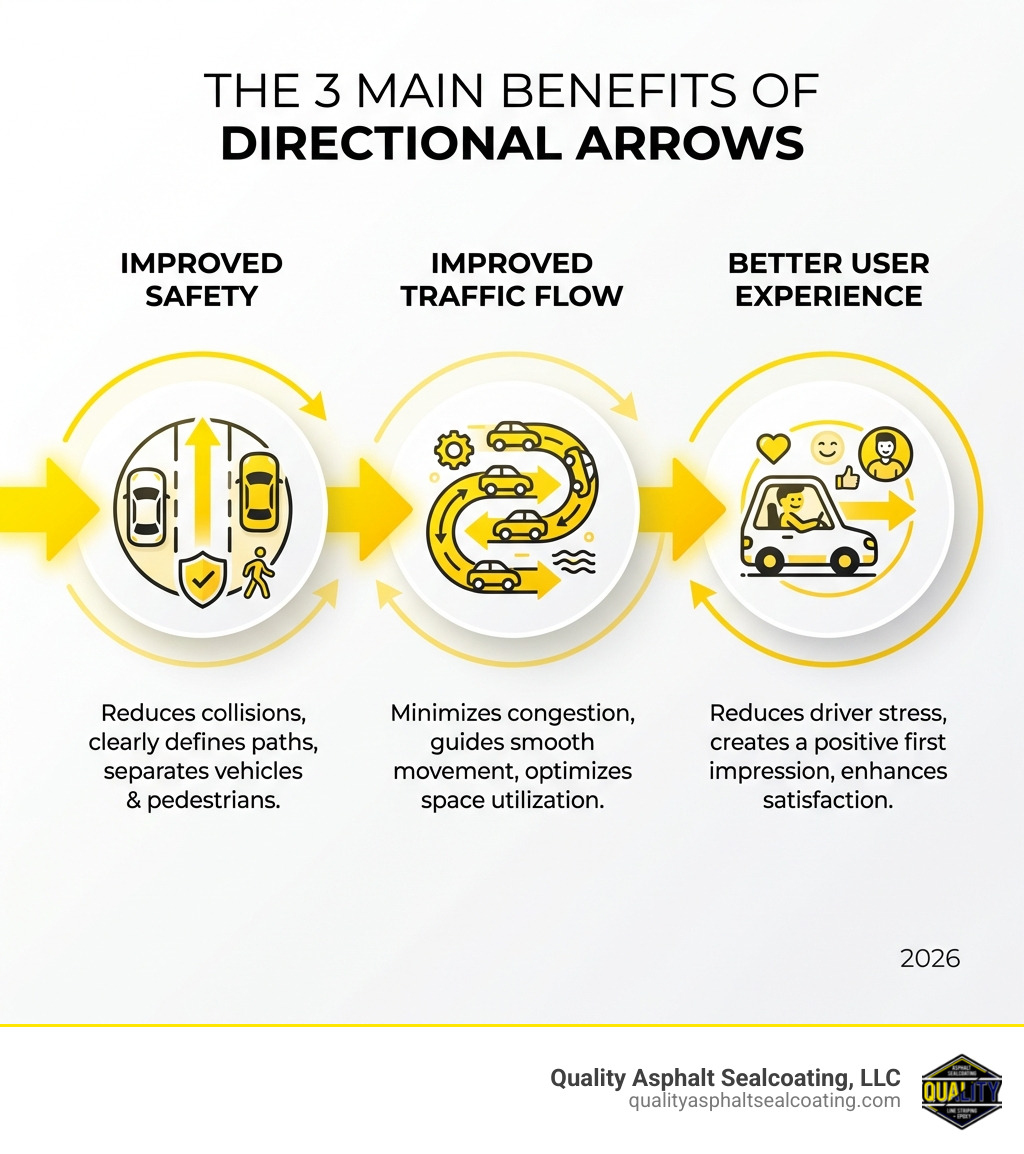
In commercial properties, hospitals, and retail centers, a parking lot is often the first point of contact. A chaotic parking area can create a negative impression and potential safety hazards. This is where parking lot directional arrows become indispensable.
Our experience in Rhode Island shows that these simple markings serve several primary purposes:
- Accident Prevention: The most critical role of directional arrows is to prevent collisions by clearly indicating traffic flow.
- Reducing Driver Frustration: Clear arrows alleviate the stress of aimlessly circling a lot, creating a more pleasant experience.
- Creating an Intuitive Path: Directional arrows guide drivers along a logical path from entrance to exit.
- Organizing Traffic: Arrows help organize vehicles into orderly lanes, preventing gridlock and improving overall flow.
Arrow stencils and signs are essential for managing traffic, guiding visitors, and ensuring clear directions to keep your parking lot running smoothly.

Enhancing Safety and Reducing Liability
Safety in a parking lot isn’t just about avoiding accidents; it’s also about protecting your business from liability. Parking lot directional arrows are a foundational element of a safe environment.
Here’s how they improve safety and reduce liability:
- Preventing Head-On Collisions: Designating one-way lanes with arrows eliminates guesswork and reduces the risk of dangerous head-on collisions.
- Protecting Pedestrians: When traffic flows predictably, drivers can focus more on their surroundings, making crosswalks and pedestrian zones safer.
- Defining Clear Exit Paths: In an emergency or during peak hours, directional arrows ensure exit routes are unambiguous, preventing panic and congestion.
- Ensuring Emergency Vehicle Access: Clear traffic patterns guided by arrows mean emergency vehicles can steer your lot quickly and efficiently.
- Reducing Chaos in High-Traffic Zones: Arrows bring order to entrances, exits, and main thoroughfares, making them safer for everyone.
Properly implemented arrows are a professional-grade tool for traffic management, contributing directly to safety and ensuring everyone on your property is protected.
Optimizing Traffic Flow and Efficiency
Beyond safety, parking lot directional arrows are powerful tools for optimizing vehicle flow and maximizing efficiency. A smoothly operating parking lot contributes directly to customer satisfaction.
Consider these benefits:
- Guiding Drivers from Entrance to Exit: Arrows create a seamless journey, directing drivers effortlessly from the moment they pull in until they depart.
- Minimizing Search Time for Parking Spots: By directing traffic efficiently through aisles, arrows reduce the time drivers spend searching for a space.
- Establishing One-Way Lanes: One-way arrows are fundamental for maintaining order and preventing bottlenecks, especially in narrower aisles.
- Managing Congestion: Arrows help distribute traffic evenly, guiding vehicles through the lot without unnecessary stops or slowdowns.
- Streamlining Navigation: When drivers know where to go, they move with confidence, which improves the overall throughput of the parking area.
An efficient parking lot, aided by clear parking lot directional arrows, increases efficiency and improves appearance. Re-striping your parking lot is more than just paint; it’s an investment in efficiency and a better experience for everyone. Find out More info about Re-Striping Your Parking Lot: More Than Just Paint.
A Guide to Parking Lot Directional Arrows: Types and Materials
Just as there’s more than one way to get to your destination, there’s more than one type of directional arrow to guide drivers. Understanding the different types and materials is key to an effective and durable parking lot layout.

Common Types of parking lot directional arrows
The variety of parking lot directional arrows ensures that every traffic situation can be addressed with clarity:
- Straight Arrows: Indicate that traffic should proceed straight ahead, common in long aisles or entry lanes.
- Turn Arrows (Left/Right): Clearly instruct drivers to turn left or right into a specific lane or parking area.
- Curved Arrows: Used for gentle bends or to guide traffic around an obstacle, indicating a change in direction without a sharp turn.
- Double-Headed Arrows: Used when a lane allows traffic to move in either direction, such as in a shared access lane.
- Combination Arrows (e.g., Straight and Turn): Offer multiple options from a single lane, such as allowing drivers to go straight or turn left. They are useful at intersections where space is limited.
- Chevron Arrows: Can be used to delineate specific zones or merge points.
These arrow types are available as stencils for pavement markings or as designs on upright signs, with a vast array of options available to suit any parking lot’s unique needs.
Pavement Stencils vs. Upright Signs
When implementing parking lot directional arrows, you have two main approaches: pavement markings (stencils) or upright signs. Both have their advantages and ideal applications.
Pavement Markings (using stencils):
Pavement markings involve painting arrows directly onto the asphalt or concrete. We use professional-grade stencils made from durable materials like LDPE, Aluminum, or UHMW plastic for precision.
- Advantages: Cost-effective for large areas, provides direct guidance on the driving surface, and blends seamlessly into the lot’s aesthetic.
- Considerations: Requires good pavement condition for application. Durability depends on traffic volume, climate, and paint quality, so regular maintenance is key.
Upright Signs:
These are physical signs mounted on posts, typically made from durable aluminum with reflective sheeting to improve visibility.
- Advantages: Highly visible from a distance, unaffected by pavement condition, and can convey more complex messages.
- Considerations: Can be obstructed by larger vehicles, and placement needs careful planning to avoid creating new obstacles.
Here’s a quick comparison:
| Feature | Pavement Stencils | Upright Signs |
|---|---|---|
| Visibility | Direct guidance on driving surface | High visibility from a distance, above obstructions |
| Cost | Generally more cost-effective for large areas | Higher initial cost per sign, but long-lasting |
| Durability | Depends on paint/material and traffic; needs repainting | Weatherproof, fade-resistant; can last 10+ years |
| Installation | Requires surface prep, painting expertise | Requires posts, mounting hardware, and proper installation |
| Flexibility | Permanent once painted, can be removed/repainted | Can be portable for temporary needs, easily moved or replaced |
| Maintenance | Regular repainting, especially in high-traffic areas | Cleaning, occasional checks for damage |
A combination of both pavement markings and upright signs often provides the most comprehensive and effective directional guidance.
Best Practices for Arrow Placement, Design, and Compliance
The effectiveness of parking lot directional arrows isn’t just about having them; it’s about having them in the right place, designed correctly, and adhering to regulations. Thoughtful placement and design are crucial for maximizing their impact.
Placement and Visibility: Getting Your Message Seen
Proper placement is paramount. An arrow that’s misplaced or hard to see is as bad as no arrow at all. Our team focuses on strategic placement to ensure your directional arrows are seen and understood instantly.
Here are our best practices for getting your message seen:
- Decision Points: Arrows should be placed well in advance of, and at, key decision points like intersections or turn-offs.
- Entrances and Exits: Clearly mark entry and exit points with prominent arrows to prevent confusion.
- Lane Designation: Use arrows to clearly designate lanes, especially in complex areas like drive-thrus.
- Proper Spacing: Avoid clutter. Too many arrows can be overwhelming, so we ensure adequate spacing so each arrow is easily interpreted.
- Appropriate Size: The arrow’s size must be proportionate to vehicle speed. For signs, text should never be smaller than 3″ capital letter height for moving vehicles.
- Line of Sight: Arrows must have a clear line of sight, day and night, and not be obscured by landscaping, parked cars, or snow. Signs should be a minimum of 24″ above grade.
- Avoid Obstructions: Signs should not be placed where they might obstruct pedestrians, disabled access paths, or be hit by vehicle bumpers.
Navigating Regulations: MUTCD and ADA Standards
Compliance with regulations is a commitment to universal safety and accessibility. When implementing parking lot directional arrows, we always consider relevant standards.
- MUTCD (Manual on Uniform Traffic Control Devices): While for public roads, MUTCD provides widely accepted standards for signs and markings. Many private lots adhere to its guidelines for consistency and driver familiarity.
- ADA Compliance for Accessible Routes: The Americans with Disabilities Act (ADA) mandates accessibility in parking lots. This means ensuring accessible spaces are clearly marked and that directional signage doesn’t obstruct accessible pathways. For every six parking spaces, at least one must be a van-accessible space.
- Local Fire and Building Codes: In Rhode Island, specific local codes may dictate requirements for fire lanes and emergency access routes, often requiring specific markings and signage that our team is well-versed in.
Adhering to these standards ensures your parking lot directional arrows are effective, legally compliant, and inclusive. For comprehensive guidance, you can refer to Official guidance on parking lot signage standards.
Integrating Arrows with Your Overall Parking Lot Design
Parking lot directional arrows are part of a larger system. For effective navigation, they must be seamlessly integrated with the entire parking lot design.
- Consistency with Other Markings: Arrows should complement other markings like stop bars, crosswalks, and parking stall lines to create a cohesive visual language.
- Stop Bars: Arrows indicating a turn should be positioned before a stop bar.
- Crosswalks: Traffic flow guided by arrows should be designed to minimize conflicts with pedestrian crosswalks.
- Parking Stall Lines: Arrows guide drivers into the appropriate aisles for different parking types, such as “Visitor Parking.”
- Creating a Cohesive System: The goal is a unified system where every sign and marking works together. This includes using consistent fonts, colors, and arrow styles throughout the lot.
By integrating parking lot directional arrows into a comprehensive design, we ensure your property’s traffic management is functional and effective. We offer comprehensive services that cover all aspects of parking lot maintenance and design. Learn more about More info about our comprehensive services.
Maximizing Your Investment: Maintenance, Costs, and Common Pitfalls
Investing in clear parking lot directional arrows is an investment in safety, efficiency, and customer satisfaction. To maximize that investment, it’s crucial to understand maintenance, costs, and common mistakes to avoid.
Maintaining Your Markings for Longevity
Pavement markings are constantly exposed to traffic and the elements, requiring ongoing maintenance to remain effective.
- Fading and Wear: Constant vehicle traffic causes paint to wear down and fade.
- Impact of Weather: Rhode Island’s weather, including UV rays, rain, snow, and ice, can cause paint to fade, crack, and peel.
- Repainting Schedules: To combat wear, regular repainting is essential. Pavement markings typically need refreshing every 1-3 years, depending on traffic, paint quality, and climate. Upright signs can last over 10 years with minimal maintenance.
- The Role of Sealcoating: Sealcoating protects your asphalt and creates a fresh, dark surface that makes painted markings stand out vividly. A properly maintained and sealcoated parking lot has an extended lifespan, leading to significant long-term cost savings.
Regular sealcoating and line striping ensure your parking lot directional arrows remain bright and effective. For more information, explore More info about Commercial Parking Lot Sealcoating.
Common Mistakes to Avoid with parking lot directional arrows
Avoiding these common pitfalls is crucial for ensuring your system is effective and safe.
- Ambiguous Arrows: An arrow that isn’t crystal clear in its direction defeats its purpose. Precision in application is key.
- Incorrect Placement: Placing an arrow immediately after a turn can be confusing. Arrows should be placed well in advance of decision points.
- Too Many Arrows: Over-saturating an area with arrows can be overwhelming. Messages should be concise; less is often more.
- Poor Color Contrast: If the arrow color doesn’t stand out against the pavement, it will be hard to see. White or yellow on dark asphalt offers excellent contrast.
- Ignoring Routine Maintenance: Fading or damaged arrows leave drivers without clear guidance, undermining the initial investment.
- Placement Obstructing Paths: Signs must be placed with care to avoid creating hazards for pedestrians or being hit by vehicles.
By being mindful of these mistakes, you can ensure your parking lot directional arrows are a clear asset, not a source of frustration.
Customization and Specialized Parking Management
Parking lot directional arrows can also be powerful tools for customization and managing specialized parking needs.
- Using Branded Colors: While standard white and yellow are common, businesses can incorporate brand colors into signs or specific zones to reinforce identity.
- Guiding Traffic to Specific Zones: Arrows are invaluable for directing drivers to different types of parking:
- Visitor Parking: Lead guests directly to designated visitor spaces.
- Employee Parking: Guide staff to their designated areas, optimizing space.
- ADA-Compliant Parking: Direct drivers to accessible parking zones, ensuring compliance and ease of access.
- Marking Drive-Thru Lanes: For businesses with drive-thrus, arrows are essential for guiding vehicles through the queue efficiently and safely.
- Directing to Loading Docks: Clear directional arrows prevent confusion and ensure service vehicles have unobstructed paths to loading docks.
- Indicating Bike Lanes: Arrows can be used to delineate bike lanes within or adjacent to parking areas, promoting safety for all users.
The ability to customize your parking lot directional arrows allows you to create a highly functional and branded environment that meets the unique needs of your property.
Frequently Asked Questions about Parking Lot Arrows
We often get questions from property owners in Rhode Island about the best practices for their parking lot directional arrows. Here are some of the most common inquiries:
How often do painted directional arrows need to be repainted?
The lifespan of painted parking lot directional arrows varies. Typically, in a commercial parking lot, you can expect them to need refreshing every 1 to 3 years. This depends on:
- Traffic Volume: High-traffic areas experience more wear.
- Paint Quality: Professional-grade traffic paint lasts longer.
- Climate Conditions: Rhode Island’s weather accelerates deterioration.
- Surface Preparation: Proper cleaning is crucial for paint adhesion.
Regular sealcoating can also significantly extend the life and vibrancy of your markings by protecting the underlying asphalt.
Are there specific colors I should use for directional arrows?
Yes, using standard colors ensures immediate understanding by drivers:
- White: This is the most common color for general lane markings, including straight and turn arrows.
- Yellow: Yellow is typically used to separate opposing traffic flows or mark no-passing zones.
- Blue: This color is specifically reserved for markings related to ADA-compliant accessible parking spaces.
The key is to ensure high contrast between the arrow color and the pavement surface for maximum visibility.
Can I install directional arrows myself?
While a DIY approach might seem appealing, we advise against it for commercial properties for several reasons:
- Professional Expertise: Achieving crisp, straight, and accurately shaped arrows requires trained personnel. Our team has 23+ years of experience.
- Proper Surface Preparation: Professionals have the right tools to properly clean the pavement so paint adheres and lasts.
- Specialized Equipment: Professional line striping machines ensure consistent, durable markings that hand-painting cannot match.
- Durable Materials: We use high-quality, traffic-grade paints and stencils designed to withstand heavy traffic and harsh weather.
- Regulatory Compliance: Ensuring compliance with local, MUTCD, and ADA standards is complex. Professionals have the necessary knowledge and experience.
For a professional appearance, optimal durability, and guaranteed compliance, entrusting the installation of your parking lot directional arrows to experienced professionals is the best choice.
Conclusion: Pointing Your Business Towards Success
In the intricate dance of vehicles and pedestrians in your parking lot, clear parking lot directional arrows are the silent choreographers, ensuring every movement is safe, efficient, and harmonious. They prevent collisions, reduce driver frustration, optimize traffic flow, and ultimately reflect positively on your business.
At Quality Asphalt Sealcoating, LLC, we understand the critical role these markings play. As a family-owned Rhode Island business with over 23 years of experience in asphalt maintenance, we specialize in ensuring your parking lot is a testament to your commitment to safety and professionalism. Our expertise in line striping guarantees lasting results that make a positive impression.
A well-marked parking lot is a safer, more efficient, and more welcoming one. Don’t let faded lines or ambiguous arrows compromise safety or detract from your property’s value.
You can See examples of our professional work and witness the difference that expert application makes. For a parking lot that is safe, compliant, and efficient, professional application is key.
Ready to improve your property’s safety and curb appeal? Contact us for expert line striping and pavement marking services today.