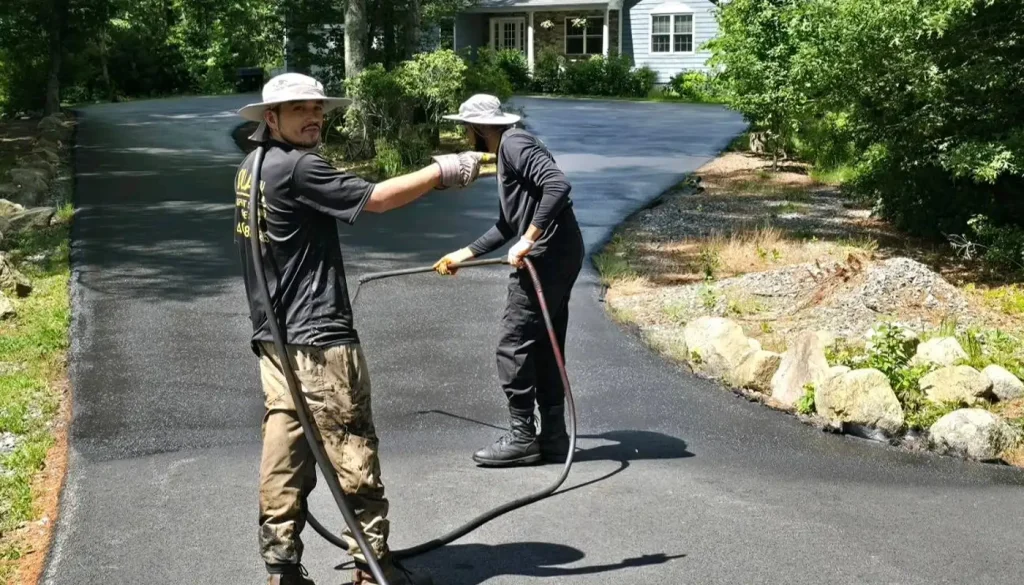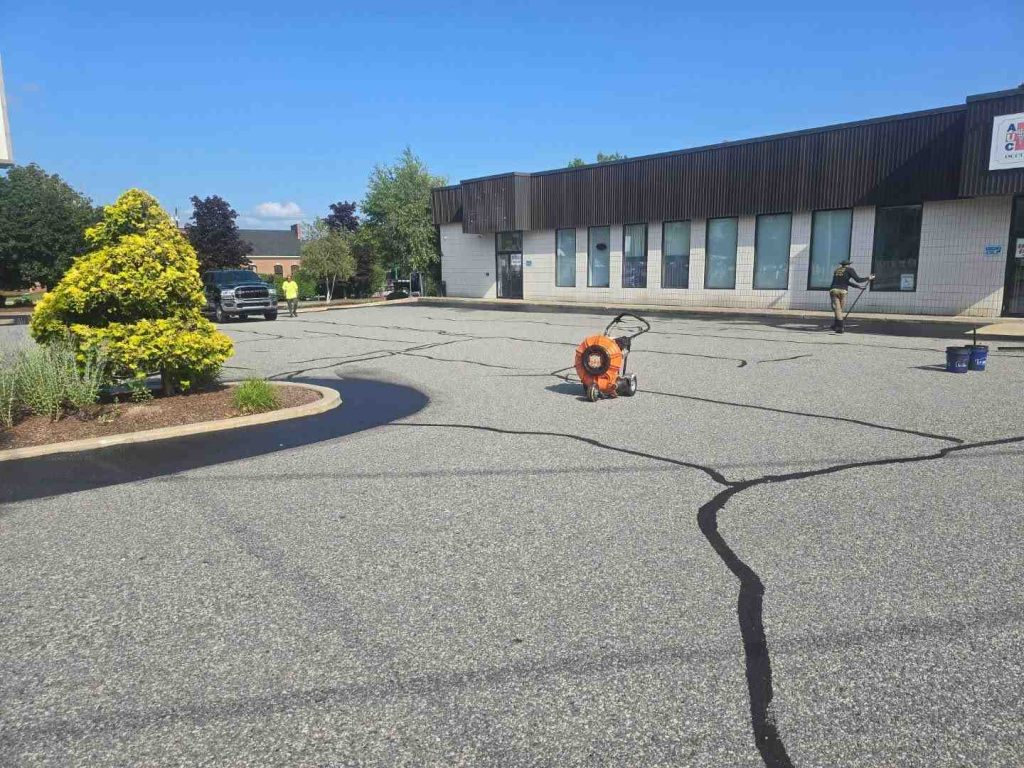
Why Every Crack in Your Parking Lot Matters
Parking lot crack filling is the process of sealing cracks in asphalt pavement with specialized materials to prevent water infiltration, extend pavement life, and avoid costly repairs. Here’s what you need to know:
- What it is: Applying hot-pour or cold-pour rubberized filler into cleaned asphalt cracks
- Why it matters: 70% of unsealed cracks develop into potholes within 3 years
- Cost savings: Crack filling is 20-30 times less expensive than pavement replacement
- Lifespan: Properly filled cracks can extend your pavement’s life by 3-5 years or more
- Best timing: Spring or fall when temperatures are between 40-95°F
That small crack zigzagging across your parking lot might not seem like much today. But it’s a warning sign.
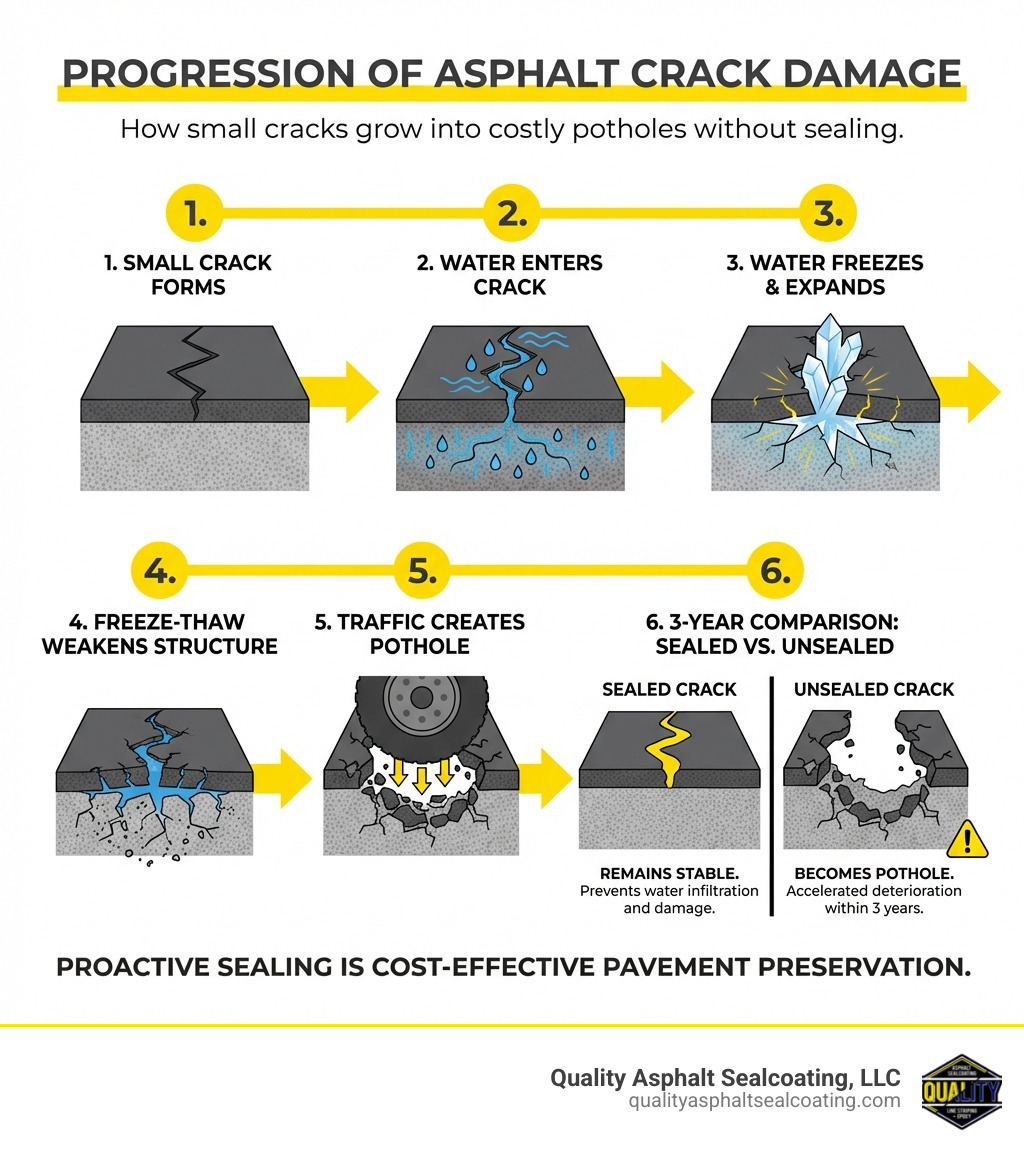
Water is asphalt’s worst enemy. When moisture seeps into even a hairline crack, it penetrates beneath the surface. During winter, that water freezes and expands—pushing the asphalt apart from the inside out. When it thaws, the weakened pavement crumbles. Traffic accelerates the damage.
The result? What started as a minor crack becomes a pothole requiring expensive repairs or even full pavement replacement.
The good news is that crack filling is one of the most cost-effective maintenance strategies available to property owners. According to industry research, proactive crack repair reduces future cracking by 75% and can extend your pavement’s life by as much as two decades.
This guide will walk you through everything you need to know about parking lot crack filling—from identifying different crack types to understanding when to DIY versus calling a professional. You’ll learn the proper repair process, the best materials for your climate, and how this simple maintenance step protects your investment.
Diagnosing Your Pavement: Understanding Asphalt Cracks
Cracks are the first sign of distress in asphalt pavement. Ignoring them leads to worse, more expensive damage. Before fixing them, it’s crucial to understand their causes and types.
Primary Causes of Parking Lot Cracks
Asphalt is resilient but battles daily wear and tear. Over time, exposure to the sun’s UV rays bakes out its flexibility, leaving the pavement brittle and prone to cracking.
The primary culprits behind cracks in our Rhode Island parking lots include:
- Sun and UV Ray Damage: Prolonged exposure to the sun’s ultraviolet rays causes the asphalt binder to oxidize, making it brittle and less flexible. This loss of elasticity makes the pavement more prone to cracking.
- Heavy Vehicle Traffic: Constant heavy loads from cars and trucks cause stress on the pavement, leading to fatigue cracking, especially in high-traffic areas.
- Water Penetration: As discussed, water is the number one enemy. It erodes the sub-base beneath the asphalt, weakening the entire structure. Rhode Island’s freeze-thaw cycles are particularly harsh, as trapped water expands when it freezes, pushing the asphalt apart.
- Poor Initial Installation: If the asphalt or its sub-base wasn’t installed correctly, the pavement will be more susceptible to premature cracking.
- Sub-base Failure: The sub-base is your parking lot’s foundation. If it settles or erodes, the asphalt above loses support and will crack.
Identifying Common Crack Types
Identifying the crack type reveals its cause and the best repair strategy. Here are the most common types we encounter:
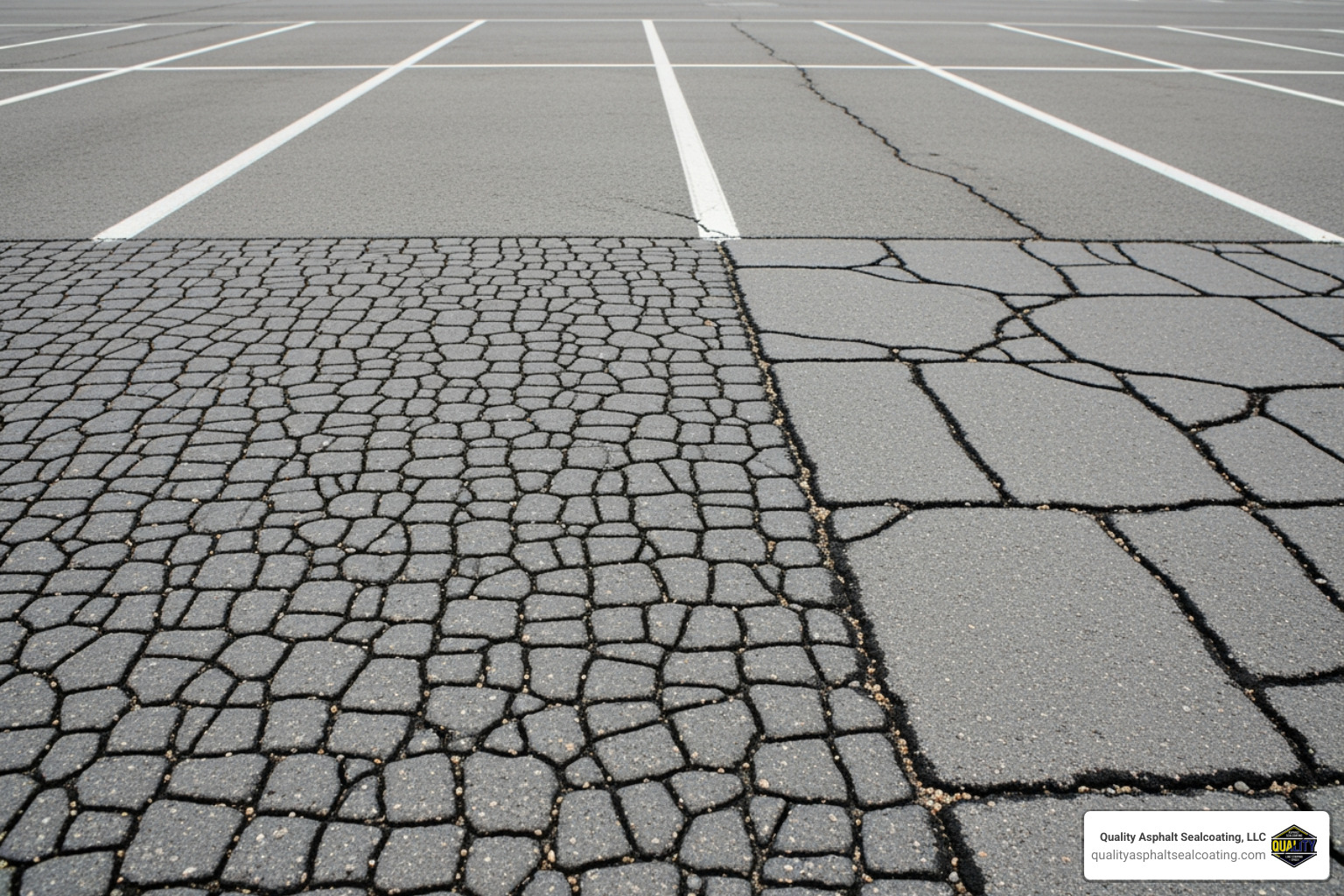
- Alligator Cracking (Fatigue Cracking): Also known as fatigue or “spiderwebbed” cracking, these interconnected cracks resemble an alligator’s skin. Caused by repeated heavy traffic loads, they typically indicate a failure in the pavement’s base layer. Alligator cracking, also known as fatigue cracking often signals a serious underlying issue requiring more than simple crack filling.
- Block Cracking: These interconnected cracks divide pavement into large rectangular pieces. They are usually caused by asphalt aging and shrinking from temperature changes, not necessarily from traffic loads.
- Longitudinal Cracks: These cracks run parallel to the pavement’s centerline, caused by poorly constructed paving joints, temperature cycling, or reflective cracking from underlying layers.
- Transverse Cracks: Running perpendicular to the pavement’s centerline, these are typically caused by thermal shrinkage as temperatures drop, which is common in Rhode Island.
- Edge Cracks: These are longitudinal cracks within two feet of the pavement’s outer edge. They appear due to a lack of support at the edge, often from erosion.
- Slippage Cracks: These crescent-shaped cracks are caused by a poor bond between asphalt layers, often due to heavy braking or turning. They indicate an adhesion problem.
Crack Sealing vs. Crack Filling: What’s the Difference?
Though often used interchangeably, crack sealing and crack filling are different processes for different crack types. Understanding the distinction is key for effective repairs.
Crack Sealing uses a rubberized sealant for ‘working cracks’ that expand and contract. The flexible material maintains a watertight seal through temperature changes. It’s typically used for cracks up to 0.75 inches wide with minimal deterioration and significant movement (≥ 0.1 inches annually).
Crack Filling uses an asphalt emulsion for ‘non-working cracks’ with little movement. It’s suitable for larger cracks (up to 1 inch) and those with more deterioration. Filler materials generally have lower performance requirements than sealants.
Here’s a quick comparison:
| Feature | Crack Sealing | Crack Filling |
|---|---|---|
| Crack Type | “Working” cracks (expand/contract) | “Non-working” cracks (little movement) |
| Material | Flexible, rubberized sealant | Asphalt emulsion or less flexible filler |
| Purpose | Prevents water intrusion by maintaining seal | Reduces water infiltration, reinforces pavement |
| Typical Width | Up to 0.75 inches | Up to 1 inch |
| Preparation | Often involves routing a reservoir | Primarily cleaning debris |
| Durability | Generally longer-term (5-9 years) | Shorter-term (2-4 years) |
| Cost | Generally more expensive due to materials/prep | Generally less expensive |
The best method depends on the crack’s type and activity. For more details on our materials, explore our Crack Filling Mastics Services.
The Complete Guide to Parking Lot Crack Filling
Once we’ve diagnosed the type of cracks, it’s time to get down to the business of parking lot crack filling. This isn’t just about pouring some material into a gap; it’s a precise process that, when done correctly, ensures a durable, long-lasting repair.
Choosing the Right Repair Materials
The material we choose is critical for the success and longevity of the repair, especially given Rhode Island’s diverse weather conditions.
- Hot-Pour Rubberized Crack Filler: This is our preferred choice for many repairs, especially for working cracks. Hot-pour rubberized crack filler is a professional-grade, thermoplastic material applied at liftd temperatures, typically between 380 and 410 degrees Fahrenheit. It offers superior durability and flexibility, expanding and contracting with the asphalt through seasonal temperature changes. Once applied and cooled, it’s traffic-ready in as little as 5 minutes to 30-45 minutes. This material can protect cracks from further damage for 3 to 5 years, and with optimal conditions, some sealants can last 5-7 years. Plus, many hot-pour fillers have a shelf-life of up to 10 years, making them a smart investment for future repairs.
- Cold-Pour Liquid Crack Filler: This material is easier and safer for smaller, DIY applications, as it doesn’t require specialized heating equipment. However, cold-pour fillers generally have a longer cure time, often taking 4+ hours to be traffic-ready. While convenient, they typically offer less durability than their hot-pour counterparts, often lasting 1-2 years.
- Asphalt Mastics: For cracks wider than 1.5 inches, or areas with significant deterioration and minor potholes, asphalt mastics might be used. These are specialized, heavy-duty materials that can handle larger voids and provide a stronger, more structural repair.
For our professional services, we rely on top-quality hot-pour rubberized materials that are designed to perform and last in cold winters, ensuring your pavement stands up to Rhode Island’s weather.
Essential Steps for Parking Lot Crack Filling
No matter the material, proper preparation and application are paramount. We follow a meticulous process to ensure each repair is effective.
Step 1: Cleaning the Crack
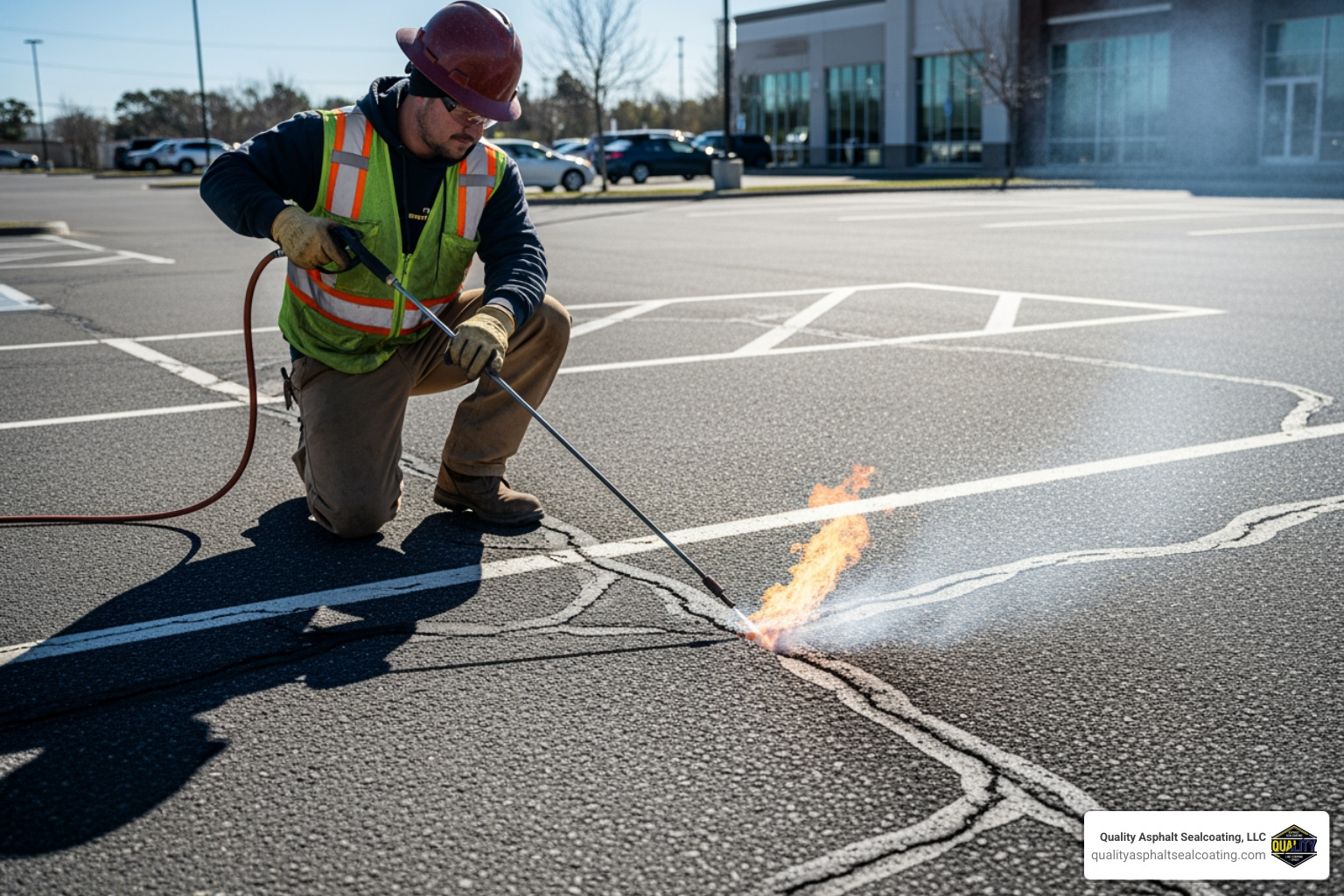
This is arguably the most critical step. If cracks are not clean, the filler won’t adhere properly, wasting time and money. We thoroughly clean cracks of all dirt, debris, vegetation, and loose asphalt. For smaller cracks, a powerful leaf blower or air compressor (minimum 90 psi) can remove loose debris. For more stubborn contaminants, we use wire brushes or specialized crack cleaning machines. The goal is a pristine, clear channel for the filler.
Step 2: Drying the Crack
Moisture is the enemy of adhesion. After cleaning, we ensure the crack is completely dry. A hot air lance is an invaluable tool for this, using high-velocity, high-pressure heated air to quickly dry the crack and even warm the surrounding asphalt. This warming helps the filler bond more effectively. Applying sealant while the surface is still warm can adhere better.
Step 3: Applying the Filler
Once clean and dry, the crack is ready for filling.
- For deep cracks: If a crack is particularly deep, we might pre-fill it with sand, leaving about a half-inch of free depth for the crack filler. This conserves material and ensures the filler performs optimally.
- Hot-Pour Application: Using specialized melter/applicator machines (like the RY10 PRO), we heat the rubberized filler to the manufacturer’s specified temperature (typically 380-410°F). The material is then applied into the crack, filling it from the bottom up to ensure a complete and void-free seal.
- Cold-Pour Application: For appropriate applications, cold-pour filler is poured directly into the crack and then smoothed.
Step 4: Curing and Finishing
After application, the filler needs time to cure. Hot-pour rubberized filler cools and hardens quickly, often allowing traffic to resume in minutes. Cold-pour fillers require more time, typically 4 or more hours, depending on ambient temperatures and humidity. We often use a squeegee to create a flush, neat finish, or a slight overband, ensuring the repair is smooth and safe for traffic. For more insights into repairing cracks to extend asphalt pavement life, refer to How To Repair Cracks to Extend Asphalt Pavement Life.
Best Practices for a Durable Repair
To ensure your parking lot crack filling lasts as long as possible, we adhere to several best practices:
- Ideal Season and Temperature: The best time for parking lot crack filling in Rhode Island is typically in the spring or fall. This is when cracks are neither completely open (as they are in the coldest winter months) nor completely closed (as they are in the hottest summer months). Most manufacturers recommend a minimum pavement temperature of 40 degrees Fahrenheit for optimal application and curing.
- Fill from the Bottom Up: When applying filler, we always ensure the crack is filled from the bottom up. This technique prevents air pockets and ensures the material fully occupies the crack, creating a stronger, more complete bond.
- Avoid Overfilling: While it might seem like more is better, overfilling can lead to excess material on the surface, which can cause issues with future sealcoating, create bumps, or lead to tracking. We aim for a flush fill or a neat, thin overband (no more than 1/8 inch thin and 2-4 inches wide) that will integrate smoothly with the pavement.
- Use a Squeegee for a Clean Finish: A soft rubber squeegee is used to properly shape the filler and create a clean wipe zone, ensuring the material is flush with the pavement surface and aesthetically pleasing.
- Post-Repair Sealcoating: After cracks are filled and cured, applying a fresh layer of sealcoat provides ultimate surface protection. This not only improves the parking lot’s appearance but also adds another barrier against water, UV rays, and chemical spills. Learn more about preparing your lot for Commercial Parking Lot Sealcoating.
The Payoff: Benefits of Proactive Crack Repair
Investing in parking lot crack filling is a strategic decision that yields significant returns. Proactive maintenance is always cheaper than reactive repairs.
The Financial Case for Proactive Maintenance
Delaying crack repairs is a false economy.
- Cost-Effective Preservation: Routine crack repair can cost as little as 50 cents per lineal foot, while neglected asphalt repair can cost up to six dollars per square foot. This makes crack filling 20 to 30 times less expensive than replacement.
- Reduced Liability: Untreated cracks and potholes create tripping hazards and can damage vehicles. Addressing these issues promptly reduces the risk of accidents and potential liability claims.
- Protecting Your Investment: Your parking lot is a significant asset. Proactive crack repair protects that investment by preventing minor issues from becoming major, costly problems, decreasing long-term maintenance costs. For a comprehensive look at the financial benefits, check out Preventive vs. Reactive: A Deep Dive into Asphalt Maintenance Expenses.
Extending Pavement Lifespan and Durability
The most compelling benefit is significantly extending your asphalt’s lifespan.
- Pavement Life Extension: Crack sealing alone can extend pavement life by three to five years. Combined with sealcoating, routine crack filling can help an asphalt parking lot last up to three decades without replacement—a remarkable return on investment.
- Preventing Sub-Base Erosion: By sealing out water, crack filling prevents it from eroding the crucial sub-base layer. This preserves the structural integrity of your parking lot and avoids premature failure.
- Factors Influencing Durability: The longevity of crack repairs depends on traffic volume, Rhode Island’s climate (freeze-thaw cycles), and the quality of materials and application. High-quality hot-pour rubberized fillers offer the best durability.
Enhancing Safety and Curb Appeal
A well-maintained lot also improves aesthetics and safety.
- Eliminating Trip Hazards: Filling cracks smooths the surface, eliminates uneven areas, and makes your property safer for pedestrians.
- Improving Visual Appearance: A smooth, crack-free parking lot looks professional and well-maintained, creating a positive first impression for visitors, customers, and tenants.
- Increasing Property Value: A well-maintained parking lot indicates a well-maintained property, which can increase its value and attractiveness to potential buyers or renters.
DIY vs. Professional Services: When to Make the Call
When it comes to parking lot crack filling, property owners often wonder if they can tackle the job themselves or if it’s best to call in the professionals.
The DIY Approach: Equipment and Considerations
For small, isolated cracks on a limited budget, a DIY approach might seem appealing.
- Essential DIY Tools: You’d need a wire brush or sturdy pick for cleaning, a leaf blower or air compressor for debris removal, and a caulk gun or pour pot for applying cold-pour liquid crack filler.
- Best for Minor, Isolated Cracks: DIY is generally suitable for small, non-working cracks in low-traffic areas.
- Potential Cost Savings: With a full pallet of crack filler, some property owners have reported saving over $10,000 doing it themselves compared to contractor rates (who charge around $1/linear foot).
However, it’s important to be realistic. While the cost savings can be significant, the quality and longevity of a DIY repair often don’t match professional results. Cold-pour materials, while easier to apply, are less durable. And thorough crack preparation, especially drying with a hot air lance, is often beyond the scope of typical DIY equipment.
When to Hire a Professional
For most commercial parking lots in Rhode Island, especially those with widespread or complex cracking, professional services are the superior choice.
- Widespread or Alligator Cracking: If you have extensive cracking, or complex issues like alligator cracking (which often indicates sub-base failure), a DIY approach is simply not adequate. Professionals have the expertise to diagnose the root cause and implement the correct, comprehensive repair.
- Need for Hot-Pour Application: As we discussed, hot-pour rubberized filler offers superior durability and faster cure times. This material requires specialized equipment like melter/applicator machines, which are a significant investment and require trained operators.
- Large Commercial Properties: Managing parking lot crack filling for a large commercial property requires considerable time, labor, and specialized equipment. Our team is equipped to handle projects of any size efficiently and effectively.
- Ensuring a Long-Lasting, Warrantied Repair: When you hire professionals like us, you’re not just paying for the repair; you’re investing in expertise, high-quality materials, and a durable solution. We offer warrantied services, giving you peace of mind that the job is done right. Plus, we handle other related maintenance needs, including Pothole Repair Services that often go hand-in-hand with crack repair.
Frequently Asked Questions about Crack Repair
We get a lot of questions about parking lot crack filling, and for good reason! It’s a critical part of asphalt maintenance. Here are some of the most common inquiries we receive:
How long does parking lot crack filling last?
The lifespan of parking lot crack filling depends heavily on the type of material used, the quality of the preparation and application, and factors like traffic volume and local weather conditions here in Rhode Island.
- Hot-Pour Rubberized Filler: Our hot-pour rubberized crack filler can last anywhere from 3 to 5 years, and in some cases, specialized sealants can extend that to 5-7 years. This is because the material is designed to expand and contract with the asphalt, maintaining its seal through our seasonal temperature fluctuations. We recommend scheduling a crack fill every 2 to 3 years, or sooner if new cracks appear, to stay ahead of damage.
- Cold-Pour Fillers: Cold-pour liquid fillers typically have a shorter lifespan, often lasting only 1 to 2 years before needing reapplication.
- Factors Influencing Durability: High traffic areas, aggressive snow removal, and extreme weather will naturally reduce the lifespan of any crack repair. Proper crack cleaning and drying are also paramount; a poor bond will lead to premature failure, regardless of material quality.
How soon can you drive on a filled crack?
This is a very practical question for property owners who need to minimize disruption to their operations.
- Hot-Pour Filler: One of the significant advantages of hot-pour rubberized crack filler is its rapid curing time. Our hot rubber polymer is ready for traffic in as little as 5 minutes after application. Other hot-pour fillers typically allow traffic in 30 to 45 minutes after they have cooled and rubberized. This ensures minimal disruption to your business operations.
- Cold-Pour Filler: Cold-pour liquid fillers, on the other hand, require a much longer curing period. You should expect to wait 4 to 8 hours or more before driving on them, depending on the ambient temperature and humidity. Full curing for sealcoating, which often follows crack filling, takes about 2-3 weeks, but driving on it after 24-48 hours is usually fine.
You might notice some tire prints or scuffing on the asphalt after crack filling, especially on a hot day. This is normal, as the material is designed to flex and maintain a seal; these marks will wear in over time.
Can you just sealcoat over cracks instead of filling them?
This is a common misconception, and the answer is a resounding no.
- Sealcoating is a Surface Treatment: Sealcoating is designed for surface protection. It acts like a protective paint for your asphalt, shielding it from UV rays, water, and chemical spills. It’s not a structural repair material.
- Cracks Will Reflect Through: If you apply sealcoat over existing cracks without filling them first, those cracks will inevitably “reflect” through the new sealcoat. The sealcoat will crack along the lines of the underlying asphalt, negating the aesthetic and protective benefits.
- Crack Filling is Essential Pre-Sealcoating: We always recommend filling cracks thoroughly before applying any sealcoat. This ensures a smooth, uniform surface that will last longer and look better. Crack filling and sealing should be considered the first line of defense in asphalt pavement maintenance, always preceding a sealcoat application for ultimate protection.
Protect Your Investment with Expert Asphalt Maintenance
Your parking lot is more than just a place to park; it’s the first impression your business makes, a critical safety element, and a significant investment. Proactive parking lot crack filling is the cornerstone of effective asphalt maintenance, safeguarding your property against the relentless assault of weather and wear.
By understanding the causes and types of cracks, choosing the right materials, and implementing best practices, you can extend the life of your asphalt pavement by years, prevent costly major repairs, and maintain a safe, attractive property. We’ve seen how a small investment in crack repair translates into long-term savings and peace of mind for our Rhode Island clients.
As a family-owned Rhode Island business with over 23 years of experience, Quality Asphalt Sealcoating, LLC is dedicated to providing top-quality asphalt maintenance services. We use the best materials and proven techniques to ensure lasting results for your commercial property. For a professional assessment and lasting results, explore our comprehensive asphalt Services. Let us help you protect your investment and keep your pavement in pristine condition.