Why Parking Lot Damage Costs More Than You Think
To fix parking lot damage effectively, you need to understand the type of problem you’re facing and act fast. Here’s what you need to know:
| Problem Type | Quick Fix Method | Professional Solution |
|---|---|---|
| Small Cracks | Clean and fill with crack sealant | Hot rubber crack sealing |
| Potholes | Cold patch asphalt | Square-cut edges and hot mix asphalt |
| Surface Wear | DIY sealcoat | Professional two-coat sealcoating |
| Structural Damage | Not DIY-friendly | Milling and overlay or full resurface |
Your parking lot is more than pavement—it’s the first thing customers, tenants, or visitors see when they arrive at your property. A cracked, potholed surface doesn’t just look bad. It sends a message that safety and maintenance aren’t priorities.
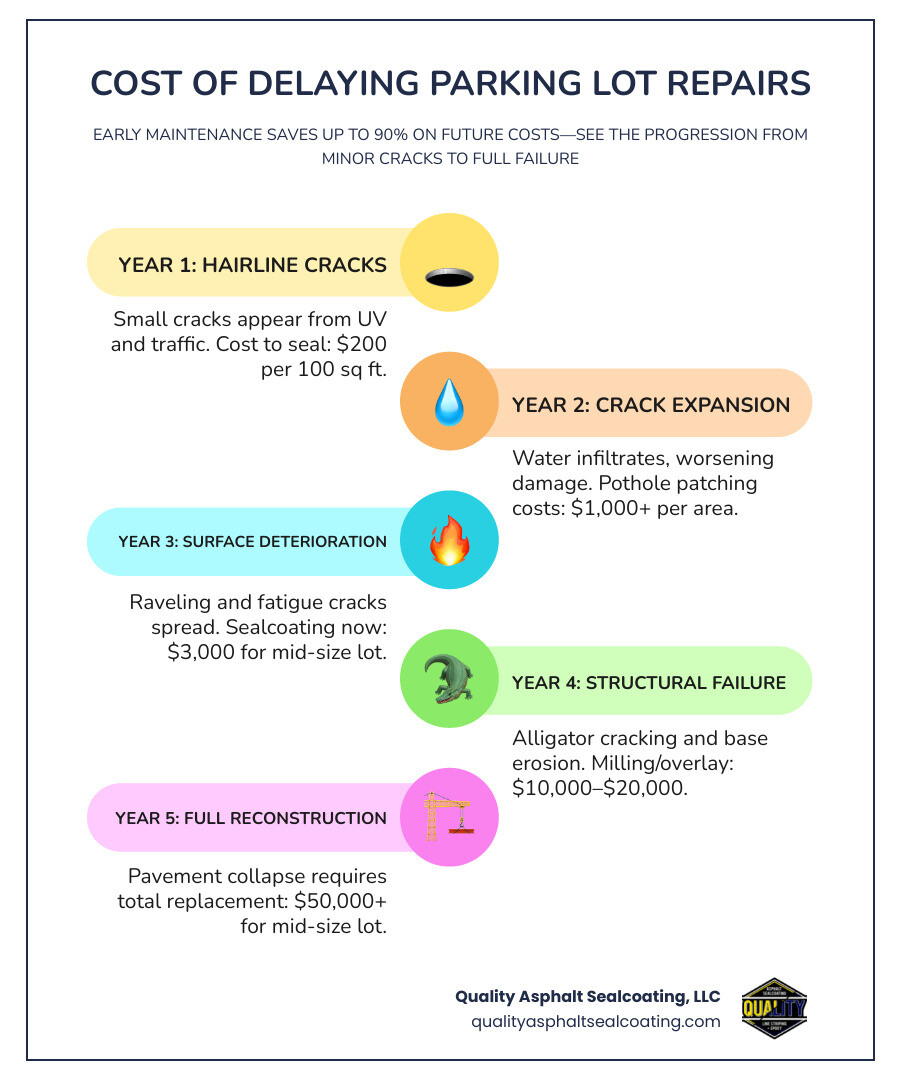
The numbers tell the story. Waiting just one year to repair small cracks can multiply your costs by 3 to 6 times. Ignore minor surface damage, and you’re looking at $20,000+ for full reconstruction of a mid-size lot. Meanwhile, early crack sealing prevents 90% of long-term structural damage for a fraction of that cost.
The risks go beyond money. Potholes create trip hazards and vehicle damage claims. Faded striping can lead to ADA violations with fines up to $75,000 for first-time offenses. Water seeping through unsealed cracks destroys the base layer, turning a $200 repair into a $5,000 emergency.
Property owners often underestimate how quickly asphalt deteriorates. Freeze-thaw cycles, UV exposure, and water infiltration work 24/7 to break down your pavement. What starts as a hairline crack becomes a pothole. What looks like minor surface wear masks major structural failure underneath.
This guide shows you how to identify damage early, understand professional repair methods, and make smart decisions between spot fixes and complete resurfacing. You’ll learn when DIY makes sense and when calling professionals saves you money in the long run.
Identifying Common Damage Before You Fix Your Parking Lot
Before we grab the shovels, we need to play detective. Not all asphalt damage is created equal. Some issues are purely cosmetic, while others are screaming that your foundation is about to give up the ghost. In Rhode Island, our pavement takes a beating from the Atlantic humidity and those brutal winter “Nor’easters.”
Spotting Early Signs of Structural Failure

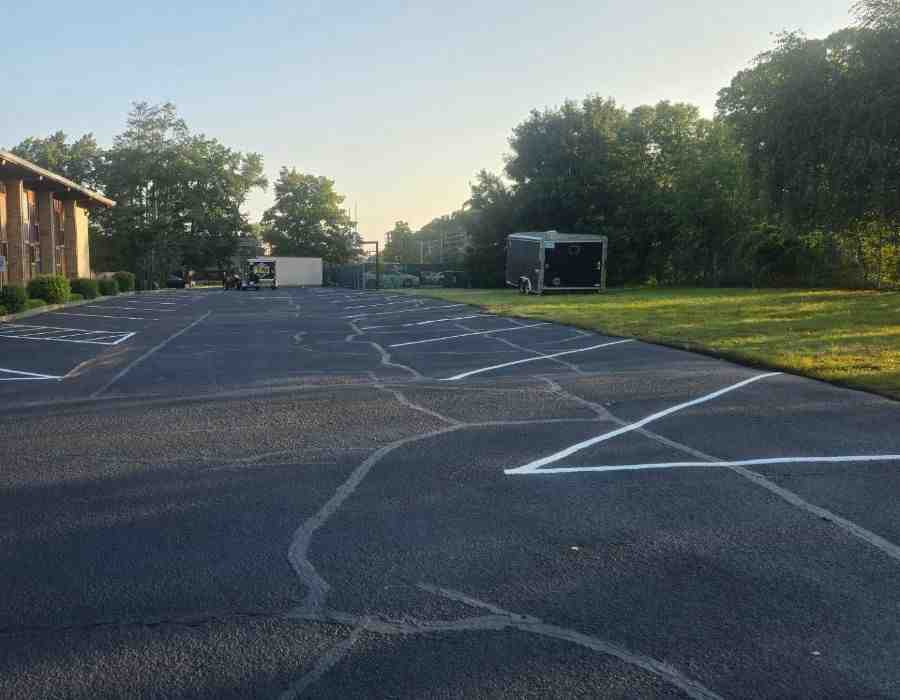
The most dreaded sight for any property owner is fatigue cracking, commonly known as “alligator cracking.” It looks exactly like it sounds—a series of interconnected cracks that resemble the scales on an alligator’s back. This isn’t just a surface blemish; it’s a sign that the base layer or the soil underneath has reached its breaking point.
When heavy vehicle loads repeatedly roll over a spot where the sub-base is saturated or weak, the asphalt flexes until it snaps. Once you see alligator cracks, water has a direct highway to your foundation. If you don’t fix parking lot issues like this immediately, the entire section will eventually collapse into a pothole.
Other early warning signs include:
- Raveling: This happens when the “glue” (asphalt binder) breaks down, leaving loose gravel on the surface. It makes your lot look like it’s shedding.
- Ruts: These are depressions that form in the wheel paths of heavy traffic. If you see ruts, your asphalt mix might be too soft for the weight it’s carrying, or the sub-grade is shifting.
- UV Oxidation: That rich black color fades to a dull gray. This means the sun is baking the oils out of your asphalt, making it brittle and prone to snapping.
Why Drainage is the Root of Most Problems
If asphalt had a mortal enemy, it would be standing water. Nine steps for effective parking lot pothole repair almost always begin with looking at where the water goes. Poor drainage is the silent destroyer of pavement integrity.
When water pools for more than 24 hours after a rainstorm, it’s a red flag. This moisture seeps into the tiny pores of the asphalt. In Rhode Island, the “freeze-thaw cycle” is our biggest headache. That water inside the pavement freezes, expands, and literally blasts the asphalt apart from the inside out.
We often find that drainage failures stem from:
- Clogged Catch Basins: Leaves and trash block the grates, turning your lot into a pond.
- Grade Depressions: Over time, the ground settles, creating “birdbaths” where water sits and waits to cause trouble.
- Improper Surface Pitch: If the lot wasn’t graded correctly during installation, water will always find the path of least resistance—usually straight into your sub-base.
The Professional Process: How to Fix Parking Lot Potholes and Cracks
When the damage moves beyond what a broom and some willpower can handle, it’s time for professional intervention. We use a systematic approach to ensure that a repair doesn’t just look good today but stays solid for years to face the New England weather.
Using Hot Rubber to Fix Parking Lot Cracks
Crack sealing is the single most cost-effective maintenance task you can perform. But we aren’t just pouring liquid into a gap. To truly fix parking lot cracks, we use a specialized rubberized sealant.
The process follows a strict step-by-step asphalt crack repair guide:
- Cleaning: We use high-pressure air or wire brushes to remove every bit of dirt, debris, and vegetation. If you seal over a weed, that weed will grow right through your new repair.
- Preparation: The crack must be dry. We often use a “heat lance” to dry out moisture and warm the asphalt edges for a better bond.
- Application: We apply the hot rubberized sealant (usually around 350-400 degrees). This material is designed to remain flexible. When the Rhode Island ground freezes and expands, the rubber stretches. When it gets hot in July, it contracts.
- Finishing: We use a squeegee to create a “bandage” over the crack, ensuring a watertight seal.
Professional Methods to Fix Parking Lot Potholes
Potholes are more than just an eyesore; they are “tire eaters.” A professional fix parking lot pothole repair is much more involved than just throwing a bag of cold patch into a hole and driving over it with your truck.
Here is how we do it for lasting results:
- Square-Cutting: We use a saw or jackhammer to cut out the damaged area in a neat square or rectangle. This provides vertical edges for the new asphalt to bond against.
- Debris Removal: We dig out the old, crumbled asphalt and check the base. If the base is soft, we replace it with fresh gravel and compact it.
- Tack Coat: We apply a “glue” (bituminous liquid asphalt) to the edges and bottom of the hole.
- Hot Mix Asphalt: We fill the hole with hot mix asphalt—the same stuff used on highways.
- Compaction: This is the secret sauce. We use a vibratory plate compactor or a roller to squeeze out all the air pockets. Proper compaction ensures the patch is level with the surrounding surface and won’t sink later.
| Repair Type | DIY Cold Patch | Professional Hot Mix |
|---|---|---|
| Longevity | 6-12 months | 5-10 years |
| Material | Liquid-based mix | Heated aggregate mix |
| Strength | Low (Temporary) | High (Structural) |
| Finish | Often rough | Smooth and level |
Maintenance Strategies to Extend Asphalt Lifespan
Think of maintenance like changing the oil in your car. You can skip it, but you’ll eventually be paying for a whole new engine. With the right strategy, a well-maintained lot can last up to 30 years.
The Role of Sealcoating in Preventative Care
Sealcoating is your parking lot’s suit of armor. It provides a protective layer that guards against UV rays, oil spills, and water penetration. Skipping sealcoating cuts lifespan by 50% because the asphalt is left defenseless against the elements.
When we perform commercial sealcoating, we typically use a high-quality asphalt emulsion. We recommend a two-coat application:
- The First Coat: Penetrates the pores and bonds to the surface.
- The Second Coat: Provides the wear layer and that deep, “new-lot” black finish.
Beyond protection, sealcoating dramatically boosts your property’s curb appeal. A fresh black lot with crisp lines makes your business look professional and successful.
ADA Compliance and Safety Striping
If your parking lot lines are fading, you’re not just risking a fender bender; you’re risking a massive legal headache. The Americans with Disabilities Act (ADA) guidelines are very specific about the number of accessible spaces, their dimensions, and their signage.
Faded or non-compliant striping can result in fines of up to $75,000 for a first-time offense. When we handle re-striping services, we ensure:
- Correct number of van-accessible spots.
- Proper blue and white handicap symbols.
- Clear “No Parking” hatched areas.
- Bright, visible directional arrows and stop bars to keep traffic flowing safely.
Repair vs. Resurface: Making the Smart Financial Choice
Every property owner eventually asks: “Can I just patch this, or do I need to start over?” This is where professional honesty matters. We hate to see people waste money on patches that won’t hold because the structural integrity is gone.
When Spot Repairs Are No Longer Enough
We generally follow the 25% Rule: If more than 25% of your parking lot is covered in alligator cracks or deep potholes, spot repairs are no longer cost-effective. At that point, you are just playing “pavement whack-a-mole.”
You should consider an asphalt overlay (resurfacing) when:
- The surface is heavily raveled and brittle.
- There are multiple depressions and drainage issues.
- The lot is 15-20 years old and showing its age.
- You want a long-term solution (8-10 years of life) without the massive cost of a full reconstruction.
Resurfacing involves milling down the top layer of old asphalt and laying a fresh 1.5 to 2-inch layer of new hot mix on top. It’s the “middle ground” that saves you from the $20k+ bill of ripping everything out to the dirt. Check out our guide on resurfacing vs. full reconstruction for a deeper dive into the costs.
Choosing a Qualified Paving Contractor
Not all “guys with a truck” are created equal. In Rhode Island, you want someone who understands our specific soil and climate. When looking to fix parking lot issues, look for these credentials:
- Local Experience: Have they worked in RI for at least a decade?
- Insurance and Licensing: Never hire a contractor without workers’ comp and liability insurance.
- Safety Training: Are they familiar with OSHA safety certifications?
- References: A reputable company will have a portfolio of local commercial and residential work they are proud to show off.
Frequently Asked Questions about Parking Lot Repair
How long does a well-maintained asphalt parking lot last?
With a consistent maintenance schedule, an asphalt lot can last 20 to 30 years. “Well-maintained” means sealing every 2-3 years, filling cracks as soon as they appear, and ensuring the drainage remains clear. Without this care, you might be looking at a full repave in as little as 10-12 years.
Can I fix parking lot cracks myself?
For very minor hairline cracks in a small area, a DIY crack filler from a hardware store can work as a temporary Band-Aid. However, DIY products often lack the bonding strength and flexibility of professional-grade hot rubber. If you have deep cracks or a large area, the DIY approach usually fails within one winter, leading to more expensive repairs later.
How often should I sealcoat my parking lot?
We recommend sealcoating every 2 to 3 years. If your lot has extremely high traffic (like a busy retail center), you might need it every 2 years. If it’s a low-traffic office lot, you can usually push it to 3. The goal is to re-apply the protective barrier before the previous layer wears thin and the asphalt starts to gray.
Conclusion
At Quality Asphalt Sealcoating, LLC, we’ve seen it all. From tiny cracks that were caught just in time to massive sinkholes that started as a “small puddle.” As a family-owned Rhode Island business with over 23 years of experience, we treat every lot like it’s our own.
Whether you’re managing a commercial shopping center in Providence or a residential driveway in Warwick, we have the specialized equipment and local expertise to do the job right. Don’t let a $200 crack turn into a $20,000 reconstruction project.
Investing in your pavement today protects your property value, ensures the safety of your visitors, and keeps your business looking its best. Ready to get a clear picture of your lot’s health? Book a professional parking lot inspection today and let us help you extend the life of your asphalt for decades to come.