Why Commercial Grade Sealcoat Matters for Your Pavement Investment
Commercial grade sealcoat is a professional-strength pavement sealer designed to protect asphalt surfaces from oxidation, water damage, and chemical deterioration. Unlike consumer products found at hardware stores, commercial sealers contain higher solids content (typically 47-57% vs. 40-43%), polymer additives, and specialized surfactants that deliver superior durability and longevity.
Quick comparison of commercial vs. consumer grade sealcoat:
| Feature | Commercial Grade | Consumer Grade |
|---|---|---|
| Solids Content | 47-57% | 40-43% |
| Coverage | 85-100 sq ft/gallon | 50-75 sq ft/gallon |
| Lifespan | 2-5 years | 1-2 years |
| Packaging | 55-gal drums, 275-gal totes | 5-gal buckets |
| Additives | Polymers, rubberizers | Minimal |
| Traffic Rating | Heavy commercial | Light residential |
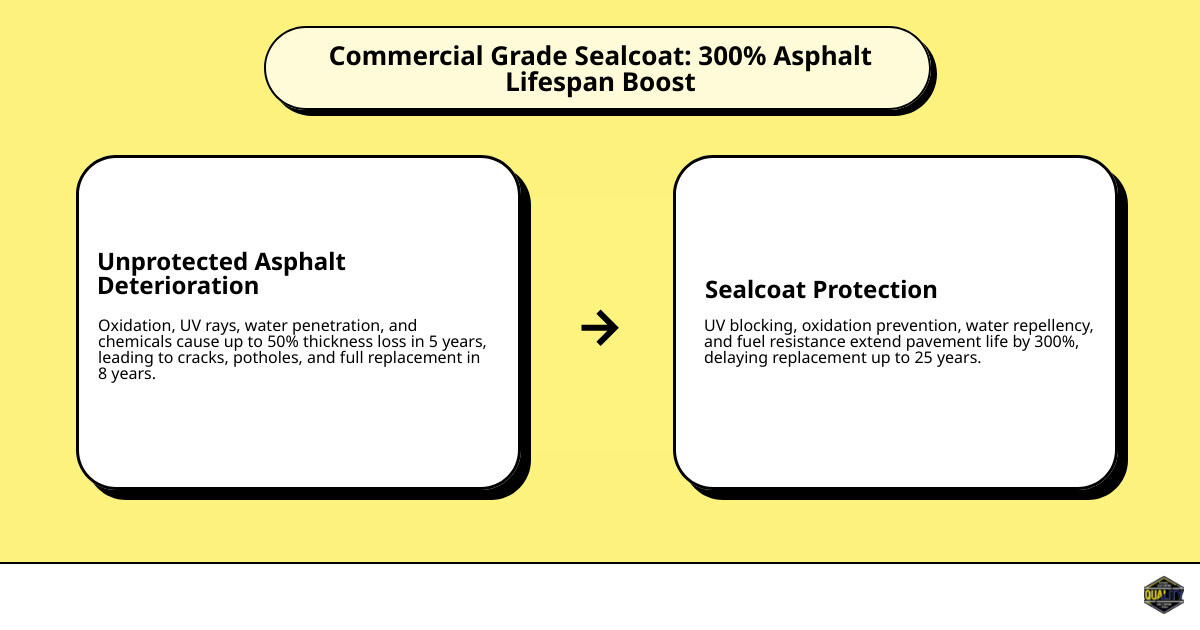
If you’ve noticed your asphalt driveway or parking lot fading to gray, developing spiderweb cracks, or forming potholes, you’re watching oxidation rob your pavement of its lifespan. Research shows that unprotected asphalt surfaces can lose up to 50% of their original thickness in just five years due to sun exposure and weathering.
The good news? Proper sealcoating with commercial-grade products can extend pavement life by as much as 300%. That’s the difference between replacing your parking lot in 8 years versus 25 years.
This guide evaluates the top commercial sealcoat products available, compares different sealer types, and helps you understand what professionals use to achieve long-lasting results. Whether you’re managing a commercial property or maintaining your own driveway, understanding commercial grade options can save you thousands in premature replacement costs.
Understanding Commercial Grade Sealcoat vs. Consumer Products
When you walk into a big-box hardware store, the buckets of “driveway sealer” you see are often a far cry from what we use on professional job sites. Think of it like the difference between a DIY craft kit and industrial-strength construction materials.

Commercial grade products are formulated with a significantly higher solids content. While a standard consumer sealer might be mostly water, a commercial grade sealcoat is packed with refined tar or asphalt resins, minerals, and specialized polymers. This higher concentration means that once the water evaporates, you are left with a much thicker, tougher membrane on your pavement.
One of the best ways to think about sealcoating is as sunscreen for your asphalt. Just as UV rays damage your skin, they break down the “glue” (liquid asphalt) that holds the sand and rocks together in your driveway. Consumer products often lack the robust UV blockers and rubberized additives found in professional mixes. These additives provide wear resistance against heavy vehicle traffic and help the sealer stay flexible during the freeze-thaw cycles we experience here in Rhode Island.
Key Benefits of Commercial Grade Sealcoat
Why go through the effort of sourcing professional-grade materials? The benefits go far beyond just a pretty black finish.
- UV Protection and Oxidation Prevention: By blocking the sun’s rays, you prevent the asphalt from becoming brittle and gray.
- Fuel and Chemical Resistance: Commercial sealers, especially coal tar or high-quality hybrids, resist damage from gasoline, oil, and road salt—common enemies of any parking lot.
- Water Repellency: Sealed surfaces prevent water from seeping into the sub-base, which is the leading cause of potholes and structural failure.
- Beautification: Let’s be honest, a deep, matte-black finish makes any property look brand new.
- Cost Savings: Investing in Commercial Parking Lot Sealcoating today prevents the massive expense of a full rip-and-replace project tomorrow.
Calculating Commercial Grade Sealcoat Quantities
Getting the math right is crucial. If you apply it too thin, you won’t get the protection you need; too thick, and it may peel or crack.
Professional coverage rates typically hover around 100 square feet per gallon for a single coat when using a sprayer, or roughly 50 to 60 square feet per gallon for two coats. For example, a standard 55-gallon drum of asphalt emulsion sealer provides approximately 5,500 square feet of coverage for a single coat.
To calculate your needs:
- Measure the length and width of your area to get the total square footage.
- Divide the total square footage by the coverage rate (e.g., 100 for one coat or 50 for two).
- Round up to the nearest drum or tote size.
For larger commercial projects, we often utilize 275-gallon totes, which can cover up to 27,500 square feet, ensuring consistency across the entire surface.
The Main Types of Professional Pavement Sealers
Not all sealers are created equal. Depending on your specific needs—whether it’s an airport runway or a residential driveway—there is a specific “flavor” of sealer that works best.
- Asphalt Emulsion (AE): This is currently the most popular choice. It’s environmentally friendly, emits very low odors, and provides a beautiful dark finish. It is excellent for choosing asphalt emulsion sealer because it has no toxic emissions and offers great anti-slip friction when mixed with sand.
- Coal Tar Emulsion: Known for its “bulletproof” resistance to gas and oil. However, it is permanently banned in some states and certain municipalities due to environmental concerns and skin-irritating fumes.
- Gilsonite: A solvent-based sealer that actually penetrates the asphalt to rejuvenate the binder. It’s a premium product often used on older, very dry pavements.
- Hybrid Sealers: These combine the best of both worlds, offering the environmental benefits of asphalt emulsion with the fuel resistance of coal tar.
- Acrylic Sealers: Often used for specialty surfaces (like tennis courts), these are very durable and come in various colors, though they are typically more expensive.
Pros and Cons of Different Sealer Types
| Sealer Type | Pros | Cons |
|---|---|---|
| Asphalt Emulsion | Eco-friendly, deep black color, user-friendly | Less resistant to oil/gas spills |
| Coal Tar | Maximum fuel resistance, very durable | Fumes, skin irritant, restricted in some areas |
| Gilsonite | Rejuvenates old asphalt, fast drying | Higher cost, solvent-based |
| Acrylic | Color options, extremely long-lasting | Expensive, specialized application |
Top Recommended Brands for Commercial Projects
When we look for a commercial grade sealcoat, we stick to brands that meet rigorous ASTM (American Society for Testing and Materials) and FAA (Federal Aviation Administration) standards.
SealMaster
As one of the world’s largest manufacturers, SealMaster is a staple in the industry. Their PMCTS (Polymer-Modified Coal Tar Sealer) is a powerhouse, fortified with rubber polymers for added flexibility. It’s designed for high-traffic areas and dries to a flat black matte finish that lasts 2 to 3 years.
STAR-SEAL
STAR-SEAL Pro Blend is another favorite among professionals. It uses “hot blending” technology to catalyze rubber and polymers directly into the refined tar. This results in unmatched water repellency and toughness. It’s the type of product that airports and high-demand clients rely on for safety and durability.
Asphalt Kingdom Big A
For those looking for high-quality asphalt emulsion, the Big A line offers professional results with a focus on ease of use and fast drying times. Their premium formulations often dry in 3 to 4 hours under ideal conditions, which is a lifesaver for businesses that can’t afford long closures.
Specialized Formulations for High-Traffic Areas
For drive-thrus, bank lanes, or busy intersections, we often use a “slurry” mix. This involves adding 300-500 lbs of sand per 100 gallons of sealer, along with rubberized latex additives like TopTuff. This creates a skid-resistant, heavy-duty surface that can withstand the constant “power steering” abuse of turning tires.
Preparation and Application for Professional Results
You could buy the most expensive sealer in the world, but if you put it on a dirty surface, it will peel off in weeks. Preparation is 90% of the job.
- Surface Cleaning: We use high-powered blowers, wire brooms, and sometimes pressure washers to remove every speck of dust, dirt, and loose gravel.
- Crack Filling: Before sealing, all cracks larger than 1/4 inch must be treated. Using Crack Filling Mastics Services ensures that water cannot penetrate the surface.
- Pothole Repair: Any structural failures must be patched with hot or cold asphalt mix before the sealer is applied.
- Oil Spot Priming: Oil and gas stains are “eaten” by sealer unless they are primed first with a product like Petro Seal.
- Curing New Asphalt: If you just paved your driveway, you must wait at least 90 days for the oils to cure before applying a sealer.
For a deep dive into these steps, check out The Complete Guide to Parking Lot Maintenance.
Professional Application Methods and Tools
There are three main ways to apply commercial grade sealcoat:
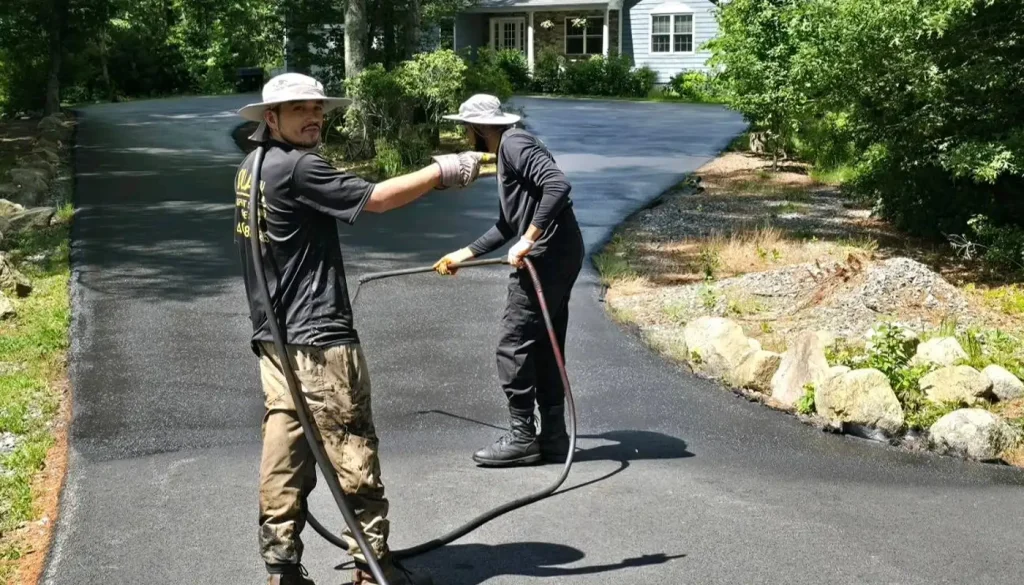
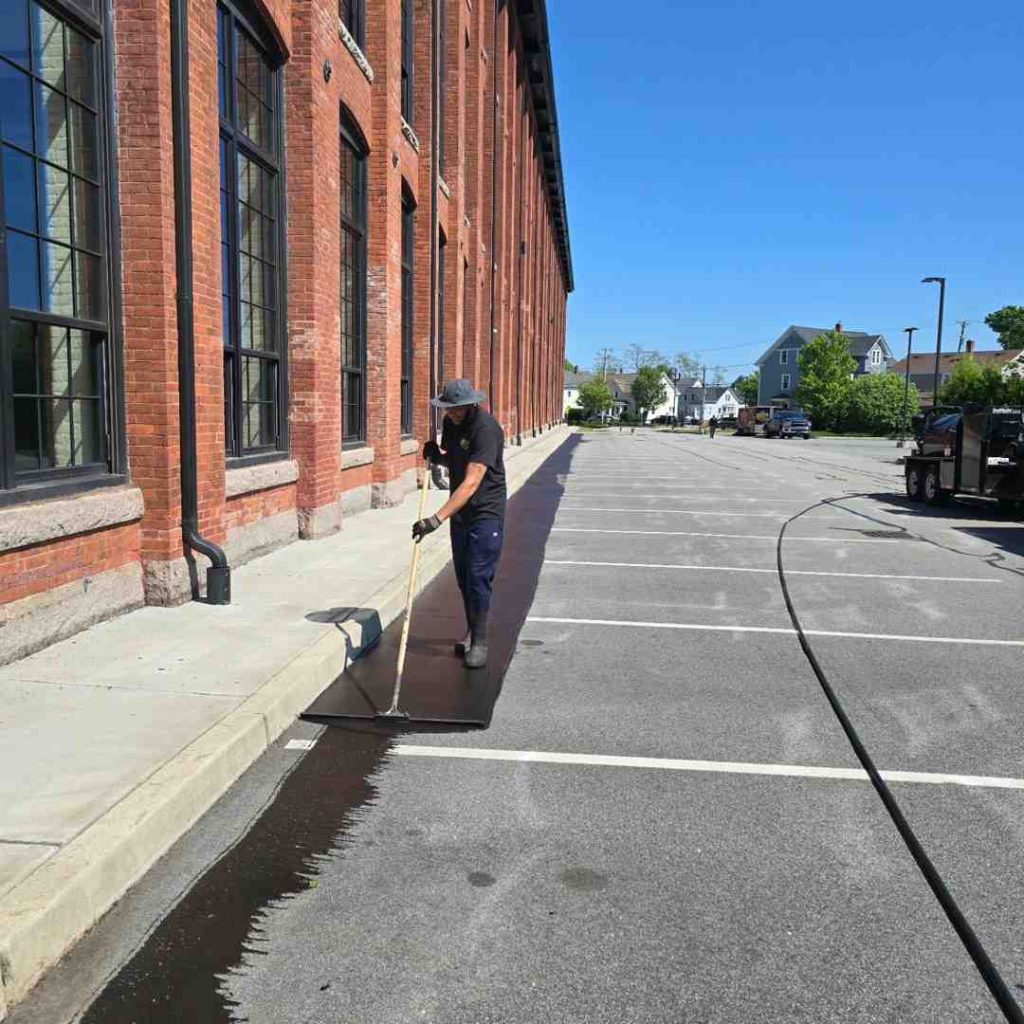
- Squeegee Application: This is the gold standard for residential driveways and smaller commercial lots. It “presses” the sealer into the pores of the asphalt, ensuring a tight bond.
- Spray Systems: For large parking lots, high-pressure spray systems allow for a fast, uniform coat. Professional sprayers often include agitation systems to keep sand and additives suspended in the mix.
- Brush Finishing: Often used for edges to ensure a clean line without overspray on your grass or Belgian block.
Pro Tip: We only apply sealer when the temperature is at least 50°F and rising. In Rhode Island, our season typically runs from early April to late October.
Maximizing Your Investment: Maintenance and Longevity
Think of sealcoating as a recurring health check for your pavement. A well-maintained asphalt surface can last 25 years or more, while a neglected one might fail in less than 10.
We recommend a sealcoating cycle of every 2 to 3 years. This frequency depends on traffic volume and the harshness of our winters. driveway becomes susceptible to cracking as soon as the binder begins to oxidize. By staying ahead of the damage, you prevent that 50% thickness loss mentioned earlier.
For homeowners, our Driveway Sealcoating Services provide the same commercial-grade protection used on major retail lots, tailored for the residential environment.
Post-Application Care and Best Practices
- Curing Time: Stay off the surface for at least 24 to 48 hours. Even if it feels dry to the touch, it needs time to “bridge” and harden.
- Tire Scuffing: On hot days, you might see temporary tire marks. Don’t panic! These are normal and will fade as the sealer fully cures over 2-3 weeks.
- Debris Removal: Keep your pavement clean. Sand and salt act like sandpaper under your tires, wearing down the sealer prematurely.
- Chemical Spills: If you spill gas or oil, soak it up with a cloth immediately. Avoid using harsh degreasers or power washers on fresh sealer.
Frequently Asked Questions about Commercial Sealcoating
How long does commercial grade sealer take to dry?
Under ideal conditions (sunny, low humidity, 70°F+), a premium sealer dries in 3 to 4 hours for foot traffic. However, we always recommend waiting 24 hours before driving a vehicle on it to ensure the bond is fully set.
Should I hire a professional or DIY with commercial products?
While you can do it yourself, applying commercial grade sealcoat requires specialized equipment like spray rigs, heavy-duty mixers for sand-loaded sealer, and professional-grade crack melters. Most “DIY” sealers sold to the public are lower quality. Hiring a professional ensures you get the materials and know-how required for a finish that lasts years, not months.
What are the ideal weather conditions for application?
The “sweet spot” is a clear, sunny day between 60°F and 90°F. Humidity should be low to allow for evaporation. In Rhode Island, we closely monitor the forecast to ensure no rain is expected for at least 24 hours after we finish the job.
Conclusion
Choosing a commercial grade sealcoat is the smartest move you can make for your property’s longevity. By opting for higher solids, polymer-modified formulas, and professional application, you aren’t just painting your driveway black—you’re armor-plating it against the elements.
At Quality Asphalt Sealcoating, LLC, we bring over 23 years of family-owned expertise to every project in Rhode Island. We understand the local climate and know exactly which products will stand up to our New England winters. From pothole repair to precision line striping, we use only the top-tier materials to ensure your pavement stays beautiful and functional for decades.
Ready to protect your investment? Explore our full range of Services and let us help you “seal the deal” on a perfect pavement.