

What Road Line Markings Mean — and Why They Matter
Road line marking is the system of painted lines, symbols, and colors on road surfaces that guide drivers, protect pedestrians, and keep traffic moving safely.
Here’s a quick reference for the most common road markings:
| Marking | Color | Meaning |
|---|---|---|
| Solid line | Yellow | No passing, separates opposing traffic |
| Broken line | Yellow | Passing allowed when safe |
| Solid line | White | Stay in lane, same-direction traffic |
| Broken line | White | Lane changes permitted |
| Double solid lines | Yellow | No passing in either direction |
| Edge line | White | Road boundary |
| Diamond | White | HOV lane, high-occupancy vehicles only |
| Stop bar | White | Stop here at signal or sign |
Every time you drive, you’re reading a silent language. The lines, colors, and symbols painted on the road are telling you where to go, where to stop, and where danger might be ahead.
Most drivers recognize the basics. But many miss the details — and that’s where accidents happen.
Road markings work alongside traffic signs and signals. Together, they form a complete system of guidance. Without clear, visible markings, drivers make guesses. Guesses cause crashes.
That’s true whether you’re navigating a busy highway, pulling into a parking lot, or crossing a school zone.
This guide breaks down exactly what every line, color, and symbol means — including the rules that apply right here in the US, with a focus on keeping your property and its pavement safe, visible, and compliant.
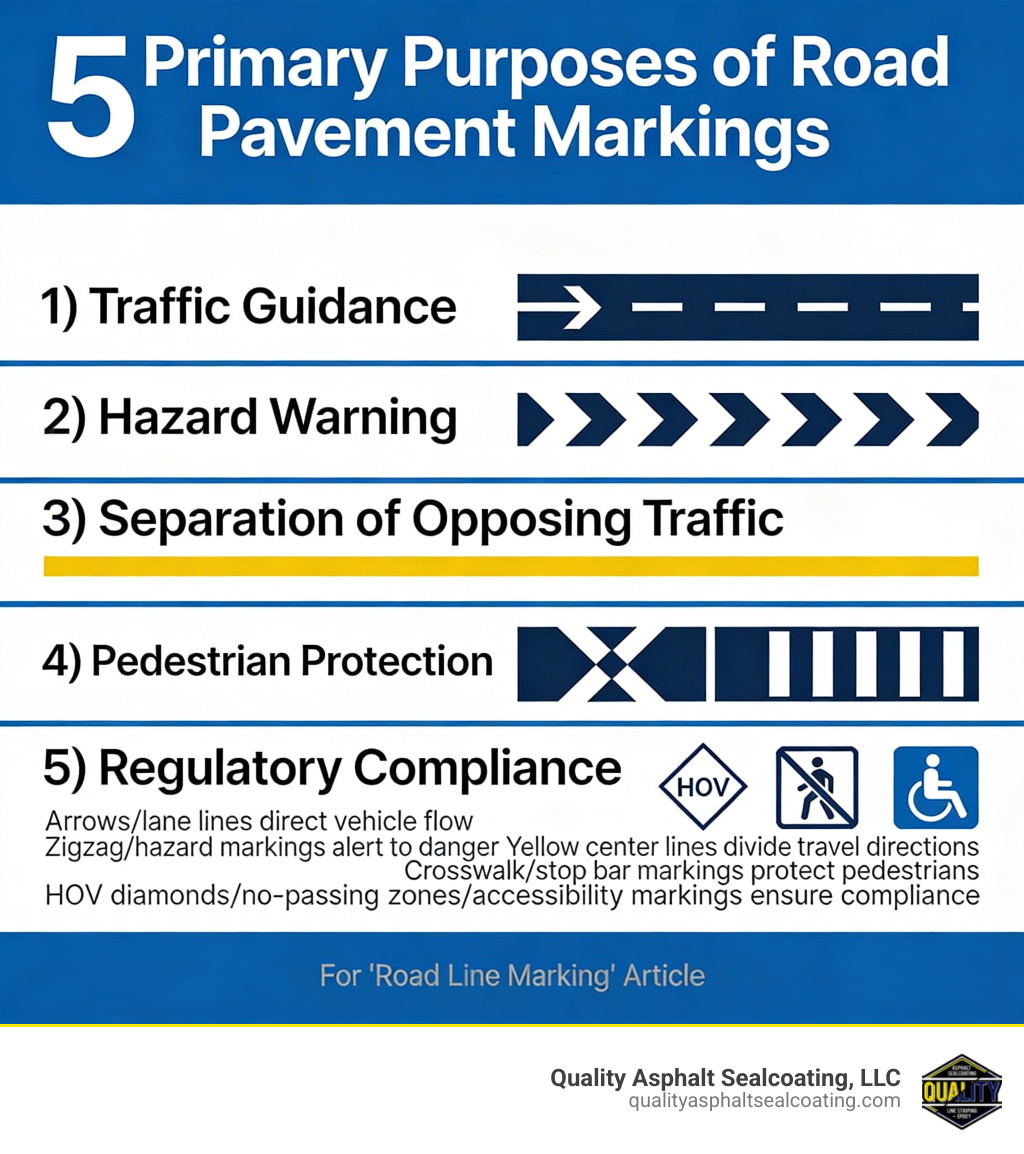
Decoding the Language of road line marking
Think of road line marking as the “horizontal traffic signs” of our world. While a stop sign tells you what to do from a post, the paint on the asphalt tells you exactly where your wheels should be at that very second. We often take these lines for granted, but they are the result of over a century of engineering and safety trials.
Historically, the idea of a center line was born out of necessity. Legend has it that back in 1911, an official in Michigan saw a leaky milk wagon leaving a white trail down the middle of a road and realized it helped keep carriages on their own side. Since then, we’ve moved from leaky milk to high-tech, retroreflective polymers.
Longitudinal vs. Transverse Markings
In pavement marking, we generally categorize lines into two groups:
- Longitudinal Markings: These run parallel to the direction of travel. These are your center lines, lane dividers, and edge lines. They tell you where to stay and whether it’s safe to pass.
- Transverse Markings: These run across the road. Think of stop bars, crosswalks, and railroad crossing symbols. They tell you where to stop or warn you about upcoming changes in the road.
One of the most critical features of modern markings is retroreflectivity. This isn’t just a fancy word to impress your neighbors; it’s a life-saving technology. By embedding tiny glass beads into the paint, the markings catch the light from your headlights and bounce it right back to your eyes. Without this, driving on a rainy night in Rhode Island would feel like driving into a black hole.
For property owners, understanding these markings is just as important as it is for highway engineers. If you manage a commercial lot, pointing the way to safety and efficiency with parking lot arrows is the best way to prevent fender-benders and keep pedestrians safe. Following official guidance on road markings ensures that your property remains compliant and professional.
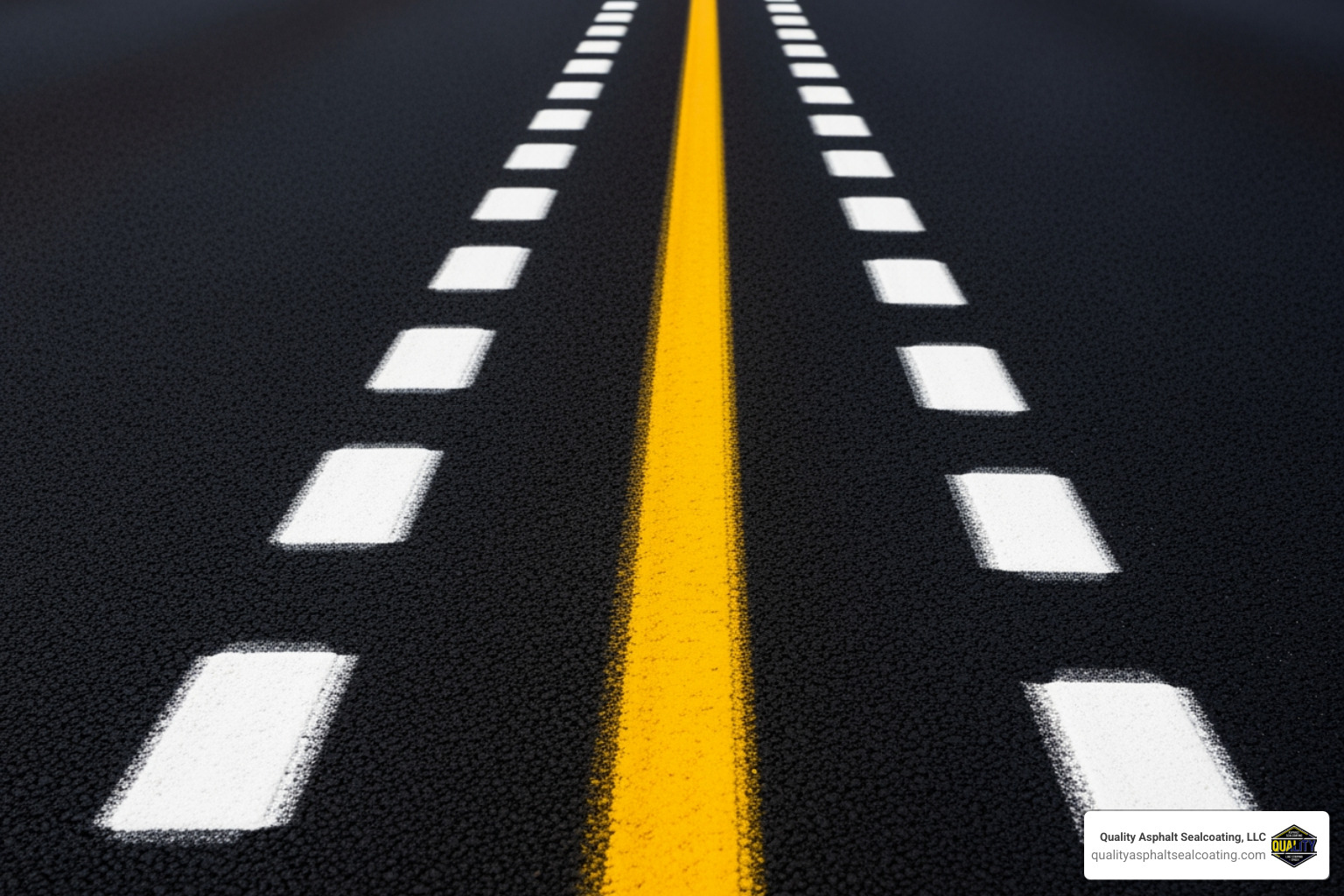
Understanding White and Yellow road line marking Meanings
If you remember nothing else from this guide, remember this: Yellow divides traffic going in opposite directions, and white divides traffic going the same way.
The Yellow Line: Your Safety Divider
Yellow lines are the “do not cross” guardians of the road.
- Solid Yellow Line: When this is on your side of the road, it means “No Passing.” It’s usually placed on curves, hills, or near intersections where you can’t see far enough ahead to pass safely.
- Broken (Dashed) Yellow Line: This means you can pass other vehicles if the way is clear. According to a Texas A&M Transportation Institute survey, about 75% of drivers correctly associate dashed yellow lines with dividing opposing traffic.
- Double Solid Yellow Lines: This is essentially a “wall of paint.” You must never cross these lines to pass. In many regions, crossing them can lead to a hefty fine because it is one of the most dangerous maneuvers a driver can make.
The White Line: Lane Guidance and Boundaries
White lines keep the flow of traffic organized and mark the edges of our world.
- Broken White Lines: These separate lanes of traffic moving in the same direction. You can cross these to change lanes, provided you use your signal (we know, we know, some people forget those exist).
- Solid White Lines: These discourage lane changes. You’ll see these near highway exits or in tunnels. While not always illegal to cross, it’s highly discouraged because it indicates a higher-risk area.
- Edge Lines (Fog Lines): These are the solid white lines on the right side of the road. They help you stay on the pavement during heavy rain or fog. They also help protect the asphalt; when drivers stay off the shoulder, the edge of the pavement lasts much longer.
For a deeper dive into how these standards are set across the country, the Pavement Marking Handbook serves as a technical bible for professionals like us.
Specialized Colors and Symbols in road line marking
Beyond the standard white and yellow, the road occasionally uses a broader palette to communicate specific rules.
Accessibility and Blue Zones
In Rhode Island, we take ADA (Americans with Disabilities Act) compliance very seriously. Blue markings are reserved exclusively for accessibility. This includes parking spaces, access aisles, and loading zones for people with disabilities. As a family-owned business, we always ensure that our commercial clients have crisp, bright blue markings that meet all legal standards. It’s not just about avoiding fines; it’s about making sure your business is welcoming to everyone.
The Power of the Diamond
If you see a large white diamond painted in a lane, you are in a Restricted Lane. Most commonly, these are HOV (High-Occupancy Vehicle) lanes. These are reserved for carpools, buses, and sometimes “green” vehicles. Driving in these without the required number of passengers is a quick way to get an expensive souvenir from the local police.
Pedestrian Protection: Zebra Crossings and Stop Bars
Pedestrians are the most vulnerable road users. Zebra crossings (those wide, longitudinal stripes) and standard crosswalks tell drivers to keep an eye out for people on foot.
- Stop Bars: These are thick, solid white lines that run across the lane at intersections. You are required to stop before your bumper reaches this line. If you stop on top of it, you’re likely blocking the crosswalk.
- Yield Triangles: Also known as “shark’s teeth,” these indicate where you should yield to oncoming traffic, often seen in roundabouts.
For businesses, the art of professional parking lot marking involves more than just lines. It includes custom stenciling for “No Parking” zones, fire lanes, and loading areas to keep your operations running smoothly.
Materials and Technology Behind Durable Pavement Markings
How does paint stay on a road when thousands of cars drive over it every day in the blistering Rhode Island summer and the freezing, plow-filled winter? The answer lies in the chemistry.
Choosing the Right Material
Not all road line marking is created equal. The choice of material depends on the traffic volume and the expected lifespan.
| Material | Typical Lifespan | Best Use Case |
|---|---|---|
| Water-Based Traffic Paint | 9 to 36 months | Parking lots, low-traffic roads |
| Thermoplastic | 3 to 6 years | High-traffic intersections, highways |
| Epoxy Coatings | ~4 years | Industrial floors, heavy-duty roadways |
| Preformed Polymer Tape | 4 to 8 years | Crosswalks and stop bars |
The Science of Thermoplastic
Thermoplastic is a favorite for high-traffic areas. It’s a mixture of plastic resin, pigment, and glass beads that is heated to about 400°F and applied to the road. As it cools, it bonds physically with the asphalt. We use additives for coating plasticity to ensure the material doesn’t become too brittle in the cold or too soft in the heat.
The Magic of Glass Beads
As we mentioned earlier, glass beads are the secret to night visibility. These tiny spheres are dropped onto the wet paint or thermoplastic during application. They act like tiny mirrors, reflecting your headlights back to you. However, quality matters. Low-quality beads can contain heavy metals like arsenic, which is why we only use industry-certified, eco-friendly safety marking spheres.
VOC Limits and the Environment
In the US and Canada, there are strict limits on Volatile Organic Compounds (VOCs) in traffic paints. These regulations ensure that the fumes released during the drying process don’t harm the environment or the workers applying the paint. We pride ourselves on using materials that meet or exceed these safety standards.
Maintenance and Safety: When to Re-stripe
Faded lines aren’t just an eyesore; they’re a liability. When markings disappear, driver confusion goes up, and safety goes down.
The 1-2 Year Cycle
For most commercial parking lots and local roads in Rhode Island, we recommend a re-striping cycle of every 1 to 2 years. Several factors affect this:
- Traffic Volume: The more tires that roll over the paint, the faster it wears away.
- Weathering: Rhode Island winters are tough. Snowplows are the natural enemy of pavement markings. A single bad winter can scrape away a significant portion of your line work.
- Surface Condition: If the asphalt underneath is crumbling, the paint won’t stay. That’s why re-striping your parking lot often goes hand-in-hand with crack filling and sealcoating.
The Role of Sealcoating
Sealcoating is like a protective “sunscreen” for your pavement. It blocks UV rays, prevents water from seeping into the subbase, and provides a jet-black canvas that makes your new white and yellow lines pop. When you combine professional line striping with sealcoating, you aren’t just making the lot look better; you’re extending the life of your asphalt by years.
ADAS Compatibility
Here is a “future-proof” fact: Modern cars with Advanced Driver-Assistance Systems (ADAS)—like lane-keep assist—rely on cameras to “see” the road. If your lines are faded, the car’s computer can’t find the lane, and those safety features become useless. Keeping your markings crisp is now a requirement for the high-tech vehicles on our roads today.
Frequently Asked Questions about Pavement Markings
How often should road markings be re-striped?
Generally, you should re-stripe every 1 to 2 years. However, if you notice that the lines are no longer reflective at night or if more than 25% of the paint has worn away, it’s time to call in the professionals. High-traffic areas like entranceways will always wear out faster than individual parking stalls.
What is the difference between paint and thermoplastic markings?
Standard traffic paint is an affordable, quick-drying option perfect for parking lots and lower-traffic areas. Thermoplastic is a thicker, more durable material that is melted onto the road. While thermoplastic costs more upfront, it lasts significantly longer in high-stress areas like busy intersections or highway lane dividers.
Why are glass beads added to road markings?
Glass beads provide “retroreflectivity.” Without them, the paint would be very hard to see at night. The beads catch the light from vehicle headlights and send it back toward the driver, making the lines appear to “glow” in the dark.
Conclusion
At the end of the day, road line marking is about one thing: getting everyone home safely. Whether we are painting a complex intersection or a small family-owned storefront parking lot, we bring the same level of precision and care to every project.
Quality Asphalt Sealcoating, LLC has been serving Rhode Island for over 23 years. As a family-owned business, we understand the local climate and the specific challenges our pavement faces. From the salt on the roads in January to the humidity in July, we know what materials work best to give you lasting, professional results.
Clear markings reduce your liability, improve your property’s curb appeal, and ensure you are compliant with all safety regulations. Don’t wait until the lines disappear and accidents start happening. Schedule your line striping and pothole repair services with us today and let us help you “read the road” with confidence.

