Why Commercial Pavement Maintenance Protects Your Investment
Commercial pavement maintenance is the systematic care of asphalt and concrete surfaces through regular inspections, preventive treatments, and timely repairs to extend lifespan, reduce costs, and maintain safety standards.
Key maintenance tasks include:
- Routine inspections every 6-12 months to catch problems early
- Crack sealing to prevent water infiltration and base damage
- Sealcoating every 3-5 years to protect against UV rays and oxidation
- Line striping to maintain ADA compliance and safety
- Drainage maintenance to prevent water pooling and structural failure
- Professional repairs for potholes, spalling, and surface deterioration
Your parking lot is one of the first things customers see when they visit your property. Cracked pavement, faded striping, and potholes don’t just look bad—they create safety hazards and potential liability issues.
The good news? Proactive maintenance costs far less than reactive repairs. Research shows that maintaining pavement in good condition costs a fraction of what you’ll spend fixing problems after they escalate. Small cracks turn into potholes. Surface damage allows water to penetrate the base. What starts as a minor issue becomes a major expense.
Most commercial properties wait too long to address pavement problems. By the time they call for help, a simple crack sealing job has turned into a complete resurfacing project. The difference in cost can be tens of thousands of dollars.
This guide walks you through everything you need to know about commercial pavement maintenance—from understanding the signs of distress to selecting the right contractor. Whether you manage a retail center, office complex, or industrial facility, you’ll learn how to protect your investment and keep your pavement in excellent condition for decades.
The Importance of Proactive Commercial Pavement Maintenance
In property management, there are two ways to handle your pavement: you can be the person who fixes a small leak before the ceiling falls in, or you can be the person swimming in their basement. We prefer the former.
Proactive commercial pavement maintenance is a forward-thinking strategy. It’s about intercepting small defects—like those tiny hairline cracks that seem harmless—before they evolve into structural nightmares. For commercial properties in Rhode Island, where our winters are less “winter wonderland” and more “freeze-thaw-repeat,” this proactive approach is non-negotiable.

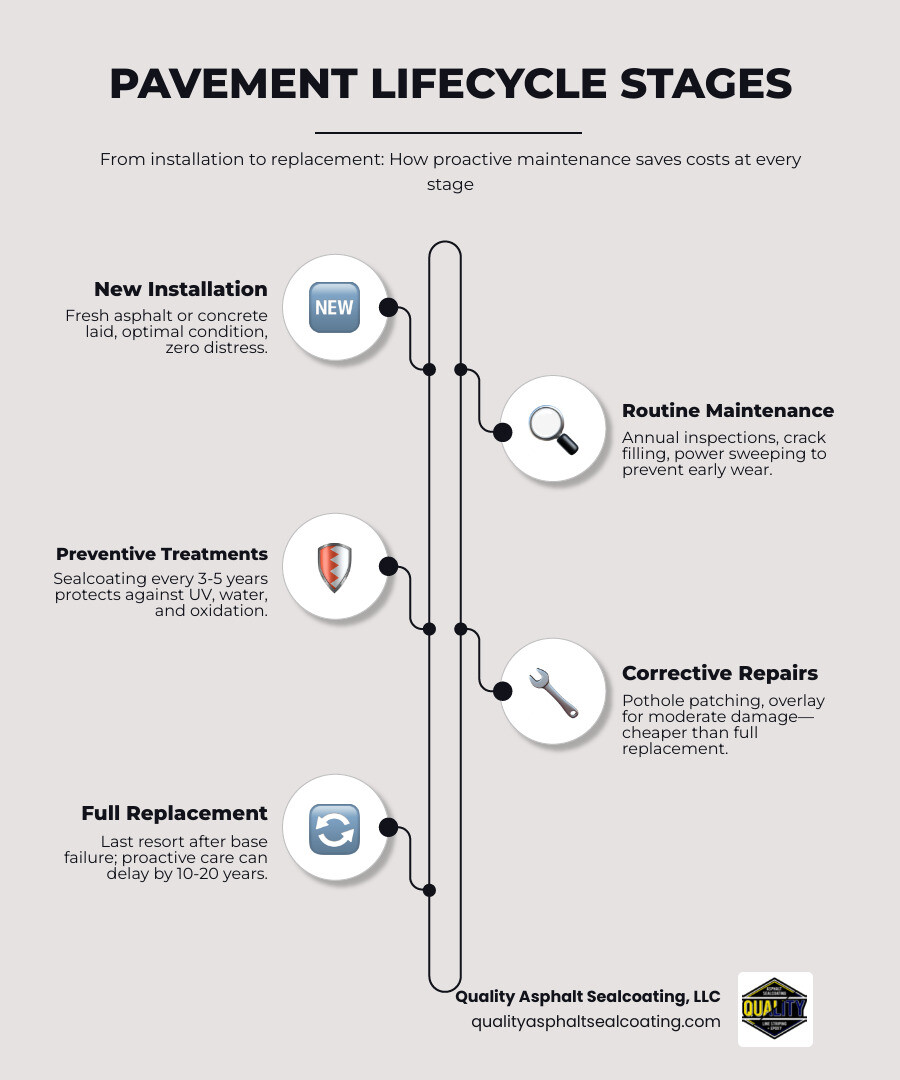
When we talk about proactive vs. reactive maintenance, the difference is usually found in your bank statement. Reactive maintenance (often called the “worst-first” approach) means waiting until the pavement is failing to do anything. By then, you aren’t just maintaining; you’re reconstructing. Proactive maintenance, however, focuses on asset preservation. By applying treatments while the pavement is still in “good” condition, we can keep it there for a lot longer.
Beyond the money, there is the massive issue of liability. As a business owner, you are responsible for the safety of everyone who walks or drives on your lot. A single pothole or an uneven surface can lead to insurance claims, legal headaches, and a tarnished reputation. By staying ahead of repairs, you significantly reduce these risks.
For a deeper look at how these choices impact your bottom line, check out our Deep Dive into Asphalt Maintenance Expenses.
The Long-Term ROI of Commercial Pavement Maintenance
Let’s talk numbers, because we know that’s what matters to your board or your budget. Pavement is an asset, much like a roof or a fleet of vehicles. If you ignore it, it depreciates rapidly. If you maintain it, the Return on Investment (ROI) is staggering.
Industry data suggests that it is significantly less expensive to improve pavement from “good” to “great” than it is to move it from “poor” to “fair.” In fact, some studies show that every $1 spent on early preservation can save $6 to $10 in future rehabilitation costs.
When we implement a maintenance plan, we aren’t just spending money; we’re buying time. A well-maintained asphalt parking lot can last several decades. Without maintenance, you might be looking at a total replacement in as little as 10 to 12 years. By spreading out the costs of sealcoating and crack filling over the years, you avoid the massive “sticker shock” of a $100,000+ repaving project.
Best Practices for Commercial Pavement Maintenance Scheduling
Consistency is the secret sauce. You wouldn’t wait five years to change the oil in your car, and you shouldn’t wait that long to look at your pavement. Here is the schedule we generally recommend for Rhode Island commercial properties:
- Routine Visual Inspections: These should happen every 6 to 12 months. Ideally, walk your lot in the spring (to see what the winter did) and in the fall (to prepare for the coming snow).
- Annual Crack Filling: Cracks are the gateway for water. Filling them every year prevents the subgrade from softening.
- Sealcoating Every 3-5 Years: Depending on your traffic volume, a fresh coat of sealer every few years keeps the asphalt flexible and protected from UV rays.
- Line Striping Every 1-2 Years: Faded lines are a safety hazard. Keeping them crisp ensures proper traffic flow and ADA compliance.
For more information on the full scope of upkeep, see The Complete Guide to Parking Lot Maintenance.
Essential Maintenance Tasks for Asphalt and Concrete
Whether your property uses asphalt, concrete, or a mix of both, there are specific tasks that simply cannot be skipped.
Routine Inspections and Cleaning
It sounds simple, but keeping a lot clean is a form of maintenance. Power sweeping removes abrasive sand and debris that acts like sandpaper under the weight of car tires. Removing oil spots quickly is also vital; oil and gasoline are solvents that literally dissolve the binder in asphalt, leading to soft spots and eventual potholes.
Concrete-Specific Care
While concrete is often touted as “low maintenance,” it isn’t “no maintenance.” Commercial concrete installation can cost between $5 and $12 per square foot, so protecting that investment is key.
- Joint Resealing: Concrete joints are designed to allow for thermal expansion and contraction. If the sealant in these joints fails, water gets underneath the slabs, leading to “pumping” and slab failure. We recommend resealing joints every five years.
- Sealing: Concrete should be sealed immediately after installation and every few years thereafter to prevent salt damage and moisture penetration.
For those who want to get into the weeds of the technical side, the Concrete Preservation Guide offers a wealth of scientific research on the topic.
Professional Crack Filling and Sealcoating
If water is the “villain” in our story, crack filling is the “hero.” When water enters a crack, it seeps into the base layers. In Rhode Island, that water freezes, expands, and pushes the pavement up. When it thaws, it leaves a void. The next car that drives over that void creates a pothole.
We use professional-grade, flexible, rubberized sealants for crack filling. Why flexible? Because pavement moves! As temperatures change, cracks expand and contract. A rigid filler will just pop out, but a flexible one stays bonded to the edges. Any crack wider than 1/4 inch should be handled by a professional immediately.
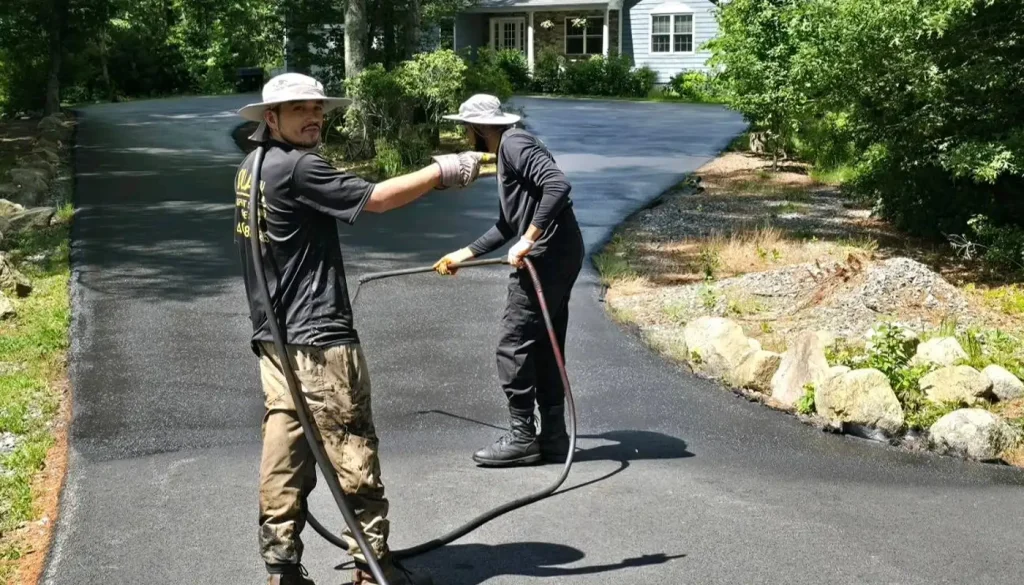
Sealcoating is the “sunscreen” for your lot. Asphalt is a petroleum-based product. When exposed to the sun’s UV rays, it undergoes oxidation. The oils that keep it flexible dry out, leaving the surface brittle and gray. Sealcoating provides a sacrificial layer that takes the brunt of the UV damage, keeping the asphalt underneath dark, supple, and strong.
Learn more about these specific services here:
Pavement Markings and ADA Compliance
Maintenance isn’t just about the surface integrity; it’s about the function. Line striping is what turns a giant slab of blacktop into an organized parking lot.
Proper markings include:
- Traffic Flow: Arrows and stop bars that prevent accidents.
- Fire Lanes: Ensuring emergency vehicles have clear access.
- ADA Compliance: This is a big one. The Americans with Disabilities Act has strict requirements for the number of accessible spaces, their dimensions, and their signage. Failing to maintain these can lead to heavy fines and legal action.
We recommend re-striping every 1-2 years to keep the lot looking sharp and safe. After all, Re-Striping Your Parking Lot is More Than Just Paint. For a full breakdown of requirements, see The Ultimate Guide to Pavement Marking Services.
Identifying Signs of Pavement Distress and Drainage Issues
You don’t need to be a paving expert to spot trouble, but you do need to know where to look. Here are the “red flags” that tell us your lot is crying out for help:
- Alligator Cracking: These are small, interconnected cracks that look like the skin of a reptile. This is a sign of structural failure. It usually means the base underneath the asphalt has softened or failed.
- Potholes: The end stage of neglected cracks. Potholes are more than an eyesore; they are a major safety hazard and can damage customer vehicles.
- Standing Water: If you see “birdbaths” (puddles that don’t go away shortly after rain), you have a drainage issue. Water is the #1 enemy of pavement. If it doesn’t run off into a catch basin, it will eventually find a way into the pavement.
- Faded Color: When your lot goes from deep black to ash gray, it’s a sign of heavy oxidation.
- 1/4 Inch Threshold: Take a quarter. If you can fit it sideways into a crack, that crack is large enough to let in significant amounts of water and needs professional sealing.
The Role of Drainage
Proper drainage is the foundation of any long-lasting pavement system. This involves ensuring the lot is graded correctly and that catch basins are clear of debris. We often see lots where the pavement is fine, but the catch basin has collapsed or is clogged with leaves and trash. Regular clearing of these basins is a critical part of your commercial pavement maintenance checklist.
Asphalt vs. Concrete: Choosing the Right Material for Your Property
If you are planning a new project or an expansion, you might be wondering which material is better. The answer depends on your specific needs and budget.
| Feature | Asphalt | Concrete |
|---|---|---|
| Initial Cost | Lower ($2-$5/sq ft) | Higher ($5-$12/sq ft) |
| Lifespan | 20-30 years (with maintenance) | 30-50 years |
| Maintenance | Requires frequent sealcoating/filling | Low maintenance, but joint care is vital |
| Repair Ease | Easy to patch and resurface | Difficult and expensive to repair |
| Cure Time | Drivable in 72 hours | Drivable in 7-14 days |
| Best Use | General parking, long driveways | Dumpster pads, loading docks |
Asphalt is the most popular choice for commercial lots because it is cost-effective and can be repaired easily. It’s also “flexible,” which helps it survive the freeze-thaw cycles of Rhode Island.
Concrete, however, is the king of durability. We always recommend concrete for areas that face “dynamic loads”—specifically dumpster pads and loading docks. When a heavy garbage truck lifts a bin, it exerts incredible pressure on the ground. Asphalt can “rut” or “shove” under that weight, whereas concrete stands firm.
Selecting a Reliable Commercial Paving Contractor
Not all paving companies are created equal. Because commercial projects are larger and more complex than residential ones, you need a partner who understands the stakes. When evaluating a contractor, look for the following:
- Experience: How many years have they been in business? Quality Asphalt Sealcoating, LLC, for example, brings over 23 years of experience to every job.
- Insurance Coverage: Never hire a contractor without proof of general liability and workers’ compensation insurance. If an accident happens on your property, you don’t want to be the one held responsible.
- Specialized Equipment: Commercial jobs require heavy-duty equipment—large-scale sprayers, heat-welded crack fillers, and high-volume striping machines.
- Project Management: Can they work around your business hours? A good contractor will phase a project so that your customers can still access your building while work is being done.
- Safety Certifications: Look for a crew that prioritizes safety and follows all local and federal regulations.
Frequently Asked Questions about Pavement Maintenance
How often should a commercial parking lot be sealcoated?
For most Rhode Island businesses, we recommend sealcoating every 3 to 5 years. If you have a high-traffic lot (like a busy retail center or a 24-hour warehouse), you may need it closer to every 3 years. If the traffic is light, you might get 5 years out of it. The key is to watch for the color change from black to gray.
What is the typical cost per square foot for commercial pavement repairs?
Repair costs vary wildly based on the type of damage. Simple crack filling is very affordable, often charged by the linear foot. Sealcoating is typically priced by the square foot and gets more economical the larger the lot is. For full concrete replacement, expect $5-$12 per square foot. It’s always best to get a professional assessment for an accurate quote.
When is an asphalt overlay better than a full replacement?
An overlay (adding a new layer of asphalt over the old one) is a great option if the “bones” of your lot—the subgrade and base—are still in good shape. If your lot is just ugly and has surface-level cracks, an overlay can add 15-20 years of life at a fraction of the cost of a full replacement. However, if you have widespread alligator cracking or base failure, an overlay is just a “band-aid” that will fail quickly. In those cases, a full replacement is the smarter move.
For more on this, see Asphalt Parking Lot Repair & Resurfacing Expenses.
Conclusion
Maintaining your commercial pavement doesn’t have to be a headache. By shifting from a reactive “fix it when it breaks” mindset to a proactive preservation strategy, you can save thousands of dollars, protect your customers, and keep your property looking its best.
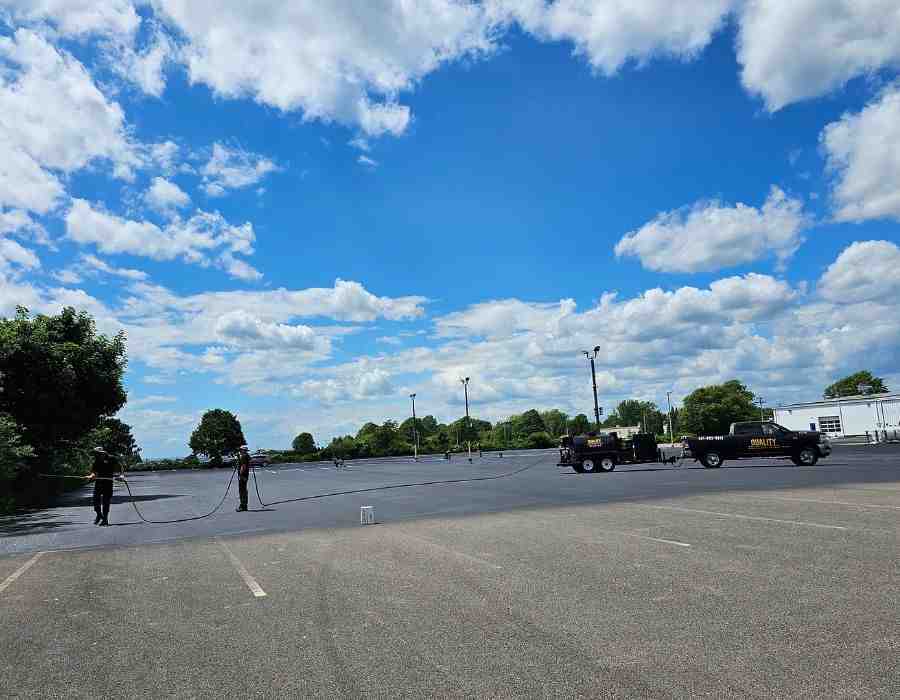
At Quality Asphalt Sealcoating, LLC, we’ve spent over 23 years helping Rhode Island business owners protect their investments. We are a family-owned business that believes in using the highest quality materials and providing honest, expert advice. Whether you need a few potholes patched or a massive retail lot sealcoated and striped, we have the experience and the equipment to get the job done right—without disrupting your business.
Don’t wait for those small cracks to become big problems. Schedule your commercial parking lot sealcoating today and give your pavement the protection it deserves.