
Why Finding the Right Commercial Asphalt Contractor Matters
A commercial asphalt contractor is a professional paving company that specializes in installing, repairing, and maintaining asphalt surfaces for businesses, municipalities, and property managers. When you’re looking to hire one, here’s what you need to know upfront:
Key Services to Expect:
- New asphalt paving – Full parking lot installation or roadway construction
- Resurfacing and overlays – Adding new asphalt layers over existing surfaces
- Crack filling and sealcoating – Preventative maintenance to extend pavement life
- Line striping – Fresh parking space and ADA-compliant markings
- Infrared repairs – Seamless pothole patching using heat technology
- Storm drainage – Managing water runoff to prevent pavement damage
What to Look For:
- Licensed and insured contractors with safety certifications
- Self-performing crews (not subcontractors) for better quality control
- Local expertise in your climate and regulations
- Transparent estimates and clear project timelines
- References from similar commercial properties
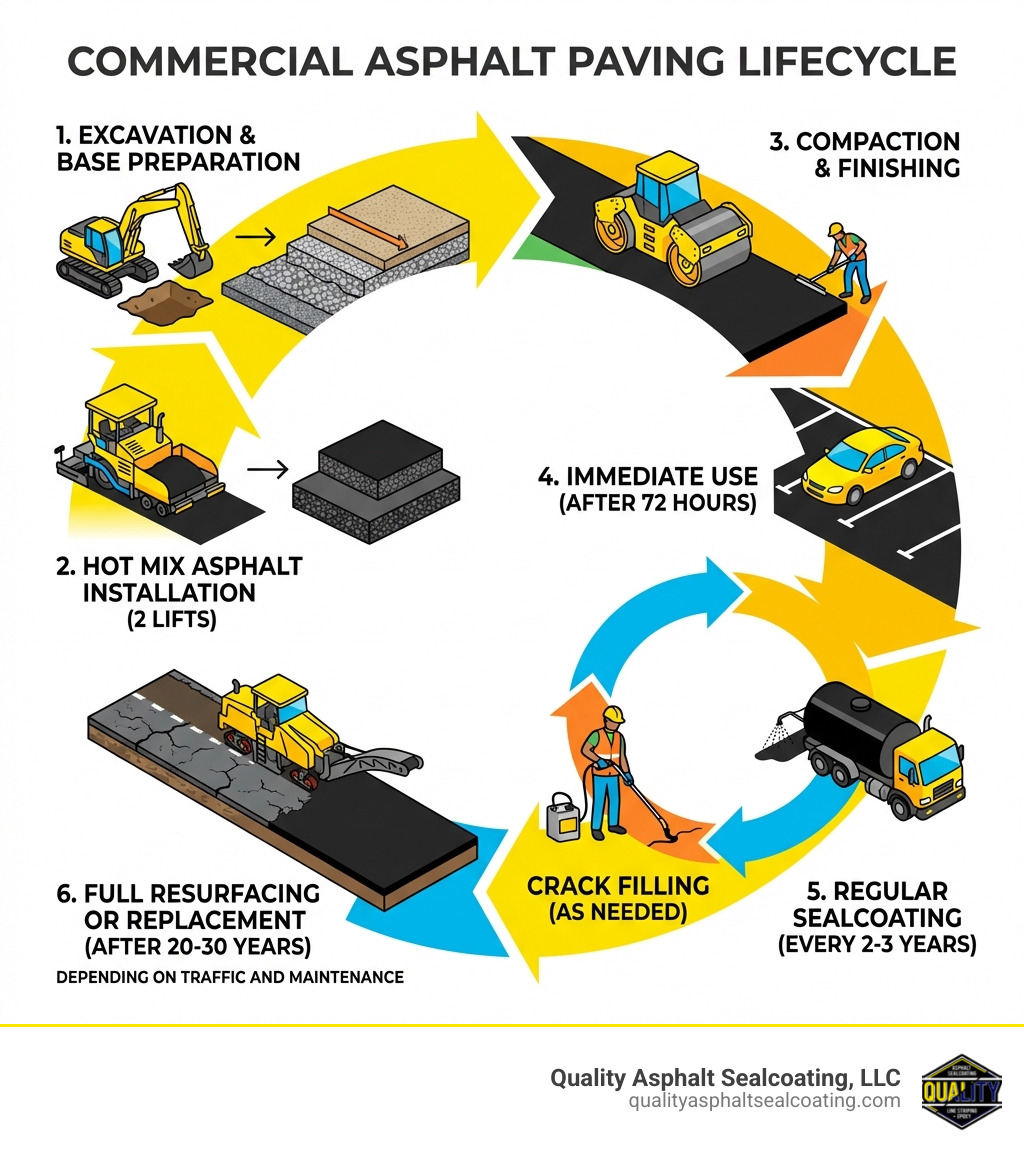
Your parking lot is often the first impression customers get of your business. Cracked, faded asphalt with worn striping doesn’t just look unprofessional—it signals neglect and creates safety hazards. According to industry data, a properly installed commercial parking lot should last approximately 30 years with regular maintenance like sealcoating every 2-3 years.
But here’s the challenge: not all asphalt contractors are created equal. Some cut corners on base preparation, others subcontract work to inexperienced crews, and many provide vague estimates that balloon into unexpected costs.
The good news? Finding a reliable contractor doesn’t have to be stressful when you know what questions to ask and what standards to expect.
Understanding the Services of a Commercial Asphalt Contractor
When you start your search for a commercial asphalt contractor, you might be surprised by the sheer variety of services they offer. It isn’t just about “dumping black stuff on the ground.” A full-service contractor acts as a consultant for your property’s long-term health.
At the core of these services is pavement maintenance, which includes everything from minor cosmetic touch-ups to major structural overhauls. For many businesses in Rhode Island, the most common needs involve line striping and pothole repair services. These are the “quick wins” that immediately improve safety and curb appeal.
However, a truly experienced commercial asphalt contractor provides a much broader toolkit:
- Asphalt Paving: This involves the full installation of new surfaces. It requires heavy machinery, precise grading for drainage, and a deep understanding of soil conditions.
- Infrared Repair: This is a bit like magic for your parking lot. Instead of cutting out a square of asphalt, contractors use infrared rays to heat the existing pavement, mix it with a small amount of new material, and fuse it together for a seamless, water-tight patch.
- Storm Basin Drainage: Water is the mortal enemy of asphalt. If your catch basins are sunken or clogged, water will seep into the base and destroy your lot from the inside out. Expert contractors handle the repair and installation of these critical drainage components.
- Milling: This process involves shaving off the top layer of old asphalt to prepare for a new overlay. It allows us to fix surface damage without raising the height of the entire parking lot, which is crucial for maintaining proper drainage and curb reveals.
- Maintenance Essentials: This includes crack filling and mastics services and commercial parking lot sealcoating. These services are designed to shield the asphalt from the elements.
To see these professionals in action, you can play this overview video of paving experts to understand the scale and precision required for commercial-grade work.
Key Benefits of Choosing Asphalt for Commercial Paving
Why do so many businesses choose asphalt over concrete or gravel? It usually comes down to the “Big Three”: cost, speed, and durability.
- Cost-Effectiveness: Asphalt is significantly cheaper to install than concrete. For a large shopping center or office park, the savings can be tens of thousands of dollars.
- 72-Hour Turnaround: Time is money. While concrete can take weeks to fully cure, most asphalt projects allow for vehicle traffic within 48 to 72 hours. This minimizes the disruption to your tenants and customers.
- Recyclability: Asphalt is the most recycled material in America. Old parking lots are ground up and turned into new ones, making it an eco-friendly choice for businesses with sustainability goals.
- Safety and Visibility: The high contrast between dark asphalt and bright white or yellow line striping makes it easier for drivers to steer and see pedestrians, especially at night or during a classic New England rainstorm.
- 30-Year Lifespan: If you build it right and maintain it well, your asphalt can last three decades. That’s a fantastic return on investment.
Innovations in Modern Asphalt Technology
The industry has come a long way from the “steamroller” days. Modern technology allows a commercial asphalt contractor to work smarter and produce longer-lasting results.
One of the most impressive innovations is infrared technology. As mentioned earlier, this creates a seamless thermal bond between the old and new asphalt. This is particularly useful in Rhode Island, where freeze-thaw cycles often create “seams” in traditional patches that eventually fail.
We also see the use of polymer-modified cold mix for emergency repairs. Unlike the “bagged” stuff you find at a hardware store, professional-grade cold mix is engineered to be a permanent solution. It stays workable even in freezing temperatures, allowing us to fix dangerous potholes in the middle of a New England winter when hot-mix plants are closed. These weather-independent repairs ensure that your property stays safe year-round.
How to Select a Reliable Commercial Asphalt Contractor
Selecting a contractor shouldn’t feel like a game of Russian Roulette. You need to look for specific “green flags” that indicate professionalism and reliability.

One of the most important distinctions to make is whether a contractor is self-performing. In the paving world, many companies are just “middlemen” who sell the job and then hire the cheapest subcontractor they can find. This often leads to poor communication and inconsistent quality.
| Feature | Self-Performing Contractor | Subcontractor-Heavy Company |
|---|---|---|
| Quality Control | High (same crew, same standards) | Variable (depends on who is hired) |
| Communication | Direct and fast | Often delayed through a salesperson |
| Equipment | Company-owned and maintained | Varies; may use rented gear |
| Accountability | Full responsibility for the work | Often points fingers at the sub |
Beyond the self-performing model, check their safety records. A reputable commercial asphalt contractor should have a strong rating from the National Council of Compensation (NCC). This rating reflects how safe their job sites are. If they have a poor rating, it’s a sign of a disorganized crew—and that’s a liability you don’t want on your property.
Always verify licensing and insurance. In Rhode Island, specialized commercial work requires specific credentials. Don’t be afraid to ask for a certificate of insurance (COI) that lists you as an additional insured. This protects you if an accident happens on your property.
Finally, look for a 10-step project procedure. Professional contractors don’t just “show up and spray.” They have a documented process that includes site evaluation, utility marking (DigSafe), grading, and a final walkthrough.
Why Local Expertise Matters in a Commercial Asphalt Contractor
You might see nationwide companies advertising paving services, but there is a distinct advantage to hiring a local Rhode Island expert. Our regional climate is brutal on pavement. We deal with heavy humidity in the summer and punishing ice and salt in the winter.
A local commercial asphalt contractor understands the “New England mix.” They know which asphalt grades handle the freeze-thaw cycle best. They also have deep roots in the community, meaning they are familiar with local municipal regulations and drainage requirements. Plus, sourcing materials locally—like recycled asphalt product (RAP) from nearby plants—keeps costs down and supports our local economy.
Ensuring Safety and Minimal Business Disruption
We know that closing your parking lot for three days can be a nightmare for business. A top-tier contractor prioritizes strategic scheduling. This might mean working in sections (phasing) so that half the lot is always open, or performing the work on weekends or overnight.
Safety is non-negotiable. Experienced crews use Certified Traffic Control Supervisors (TCS) to manage vehicle and pedestrian flow. They ensure that work zones are clearly marked and compliant with state laws.
Furthermore, they pay close attention to ADA compliance. If your handicap ramps are too steep or your parking spaces aren’t marked correctly, you could face significant fines. A professional contractor knows the exact measurements required to keep your property legal and accessible. For more on these standards, many professionals attend the National Pavement Expo to stay updated on the latest safety regulations.
Planning Your Project: Resurfacing vs. Full-Depth Replacement
One of the biggest questions property owners face is: “Do I need a new parking lot, or can I just fix the one I have?”
The answer starts with understanding the expenses involved. To give you an accurate recommendation, a commercial asphalt contractor will often perform core testing. This involves drilling a small hole in your pavement to see what’s happening underneath.
If the “sub-grade” (the soil and gravel under the asphalt) is still strong, you might be a candidate for an asphalt overlay. This is where we mill off the top inch or two of old asphalt and lay a fresh “top coat.” It’s much more affordable than a full replacement and can add 10-15 years to your lot’s life.
However, if the core test shows that the base is soft or “pumping” mud, an overlay is just a Band-Aid. In this case, full-depth replacement is necessary. This involves excavating down about a foot, installing 4-6 inches of new gravel base, and then laying the asphalt in two “lifts”: a binder course for strength and a finish course for smoothness.
In some cases, we can use pavement fabrics. These are high-tech “blankets” laid between the old and new asphalt to prevent old cracks from “reflecting” up into the new surface.
Common Signs Your Parking Lot Needs Major Repairs
How do you know when it’s time to call in the pros? Watch for these red flags:
- Alligator Cracking: These are small, interconnected cracks that look like the skin of a reptile. This is a sign of structural failure. It means the base can no longer support the weight of the traffic.
- Standing Water: If you have “birdbaths” (puddles) that don’t disappear after a rainstorm, your grading is off. This water will eventually seep down and rot the base.
- Sunken Catch Basins: If the area around your storm drains is dipping, the structure underneath is likely failing. This is a trip hazard and a major drainage issue.
- Deep Potholes: A pothole is more than a nuisance; it’s a sign that the asphalt has completely broken away from the base.
- Graying/Oxidation: If your asphalt has turned light gray, it has lost its essential oils. It’s now brittle and prone to cracking.
Maximizing ROI with Preventative Maintenance
The best way to save money on a commercial asphalt contractor is to hire one before you have a major problem. Think of it like changing the oil in your car.
A solid parking lot maintenance plan is the secret to making your investment last 30 years. The two heavy hitters here are sealcoating and crack filling.
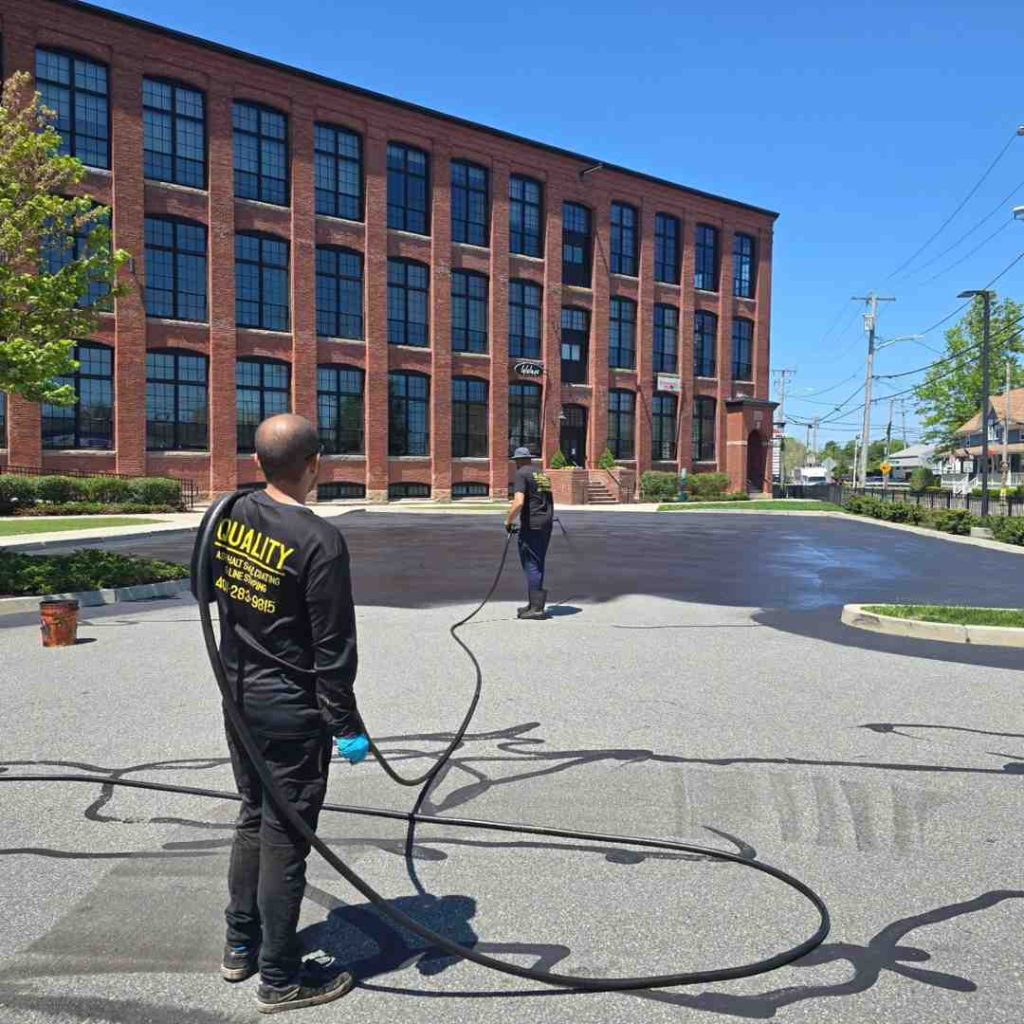
Sealcoating acts as a sunscreen for your pavement. It blocks UV rays that dry out the asphalt and provides a waterproof barrier against rain and snow. Plus, it gives your lot that beautiful, jet-black finish that makes your business look brand new.
Crack filling is even more critical. We focus on cracks that are 1/2″ to 3/4″ wide. By filling these with a hot-applied rubberized sealant, we prevent water from getting under the pavement. Remember: water expands when it freezes. A tiny crack in November can become a massive pothole by March if it isn’t sealed.
By staying on top of these small tasks, you maintain your property’s curb appeal and avoid the massive expense of a full-depth replacement.
What to Expect from Your Commercial Asphalt Contractor
When you finally choose a contractor, the process should be transparent. You should receive a detailed estimate that breaks down the square footage, the depth of the asphalt, and the specific materials being used.
During the project, you’ll notice the asphalt arrives in steaming trucks. It should be between 220°F and 300°F when it’s laid. If it’s too cold, it won’t compact properly and will fail prematurely.
After the work is done, there is a curing period. While you can drive on it in 72 hours, the asphalt stays “soft” for several months as the oils evaporate. Your contractor should give you clear instructions on how to care for it during this time (like avoiding sharp turns with heavy trucks).
Finally, top contractors emphasize long-term relationships. We don’t want to just pave your lot and disappear; we want to be the team you call for sealcoating in two years and striping in four. A good warranty—usually one to two years on workmanship—is a sign that the contractor stands behind their results.
Frequently Asked Questions about Commercial Asphalt
How long does a commercial asphalt installation take?
Most projects are completed in just one to two days, depending on the size of the lot. After the final rolling, we recommend keeping cars off the surface for 72 hours to allow it to harden sufficiently.
What is the difference between asphalt and blacktop?
In the commercial world, these terms are often used interchangeably, but there is a slight technical difference. Asphalt is a high-durability mix used for highways and large parking lots. Blacktop often has a higher percentage of “fines” (smaller stones) and more liquid sealer, which gives it a darker look but slightly less structural strength than heavy-duty commercial asphalt.
How often should a commercial parking lot be sealcoated?
For the best protection in Rhode Island’s climate, we recommend sealcoating every 2 to 3 years. If your lot sees extremely high traffic (like a fast-food drive-thru or a busy retail hub), you might need it every two years to maintain the protective layer.
Conclusion
Finding the right commercial asphalt contractor doesn’t have to be a stressful ordeal. By focusing on local expertise, self-performing crews, and a commitment to preventative maintenance, you can ensure your parking lot remains a safe and attractive asset for your business.
At Quality Asphalt Sealcoating, LLC, we bring over 23 years of experience to every project. As a family-owned Rhode Island business, we understand exactly what our local weather does to pavement, and we use only top-quality materials to fight back. Whether you need a few potholes patched or a complete parking lot overhaul, we are here to build a long-term partnership with you.
Don’t wait for a small crack to become a big liability. Start your commercial parking lot project today and give your business the first impression it deserves!

