

Why Line Marking Pavement Matters for Safety and Compliance
Line marking pavement is the process of applying painted or thermoplastic lines, symbols, and markings to road or parking lot surfaces to guide traffic, define spaces, and improve safety.
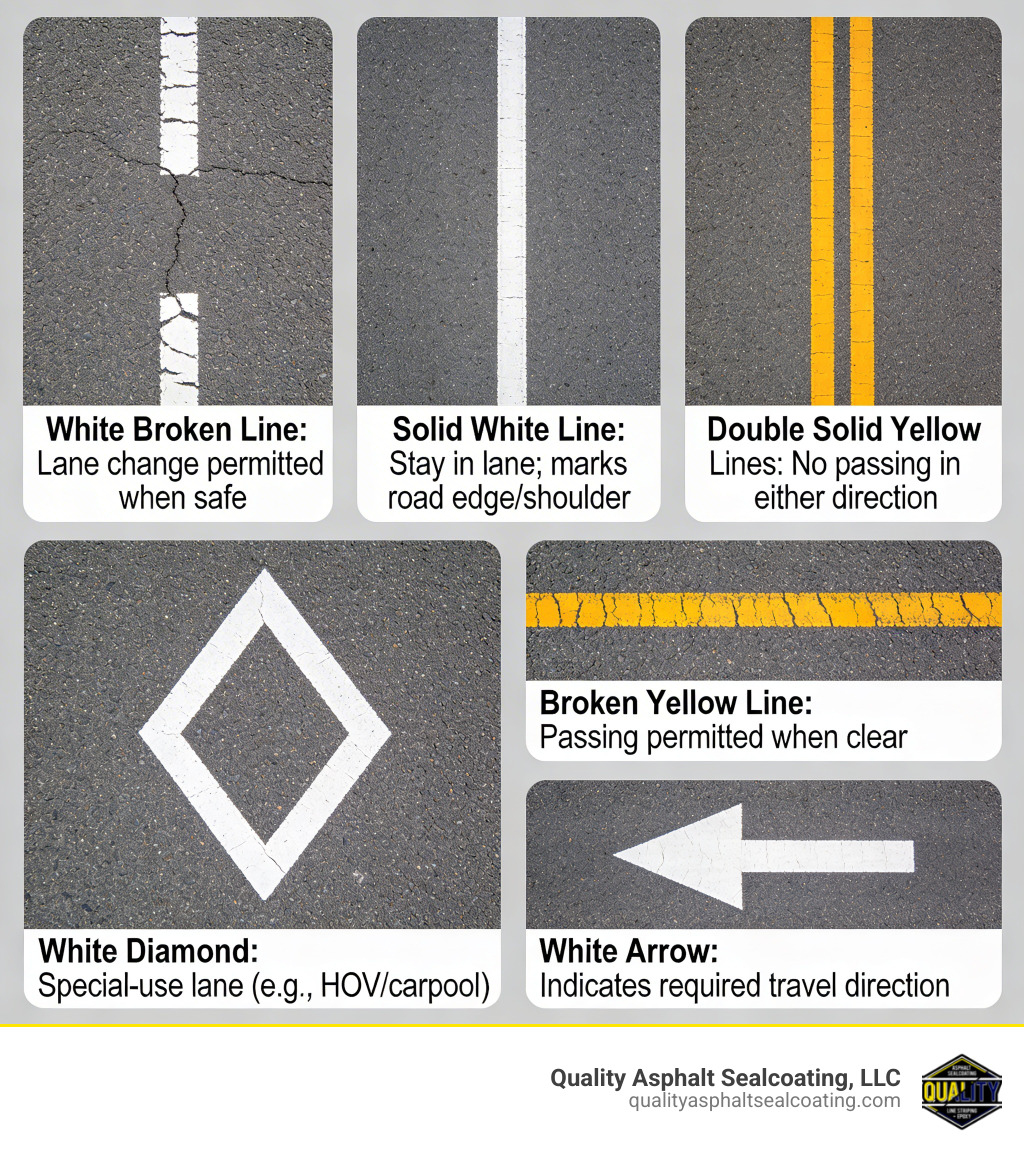
Here’s a quick summary of what the most common pavement markings mean:
| Marking | Color | Meaning |
|---|---|---|
| Broken line | White | Lane change permitted when safe |
| Solid line | White | Stay in lane; marks road edge or shoulder |
| Double solid line | Yellow | No passing in either direction |
| Broken line | Yellow | Passing permitted when clear |
| Edge line | White (right) / Yellow (left) | Marks where pavement ends |
| Diamond symbol | White | Special-use lane (e.g., HOV/carpool) |
| Arrow | White | Indicates required or permitted travel direction |
Every time you drive, park, or walk through a lot, pavement markings are silently doing a big job. They tell you where to go, when to stop, and where it’s safe to pass. Without them, roads and parking lots would be chaotic — and dangerous.
The stakes are real. Studies show that installing center lines, edge lines, and delineators on roadway segments can reduce injury crashes by as much as 45%. On rural curves alone, edge lines cut all crash types by 26–33%.
For property owners, faded or missing markings aren’t just an eyesore. They can mean liability, ADA violations, and unsafe conditions for drivers and pedestrians alike.
This guide covers everything you need to know — from what each line means to what materials last longest and how to keep your pavement markings performing year after year.
Understanding the Language of Line Marking Pavement
Think of line marking pavement as a visual language. Just like a stop sign tells you what to do without using a megaphone, the lines on the asphalt provide a constant stream of information to your brain. In Rhode Island, where our roads can be narrow and our weather unpredictable, these markings are essential for keeping everyone in their own lane.
White lines generally separate traffic moving in the same direction. They also mark the right-hand shoulder of the road. Yellow lines, on the other hand, act as a barrier between you and oncoming traffic. These are known as longitudinal markings because they run along the length of the road.
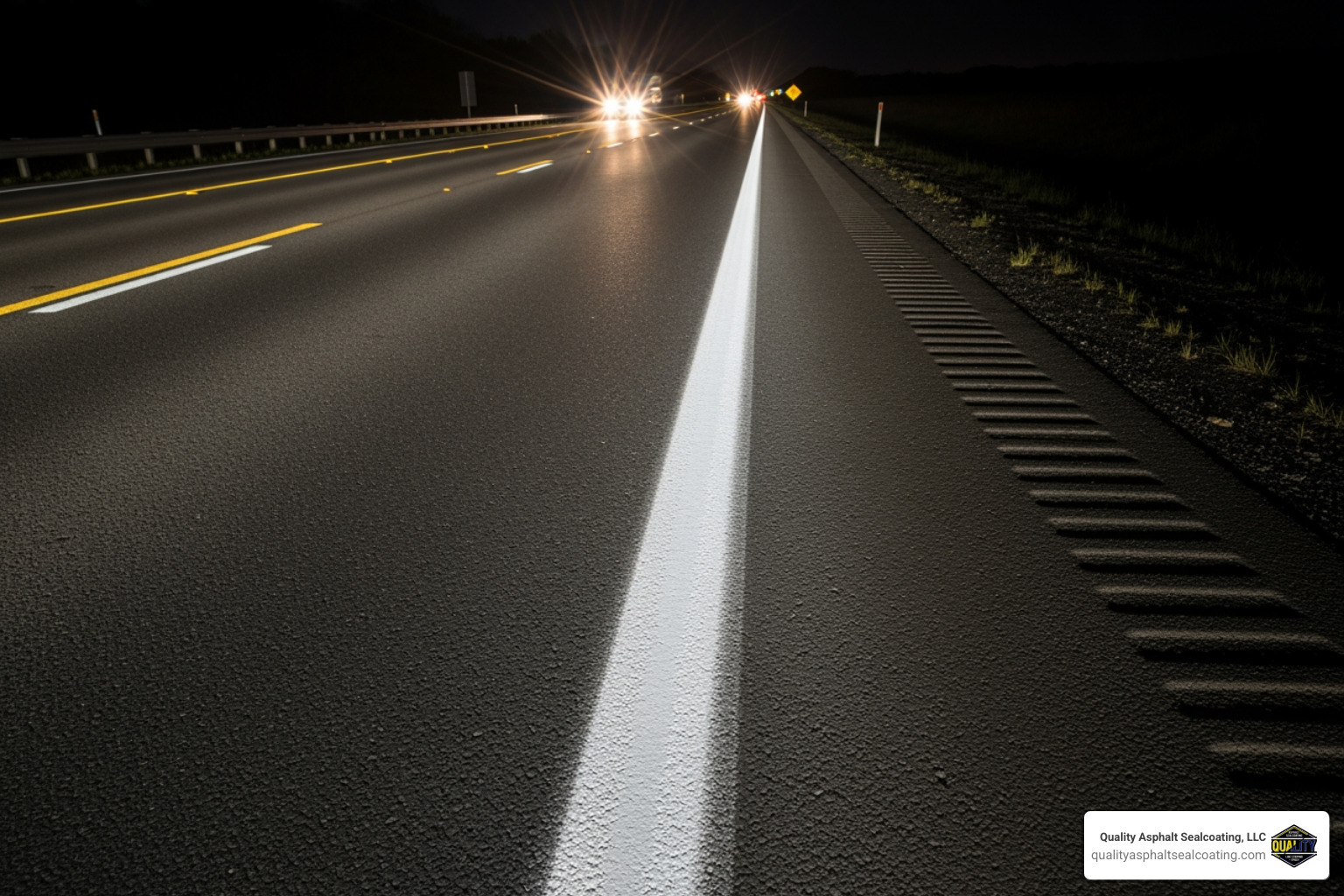
One of the most important features is the edge line. The meaning of edge line pavement markings is to define the limit of the traveled way. These solid lines provide a visual reference that helps motorists avoid drifting onto the shoulder, especially at night when the glare from oncoming headlights can be blinding. If you want to dive deeper into how these markings are applied, check out more info about professional marking services.
Standard Meanings of Longitudinal Lines
To drive safely, you have to know the “code.” The patterns of these lines tell you exactly what is legal:
- Single Broken White Lines: You can cross these to change lanes, but only when it is safe to do so.
- Single Solid White Lines: These discourage lane changes. You’ll often see them near intersections. While not always illegal to cross in every specific scenario, they are a strong warning that moving lanes is risky.
- Double Solid White Lines: Crossing these is strictly prohibited. They are used to separate lanes where lane changes would be extremely dangerous.
- Broken Yellow Lines: These indicate that passing is permitted, provided the road ahead is clear.
- Double Solid Yellow Lines: These are the “walls” of the road. They mean no passing for traffic in either direction.
Understanding these is a core part of The Highway Code for road markings, ensuring that traffic flows predictably and safely.
Specialized Symbols and HOV Lanes
Beyond simple lines, we use symbols to designate “special” parts of the pavement. The diamond symbol is the most recognizable, indicating High-Occupancy Vehicle (HOV) lanes. These lanes are reserved for vehicles with a certain number of passengers, buses, or sometimes motorcycles. You can find detailed High-Occupancy Vehicle lane regulations to understand the entrance and exit rules for these zones.
We also use:
- Pavement Arrows: These tell you which way you must go. If you are in a lane with a “left-only” arrow, you’ve committed to that turn! For property owners, using these correctly in a parking lot is vital for traffic flow. Learn more info about parking lot arrows to see how they prevent head-on “oops” moments in tight lots.
- Reversible Lanes: These are the “transformers” of the road world. Marked by double-broken yellow lines, they change direction based on the time of day to help with rush hour traffic.
The Critical Role of Pavement Markings in Road Safety
We don’t just paint lines because they look neat; we do it because they save lives. The statistics are hard to ignore. For example, adding edge lines to two-lane rural roads with moderate traffic can reduce total crashes by 15% and severe crashes by 19%.
Safety also depends on legibility. If a driver can’t read a word message on the ground in time, it’s useless. That’s why the NCHRP Report 600 on pavement marking legibility specifies that letters must be elongated. When you’re looking at a word like “STOP” from a low angle in a car, those stretched-out letters actually look normal to your eyes.
For local businesses, keeping these markings fresh is part of being a good neighbor. Clear crosswalks and stop bars protect pedestrians, especially in busy Rhode Island town centers. For more on how this works in our communities, read more info about local road striping.
Enhancing Safety on Curves and Rural Roads
Curves are where things get tricky. In rural areas, edge lines on curves can reduce all types of crashes by 26% to 33%. Because curves are high-wear areas (tires cross the lines more often), they require durable materials and smart design.
We often use:
- Speed Advisory Markings: These are painted right in the lane (e.g., “40 MPH”) to warn you before you hit a sharp bend.
- Optical Speed Bars: These are sets of lines spaced closer and closer together. They create an illusion that the driver is speeding up, which naturally causes them to lift off the gas.
- Delineators: These are the little reflective posts that follow the curve, providing a “breadcrumb trail” for the driver’s eyes at night.
ADA Compliance and Accessible Design
If you own a commercial property in Rhode Island, line marking pavement isn’t just about traffic—it’s about the law. The Americans with Disabilities Act (ADA) requires specific markings for handicap stalls and van-accessible aisles.
Failing to meet these standards can lead to heavy municipal penalties and legal headaches. A compliant stall needs:
- The international symbol of accessibility (the person in a wheelchair).
- An adjacent “access aisle” (usually marked with diagonal “hatching” lines) so there’s room for a ramp or lift.
- Proper signage at the head of the stall.
We take this seriously because everyone deserves safe access to local businesses. You can find more info about professional parking lot marking to ensure your lot is up to code.
Professional Pavement Marking Materials and Techniques
Not all paint is created equal. If you used standard house paint on a road, it would disappear after the first few cars drove over it. Professional line marking pavement requires specialized materials designed to withstand thousands of pounds of pressure and the harsh New England winters.
One of the “secret ingredients” in road safety is the use of glass beads. These tiny spheres are dropped into the wet paint during application. When your headlights hit the lines at night, these beads reflect the light back to you. This is called retroreflectivity. For the best results, those beads need to be embedded at exactly 50% of their diameter.
| Feature | Standard Waterborne Paint | Thermoplastic Markings |
|---|---|---|
| Lifespan | 1–2 years | 4–6+ years |
| Drying Time | 10–30 minutes | Almost instant |
| Visibility | Good | Excellent (higher profile) |
| Best For | Low-volume roads/Restriping | High-traffic roads/Intersections |
| Cost | Lower upfront | Higher upfront, lower long-term |
Benefits of Thermoplastic Line Marking Pavement
Thermoplastic is a game-changer for high-traffic areas. It isn’t actually “paint”; it’s a mixture of plastic resins and glass beads that is heated to about 400°F and “extruded” onto the road.
The benefits are massive:
- Durability: It is much thicker than paint, meaning it can survive snowplows and heavy trucks for years.
- Quick Drying: Because it hardens as it cools, traffic can drive over it almost immediately. No more long lane closures!
- Skid Resistance: We can add “friction” elements to the mix so the lines don’t become slippery when wet.
You can learn more about the precision required for these applications in more info about the art of the line.
Surface Preparation and Equipment Requirements
You can have the most expensive paint in the world, but if the pavement is dirty or wet, it won’t stick. We use the “plastic wrap method” to test for moisture: we tape a square of plastic to the asphalt for 15 minutes. If there’s condensation under the plastic, it’s too wet to paint.
Preparation also involves:
- Line Removal: If we’re changing the layout, we have to get rid of the old lines. We use hydro blasting (high-pressure water) or grinding to erase the past without damaging the asphalt.
- Airless Sprayers: These machines provide a crisp, clean edge. They don’t use air to push the paint, which prevents “overspray” and fuzzy lines.
Understanding the prep work is key to a lasting job. Check out more info about the difference between stripping and striping—trust us, it’s a very important distinction!
Maximizing Efficiency with Parking Lot Striping
A well-marked parking lot is a beautiful thing. It maximizes space (meaning more customers can park) and keeps traffic moving smoothly. Beyond just the lines for stalls, we use:
- Curb Painting: Yellow for no-parking zones, blue for handicap access.
- Stall Numbering: Essential for reserved parking or apartment complexes.
- Crosswalks: Keeping pedestrians safe as they walk from their cars to your front door.
A fresh coat of paint makes a property look brand new and well-cared for. It’s the “curb appeal” of the commercial world. For more tips on refreshing your property, see more info about re-striping your parking lot.
Essential Stencils and Directional Arrows for Line Marking Pavement
Stencils allow us to put clear, standardized messages on the ground. This includes “STOP” bars at exits, “FIRE LANE” warnings, and “LOADING ZONE” designations.
We can also do custom stencils! If you want your company logo or a specific branding element on the pavement, custom stenciling is a great way to stand out. These markings help maintain a law-abiding lot and prevent people from parking where they shouldn’t (like right in front of the fire hydrant).
Maintenance and Environmental Considerations
Weather is the biggest enemy of line marking pavement. In Rhode Island, we have to deal with freeze-thaw cycles that can make asphalt expand and contract, causing cracks. That’s why we often integrate line striping with other maintenance.
- Sealcoating: Applying a protective layer to the asphalt before striping protects it from UV rays and water.
- VOC Compliance: We use paints that are low in Volatile Organic Compounds (VOCs) to stay environmentally friendly and compliant with modern regulations.
- Maintenance Schedules: Most commercial lots should be re-striped every 1–2 years to maintain safety and visibility.
To see how we combine these services for a total pavement solution, read more info about line striping and pothole repair.
Frequently Asked Questions about Pavement Markings
What is the difference between standard paint and thermoplastic markings?
Standard paint is a thin film (about 15 mils thick) that is great for low-traffic areas and frequent re-striping. Thermoplastic is a thick, melted plastic (up to 90 mils or more) that is incredibly durable and highly reflective, making it the better choice for busy roads and intersections.
How often should a parking lot be re-striped for safety?
For most Rhode Island businesses, we recommend re-striping every 18 to 24 months. If your lot sees heavy truck traffic or lots of snowplowing in the winter, you might need a touch-up once a year to keep your ADA compliance and safety markings visible.
Is it legal to cross a solid yellow line to enter a driveway?
Yes, in most cases! While a solid yellow line generally means “no passing,” traffic codes usually allow you to cross a yellow line (even a double one) to turn left into a driveway, a commercial entrance, or a parking lot, provided it is safe to do so.
Conclusion
At Quality Asphalt Sealcoating, LLC, we know that the lines on your pavement are more than just paint—they are a commitment to the safety of your customers, employees, and neighbors. As a family-owned Rhode Island business with over 23 years of experience, we’ve seen how proper maintenance can extend the life of your asphalt and prevent accidents.
Whether you need residential sealcoating to protect your driveway or a full commercial re-striping to ensure ADA compliance, we use top-quality materials to get the job right. Don’t let faded lines create a liability for your property.

