

Why Commercial Pavement Maintenance Is the Smartest Investment You Can Make
Commercial pavement maintenance is the ongoing process of inspecting, repairing, and protecting asphalt surfaces on business properties — including parking lots, driveways, and entryways — to keep them safe, functional, and looking their best.
Here’s what a solid maintenance plan typically includes:
- Sealcoating — applied every 2-3 years to block UV rays, water, and chemical damage
- Crack sealing — done annually to stop water from getting into the base layers
- Pothole repair — addressed promptly to prevent accidents and deeper structural damage
- Routine inspections — at least twice a year (spring and fall) to catch problems early
- Line striping — refreshed as needed for safety and ADA compliance
- Drainage management — to prevent standing water from weakening the pavement structure
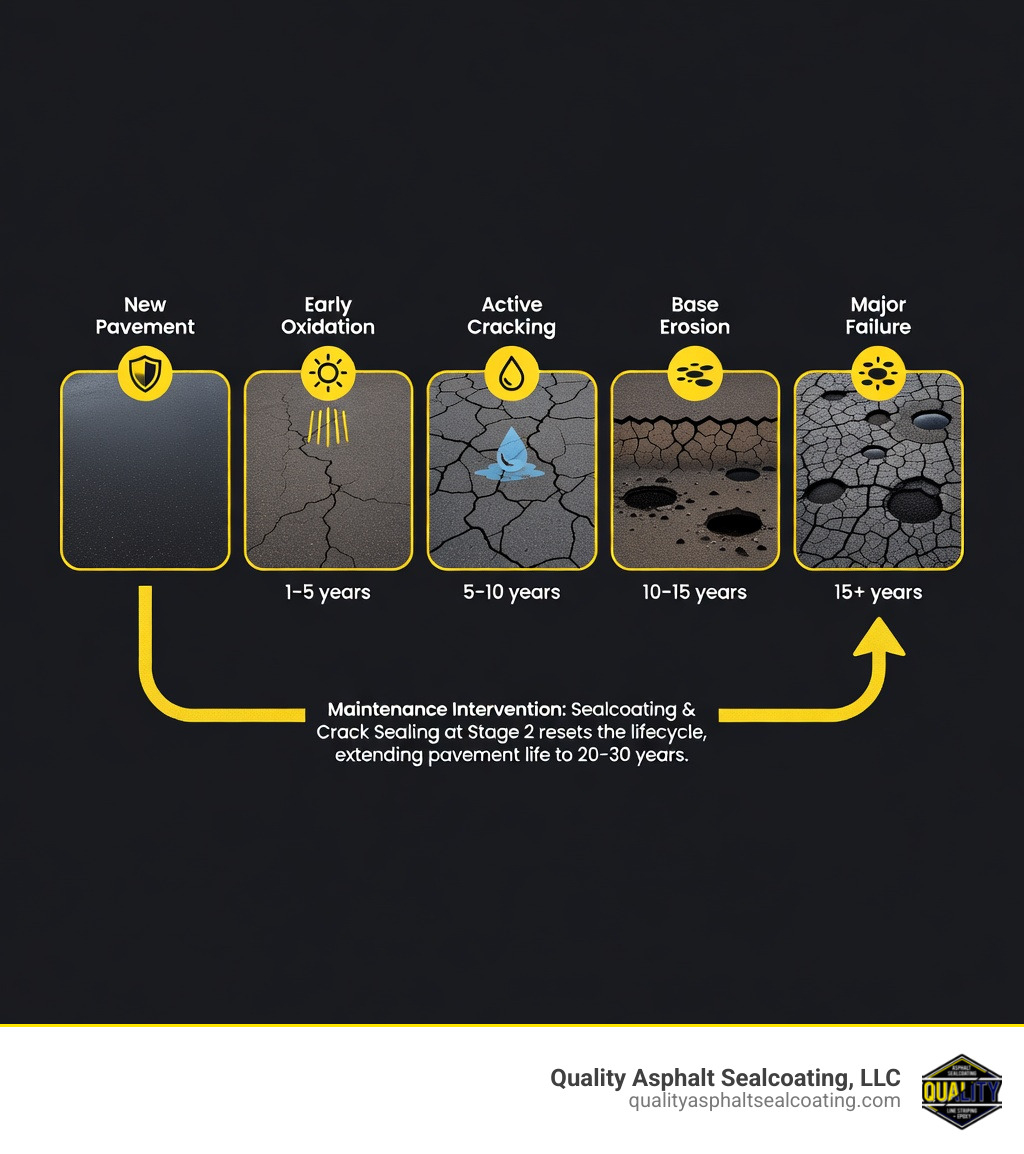
With proper care, asphalt can last 20 to 30 years. Without it, you’re looking at costly repairs — or full replacement — much sooner.
Every crack, pothole, or faded parking line on your commercial property sends a message to customers, tenants, and employees. It’s not the message you want to send.
Beyond first impressions, neglected pavement is a real liability. Water seeps into cracks, erodes the base, and turns a small fix into a major structural failure. High-traffic commercial surfaces — retail lots, office parks, industrial yards — take a beating every single day. That constant stress accelerates deterioration faster than most property owners expect.
The good news? Proactive maintenance costs a fraction of what reactive repairs do. Catching damage early keeps your pavement — and your budget — in much better shape for the long run.
The Core Pillars of Commercial Pavement Maintenance
When we talk about Commercial pavement maintenance, we aren’t just talking about making things look pretty. We are talking about the structural preservation of one of your property’s most expensive assets. Think of your parking lot like a car; if you never change the oil, the engine will eventually seize. In asphalt, sealcoating and crack sealing are your “oil changes.”

Asphalt is a flexible pavement, which is both its greatest strength and its primary weakness. It can handle heavy loads and the shifting earth of Rhode Island, but it is highly susceptible to environmental damage. UV rays from the sun bake the oils out of the asphalt, making it brittle and grey. Once it loses its elasticity, it cracks. Once it cracks, water gets in. Once water gets in, the foundation fails.
By following The Essential Guide to Commercial Pavement Maintenance, business owners can implement a strategy that keeps the surface “malleable.” This flexibility allows the pavement to expand and contract with temperature shifts without shattering.
A key part of this is choosing the right materials. While there are many options on the market, scientific research on sealcoat materials suggests that tar-based products (specifically UN 1999) are often superior for commercial applications because they restore the necessary bitumen components that keep asphalt strong, rather than just “painting” the surface with acrylics that can actually trap moisture and cause “alligator skin” cracking.
Essential Services for Commercial Pavement Maintenance
To keep a commercial lot in peak condition, we focus on three primary service areas:
- Sealcoating: This is the “sunscreen” for your pavement. It provides a sacrificial layer that takes the brunt of UV damage, oil spills, and water. For commercial properties with high traffic, we recommend reapplying this every 2 to 3 years.
- Crack Sealing: This is perhaps the most cost-effective maintenance task. By using high-quality rubberized sealant applied at high temperatures (around 365°F), we can “weld” cracks shut. This prevents water from reaching the sub-base. You can find more info about crack filling services to see how this simple step saves thousands in the long run.
- Pothole Repair: Potholes are more than an eyesore; they are a safety hazard and a liability nightmare. Whether using traditional cut-and-patch methods or modern infrared technology—which blends new asphalt seamlessly with the old to eliminate seams—fixing these quickly is vital.
Proactive Preservation vs. Reactive Repairs
There are two ways to manage a parking lot: the “Fix It When It Breaks” method (Reactive) and the “Keep It From Breaking” method (Proactive).
Reactive maintenance is the “worst-first” approach. You wait until the lot is full of potholes and then spend a fortune on a full mill-and-fill or replacement. Proactive preservation, however, focuses on low-cost treatments applied while the pavement is still in relatively good condition.
The Return on Investment (ROI) for proactive care is staggering. Research indicates that preservation treatments are typically 3 to 5 times less costly when applied early compared to the cost of major rehabilitation later.
| Maintenance Strategy | Frequency | Primary Benefit | Relative Cost |
|---|---|---|---|
| Proactive (Seal/Crack Seal) | Every 2-3 Years | Prevents base failure, doubles life | Low ($) |
| Minor Repair (Patching) | As Needed | Prevents liability, stops spread | Moderate ($$) |
| Reactive (Replacement) | Every 12-15 Years | Restores failed surface | Very High ($$$$) |
Extending Lifespan Through Strategic Scheduling
A well-maintained commercial asphalt surface can last between 20 and 30 years. To reach that milestone, you need a schedule. You wouldn’t wait for your roof to leak before checking the shingles, and you shouldn’t wait for your parking lot to crumble before calling a professional.
We recommend conducting routine inspections at least twice a year—once in the spring to assess winter damage and once in the fall to prepare for the coming freeze. During these walks, we look for “alligator cracking” (small, interconnected cracks that look like scales), which indicates the base is starting to fail. Catching this early allows for localized repairs rather than a total lot overhaul.
For a deeper dive into managing these timelines, check out The Complete Guide to Parking Lot Maintenance. Even the federal government agrees on the importance of timing; the technical guide on pavement preservation from the FHWA highlights that “doing the right treatment on the right pavement at the right time” is the secret to infrastructure longevity.
Seasonal Maintenance Tips for Commercial Pavement Maintenance
In Rhode Island, our pavement deals with a “double whammy” of extreme summer heat and brutal winter freeze-thaw cycles.
- Spring: This is the time for a “deep clean.” Remove the sand, salt, and debris left over from winter. Inspect for new cracks caused by frost heaves.
- Summer: The best time for sealcoating. The warm temperatures allow the material to cure properly, creating a hard, protective shell against UV rays.
- Fall: Your last chance to seal cracks. If water gets into a crack in November and freezes in December, it will expand by 9%, literally “popping” your asphalt apart.
- Winter: Use de-icing agents sparingly. While necessary for safety, some chemicals can accelerate the degradation of the asphalt binder.
For more details on specific repair types, see more info about parking lot repair.
The Critical Role of Proper Drainage
Water is the number one enemy of asphalt. If your parking lot has “birdbaths” (standing water), you have a drainage problem. When water sits on the surface, it eventually seeps through the porous asphalt and saturates the gravel base underneath. This softens the foundation, and when a heavy truck drives over that soft spot, the asphalt collapses, creating a pothole.
Proper grading and the installation of catch basins or asphalt ramps are essential. Ensuring that water runs off the lot and into the drains—rather than sitting in the middle of a driving lane—can add 5 to 10 years to the life of your pavement.
Identifying and Preventing Common Pavement Issues
Commercial properties face unique stresses. Heavy delivery trucks, high-volume traffic, and chemical spills (like oil and gas from parked cars) all take a toll.
Common issues include:
- Oxidation: The asphalt turns from black to grey and becomes brittle.
- Rutting: Depressions in the wheel paths caused by heavy vehicles.
- Thermal Cracking: Large, transverse cracks caused by extreme temperature swings.
- Alligator Cracking: A sign of structural failure in the sub-base.
Understanding these issues is the first step to fixing them. Our A to Z of Asphalt: Your Guide to Parking Lot Maintenance & Repair provides a comprehensive glossary of what to look for.
Safety, ADA Compliance, and Curb Appeal
Your parking lot is often the first thing a customer sees. A dark, freshly sealed lot with crisp white and yellow lines screams “professionalism.” On the flip side, faded lines and potholes scream “liability.”
Safety is paramount. Faded striping leads to “freestyle parking,” which reduces the number of cars you can fit and increases the risk of fender benders. Furthermore, the Americans with Disabilities Act (ADA) requires specific markings, stall widths, and ramp slopes. Failing to maintain these isn’t just a safety risk; it’s a legal one.
Refreshing your lines and ensuring your surfaces are level helps reduce trip-and-fall hazards. You can find more info about line striping services to ensure your property stays compliant and safe.
Choosing the Right Partner for Your Property
Not all paving companies are created equal. When selecting a partner for your Commercial pavement maintenance, look for experience and local knowledge. A company that understands the specific soil and weather conditions in Rhode Island will provide a much better result than a “fly-by-night” operation.
Key things to check:
- Experience: Quality Asphalt Sealcoating, LLC brings over 23 years of family-owned expertise to every job.
- Reviews: Look for high Google ratings and detailed customer feedback. A score of 4.5 or higher is usually a great sign of reliability.
- Insurance: Never hire a contractor who isn’t fully licensed and insured.
- Materials: Ask what they use. We recommend commercial-grade, tar-based sealants for the best results.
For more tips on vetting your contractor, read Your Local Lot Lifesavers: A Guide to Finding Parking Maintenance Companies.
Frequently Asked Questions about Commercial Pavement
How often should a commercial lot be sealcoated?
For most Rhode Island businesses, we recommend sealcoating every 2 to 3 years. High-traffic areas like drive-thrus or main entrances may need it more frequently to maintain protection.
What is the difference between crack sealing and crack filling?
Crack sealing involves using a flexible, rubberized hot-pour material that “bonds” to the edges and moves with the pavement. Crack filling is a more temporary fix using “cold-pour” liquids that don’t handle the expansion and contraction of our seasons nearly as well.
How does pavement maintenance impact business liability?
Potholes, cracks, and faded markings are “negligence” in the eyes of insurance companies. By maintaining a smooth, well-marked surface, you significantly reduce the risk of slip-and-fall lawsuits and vehicle damage claims.
Conclusion
At the end of the day, Commercial pavement maintenance is about protecting your bottom line. By being proactive, you avoid the massive expense of a total parking lot replacement and keep your property looking sharp for years to come.
At Quality Asphalt Sealcoating, LLC, we take pride in our 23+ years of experience serving the Rhode Island community. As a family-owned business, we understand that your property is an investment, and we treat it with the care it deserves. Whether you need a comprehensive evaluation or a simple touch-up, we are here to help you save your pavement—and your wallet.
Protect your investment with professional commercial sealcoating today and see the difference that expert care can make!

